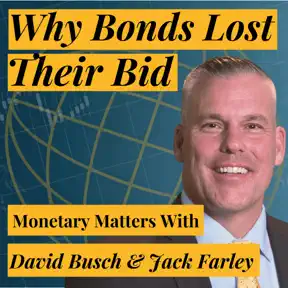
Why The 30-Year Treasury Lost Its Biggest Buyers | David Busch on Why High Yields Are Attractive Right Now
Monetary Matters with Jack Farley
September 19, 2026
Jack Farley is joined by David Busch, Chief Investment Officer of Trajan Wealth, to discuss rising U.S. Treasury yields, persistent inflation, and the Federal Reserve's monetary policy trajectory.
Speakers Jack Farley, David Busch
TopicsInvestingBusinessNewsBusiness News
Jack Farley (0:00)
Today, I'm joined by David Busch, Chief Investment Officer of Trajan Wealth. David, welcome to Monetary Matters.
David Busch (0:06)
Jack, thank you so much for having me. It's truly a pleasure to join you. And as I said in our communication back and forth via email, not only am I a fan, but also my team of analysts are fans of your podcast as well. So this is truly a treat for me.
Jack Farley (0:22)
I really appreciate that very much, David. The 10-year yield has gone only one direction over the past six months up. So the 10 years up about 60 basis points, 30-year yield up a tremendous amount as well.
I want to know just this huge sell-off in government bonds and rising government yields. I want to know what you think of it. What's your outlook? Where are they headed next? But first, David, my question is, does it matter? Do rising yields matter for the economy? Do they matter for the stock market at what level?
David Busch (0:54)
Really what's causing rates to rise is a combination of factors. One, we have $40 trillion in outstanding US. Treasury debt, and that has grown over the last 15, 20 years, but more recently, it's ramped up.
We have greater supply. We also have a combination of rising inflationary pressures, and that's been caused by really two critical events. One is the conflict with Iran and the subsequent rise in oil and gas prices, and the tariffs slash trade wars that we've had with different countries. I mean, most recently, it's been Canada. So tariffs are initially inflationary because they increase the price of goods imported from these different countries, and energy obviously flows through the whole economy.
I recognize that the Federal Reserve focuses on core PCE, which core excludes food and energy prices. But as a consumer, we feel it when we go to the grocery store, when we go to buy new equipment or devices, or if we are just filling up our gas tanks at the gas station. So it is elevated, and it's really a combination of those factors. The last thing that I'll point out is the recent issuance of corporate debt. And this has really been in an effort to raise funding for all the AI infrastructure capital expenditures. But it acts as kind of a crowding out effect, meaning that investors now have a choice to buy Treasuries or to buy these newly issued IG corporates. So there's also a trade-off there. So overall, those are the causes of why rates are still elevated.
Jack Farley (2:50)
At what level do they begin to become a problem for stocks and for the economy?
David Busch (2:55)
Rates are embedded in almost every valuation calculation that we use. So one, Treasuries with higher yields are now an alternative to equities, meaning that investors can use Treasuries and other investment-grade corporates as a diversifying mechanic in their portfolios. So there is now a stronger case to use fixed income because of the rising yields. But it also has a tendency, because every equity valuation model that's out there discounts future cash flows back to today using the risk-free rates. So what we're seeing is equity risk premiums could start to compress, and that's just a function of higher rates and the discounting technique that's used to value those companies.
As a result, PE multiples become harder to justify as corporate borrowing costs rise and that capex hurdle rate rises. And then the last thing is that leverage companies, those that are most exposed to higher interest rates, become far more vulnerable. And so that's kind of how it plays out into the rest of the markets.
Jack Farley (4:12)
Do you think that there is some level on the 10 year at the 30 year at which you begin to get concerned about equities? And I'll say the reason I'm asking the question, David, is because I, like so many, have heard and also said that that theory of when interest rates rise, the discounted value of future cash flows goes down. And it does theoretically, but I think there are just about two investors in the world who actually do that in practice. One, Aswath Damodari, the Dean of Evaluation, great professor, who explained this principle. And the second is Warren Buffett. But I think the investing world does not trade and invest based on that principle because yields go up and stocks go up as well.
And do you think yields can continue to go up alongside the S&P 500 as they have since March?
David Busch (5:07)
Really, what's driving equity markets today is earnings. Because we've seen the rise of AI technology and hyperscalers and the promise of this technology that's now going across and being adopted across the economy. So corporate earnings have kept pace. And then now that we're in the AI infrastructure buildout phase, those sectors and companies that are participating in that buildout, their earnings have been stable. So really, what the markets are actually saying is, is that we've moved from more of a passive type. We're just going to continue to invest in the equity markets, which that's still a function within the markets. But now we're focused more on fundamentals. And I think that's why we've seen rates have the ability to rise as far as they have, while equity markets have continued to rise simultaneously. Having said that, the biggest risk is, can these companies that need to finance to expand their operations, what is their borrowing cost going to look like?
48 more minutes of transcript below
Thousands of transcripts fetched by people building searchable podcast archives
Fetch the whole transcript
The demo key returns a sample episode in full, no card needed:
curl -H "x-api-key: pt_demo" \
  https://spoken.md/transcripts/1000651996090
Markdown with the speakers named, for your notes, your knowledge base, or anything that makes HTTP calls.
From $0.10 per transcript. No subscription. Credits never expire. Prices exclude VAT, added at checkout for EU customers. Not what you expected? Email us within 14 days with 20 or fewer credits used and we refund the pack in full.
Using your own key:
curl -H "x-api-key: YOUR_KEY" \
  https://spoken.md/transcripts/1000790690011