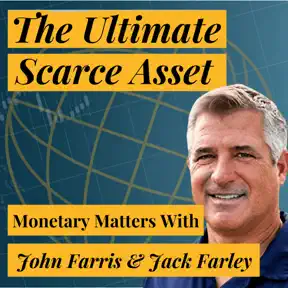
Why Farmland With Centuries of Water Is the Ultimate Scarce Asset | John Farris of LandFund Partners on Super El Niño, Food Security, and the Sources of Alpha in Farmland
Monetary Matters with Jack Farley
September 11, 2026
Jack Farley speaks with John Farris, founder & CEO of LandFund Partners and former World Bank agricultural economist, about the tightening global food equation — and where the return actually comes from in farmland.
Speakers Jack Farley, John Farris
TopicsInvestingBusinessNewsBusiness News
Jack Farley (0:00)
On today's episode of Monetary Matters, we're doing something a little different. We're going to talk about farmland and food security, and why I think this is one of the more underappreciated real asset stories in markets right now.
Everyone on Monetary Matters is used to talking about inflation, interest rates, the Federal Reserve, but there's a slower moving, more structural story sitting underneath all of that, which is that the world's arable land base is shrinking at the same time that the world's appetite for food and specifically protein is going up. That tension is about to get a lot more real this year, because we're heading into what could be a super El Nino, and global grain reserves are thinner than they've been in a decade. So this isn't an abstract decades out story, it's relevant right now.
To talk about all of this, I've got John Farris. John's background is unusual for someone running a farmland investment fund.
Back in the 1990s, straight out of grad school, John was an agricultural economist at the World Bank, studying global food supply trends. That's where a lot of his thinking on this actually started. In 2013, he put real money behind that thesis, setting out to buy 100 acres as a personal investment, only to end up going much larger than that. Today, he runs LandFund Partners. They're on their seventh fund with close to 50,000 acres of farmland under management, concentrated in irrigated land sitting above the Mississippi alluvial aquifer. This episode is a fireside chat sponsored by LandFund Partners. Any data, statistics, or information discussed by John Farris is for informational purposes only. This is not an offer to sell securities. Past performance is not a guarantee of future results. Such statements are estimates and comparisons based on current data and management assumptions, not guarantees. Let's get into it. Today, I'm joined by John Farris, economist and founder and CEO of LandFund Partners, which currently manages over 40,000 acres of farmland in the lower Mississippi River Valley through its investment vehicles and investment relationships. John, welcome to Monetary Matters.
John Farris (1:56)
Thank you, Jack. Excited to be here.
Jack Farley (1:59)
I'm excited too, John. Today, we're going to be talking about food and food security, which really is the most important topic in the world. And obviously, it touches on macro a lot. Interest rates impact farming. You know, food prices are a key input into inflation and obviously, the most important element in human life. You know, so you're currently running a fund, but you've been thinking about this issue for a lot longer than that.
Tell us about when you were an agricultural economist at the World Bank, your thinking on this issue.
John Farris (2:31)
My time at the World Bank was great after grad school. Went there and worked and studied food supply. And really was, you know, the bank was interested in the question. We have so many people moving to the middle class in East Asia, about 200 million a year at that time. And then moving to the middle class in East Asia at the time, in the late 90s or turn of the century, meant that you were moving from one meal a day with protein to two meals a day with protein. Not going out like we think in the US and buying TVs at Best Buy, but you were moving up the protein scale.
And what has happened throughout time and if you study it, it's like once populations move up the protein scale, they rarely move back down without massive unrest, civil unrest, war, many of the things that are the negative attributes that are unsettling to society. So you have this population boom of people moving up the protein scale. And at the same time in Asia in the mid 90s, you started to see a plateau of arable and tillable land and production, agricultural production. So you actually started seeing land not only in Asia, but around the world, farmland in particular, start to shrink. Farmland with water, irrigated farmland was shrinking. So you had this complex problem that the bank was interested in. And as we see, as we seen this play out, you know, we moved from in the late 90s, from 6 billion people on the planet to 8 billion today. And not only we've seen that, but we've seen an increase in protein production per capita. So more people eating more protein with less land. So how does that work? You know, there's been some technology improvements, but even with technology improvements, what has happened is we've, world food stocks have declined. And that's important. By food stocks means if we don't grow another crop, how many days do we have left to feed the people on this planet?
59 more minutes of transcript below
Thousands of transcripts fetched by people building searchable podcast archives
Fetch the whole transcript
The demo key returns a sample episode in full, no card needed:
curl -H "x-api-key: pt_demo" \
  https://spoken.md/transcripts/1000651996090
Markdown with the speakers named, for your notes, your knowledge base, or anything that makes HTTP calls.
From $0.10 per transcript. No subscription. Credits never expire. Prices exclude VAT, added at checkout for EU customers. Not what you expected? Email us within 14 days with 20 or fewer credits used and we refund the pack in full.
Using your own key:
curl -H "x-api-key: YOUR_KEY" \
  https://spoken.md/transcripts/1000789065717