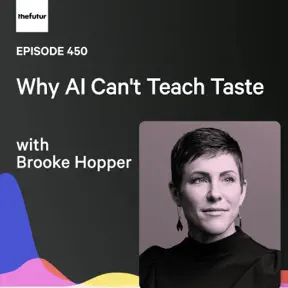
Why AI Can't Teach Taste w/ Brooke Hopper | Ep 450
The Futur with Chris Do
September 9, 2026
Brooke Hopper is Adobe’s first Senior Principal Designer, and one of the people building Firefly from the inside.
Speakers Brooke Hopper, Chris Do
TopicsMarketingBusinessArtsDesign
Brooke Hopper (0:00)
The nature of AI is to recognize and repeat patterns. By its nature, it's giving us patterns, and if you are only following the patterns, it's training you as a human. And I think as designers, our challenge is to do things like breaking the rules.
Hey, my name is Brooke Hopper, and you're listening to The Futur.
Chris Do (0:25)
I have a rare opportunity to speak to somebody very high up at Adobe to find out what is going on. Brooke, welcome to the show.
Brooke Hopper (0:30)
Thank you. It's a pleasure to be here.
Chris Do (0:32)
Tell me a little bit about you for people who don't know who you are. What is your role at Adobe?
Brooke Hopper (0:36)
Sure. I'm a senior principal designer at Adobe, first one ever actually, on the Adobe design team. But I lead a lot of thinking around, what is the future of creative tools? And specifically, my contributions have been sort of bringing Firefly into our creative tools, thinking about what the role is, and honestly just making sure that it's useful in creative workflows, rather than no one wants to generate just something. We all want it to be useful, and so that's really how I think about that. And where do we go in the future?
Chris Do (1:07)
So we are to give you credit or the blame of Firefly is what we love?
Brooke Hopper (1:11)
You can do both.
I'm actually one of my big passions is really around helping people do the things that they really want to do. Whether that's using AI as a tool, whether it's just doing it on your own, it doesn't matter. Really what I view my role is I'm here to help people do what they love, and also make it better.
Chris Do (1:33)
So one thing I think about that's really remarkable about Adobe is how intentional you are and thoughtful in creating AI tools, because it's a tightrope, I think, you're walking and that you're iterating AI technologies, but you're for creators. So some creators are very emotionally not cool with AI.
What is the philosophy behind what you guys are doing and how you decide what you're going to make or not make?
Brooke Hopper (1:54)
Yeah. You'll hear people say this a lot as we view AI as a tool, but it's actually more than that. I've been in Adobe for 10 years. I spent seven of those years building drawing apps.
So I'm very close to the illustration community. A lot of that community has real concerns and I think has legitimate concerns around what is going to happen to their craft, their art, what comes next. And that's really a lot of the things that I think about. And I think it's important as a designer, as someone who's building creative experiences to hold that intention and to understand both of those sides. And so when we bring this into our tools, it's not again, you're just generating a thing. Adobe has been around for 40 plus years. We've been building creative tools that entire time. So Adobe knows precision and control better than any other company.
And we know that when you're trying to make something, pixels matter.
The tiny micro adjustments are actually the thing that matters. Anyone can do big, sweeping, gorgeous designs. But when it gets down to it, I'm actually wearing a shirt right now that says Control Freak. Designers are Control Freaks. We have to have everything in a way that really makes sense. And so it's all about the craft. And that's really what we're leading into as we're thinking about, what is the future of design tools? What is the future of illustration tools? What is the future of video?
How does this stuff all play together to make your life better?
Creative tools should feel creative.
Chris Do (3:26)
I like the integration. I like the level of control that as an early user of Firefly, I thought it was really neat. Like, you're building a tool to do something versus just a wide open sandbox. I've seen it go through different iterations. I have to admit, sometimes I have a love and hate relationship with Firefly. Sometimes it does exactly what I want. I rush over to tell my wife who's a designer, like, babe, look at what I just did. And sometimes I'm like, God, I asked you to do this and it's not working.
Do I take blame responsibility that I just don't know how to tell it what to do?
Brooke Hopper (3:55)
You're not the only one. I get a lot of bad results. In fact, I got one up on stage today.
22 more minutes of transcript below
Thousands of transcripts fetched by people building searchable podcast archives
Fetch the whole transcript
The demo key returns a sample episode in full, no card needed:
curl -H "x-api-key: pt_demo" \
  https://spoken.md/transcripts/1000651996090
Markdown with the speakers named, for your notes, your knowledge base, or anything that makes HTTP calls.
From $0.10 per transcript. No subscription. Credits never expire. Prices exclude VAT, added at checkout for EU customers. Not what you expected? Email us within 14 days with 20 or fewer credits used and we refund the pack in full.
Using your own key:
curl -H "x-api-key: YOUR_KEY" \
  https://spoken.md/transcripts/1000788646895