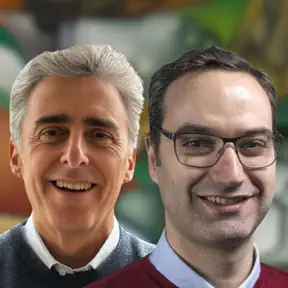
What did Google's AI Co-Scientist "Discover"? The Human Scientists' POV, from the Podovirus podcast
"The Cognitive Revolution"
June 4, 2025
We're following up on our recent episode on Google's AI Co-Scientist with a special crossover episode from the Podovirus podcast.
Speakers Nathan Labenz, Dr. Jessica Sacher, José Penadés, Tiago Costa, Dr. Joe Campbell
TopicsTechnologyBusinessEntrepreneurship
Nathan Labenz (0:00)
Hello, and welcome back to The Cognitive Revolution. Today, we're following up on our recent episode on Google's AI Co-Scientist, with a special crossover episode from the Podovirus Podcast, in which hosts Dr. Jessica Sacher and Dr. Joe Campbell speak with José Penadés and Tiago Costa, the scientists at Imperial College London, who recently made a surprising discovery, which Google's AI Co-Scientist later put forward as a hypothesis entirely on its own. For context, here's a quick crash course on the biology that you'll hear discussed in this episode. Bacteriophages are viruses that infect bacteria. In general terms, these phages reproduce by inserting their genes into a host bacteria cell and hijacking the cell's protein-making mechanisms to produce copies of the virus itself, until the cell ultimately bursts and releases many copies of the virus into its environment. Structurally, phages consist of a tail, which is specifically adapted to attach to specific types of bacteria cells, and a head, also known as a capsid, which stores and protects the genetic material until it's injected into a target cell. Phage-inducible chromosomal islands, also known as pickies, are really a fascinating product of evolution. They are DNA sequences that have evolved to lie dormant in bacterial genomes until the cell is infected by a certain type of bacteriophage, at which point they become active and actually hijack the virus' reproduction process, replacing the virus' normal DNA with copies of itself. The affected cell still ends up bursting, but instead of releasing copies of the virus that infected it, it releases viruses that spread the picky DNA to its sister cells, in some cases thus serving as a collective bacterial defense against the attacking virus.
Now, the question that José and Tiago and their teams, and also independently the Google AI Co-Scientists, had set out to answer was how a certain class of pickies, known as Capsid-forming pickies, or CF pickies for short, which encode only the capsid or head portion of the virus, with no tail to latch on to other target cells, had somehow managed to spread widely across many different types of bacteria. The surprising answer, which had eluded the human scientists for years, but which Google's AI co-scientists was able to surmise just from its analysis of the relevant literature, at an estimated inference cost of maybe somewhere between $100 and $1000, is that these capsids have evolved the ability to connect up with different kinds of virus tails in the environment, and that's how they were able to infect and ultimately become incorporated into many different kinds of bacterial cells. Beyond serving as a vivid reminder that evolution is an eternal arms race, and that we should absolutely avoid evolutionary competition with AIs at just about all costs. This episode shows that as of the Gemini 2 generation, large language models with proper scaffolding and a decent inference budget can now contribute to frontier scientific research. And not just by expediting the grunt work, but in some cases by providing an unbiased perspective or even the key insight. Obviously, such hypothesis generation can and will accelerate scientific discovery even if its hit rate is ultimately fairly modest. And you can imagine how quickly this becomes even more powerful as Google plugs Gemini 2.5 into the coscientist architecture, which they've surely already done by now, and then again as AIs begin to direct experiments and collect their own data via cloud lab APIs. This is all science fiction, but it's happening for real in our lifetimes right now. And once again, I can only conclude that the singularity really is quite near. As always, if you're finding value in the show, we'd appreciate it if you take a moment to share it with friends, write a review on Apple Podcasts or Spotify, or just leave us a comment on YouTube. Your feedback is always welcome too. Feel free to reach out anytime via our website, cognitiverevolution.ai, or by DMing me on your favorite social network. Finally, before diving in, I should note that Erik Torenberg, in his new role at A16Z, has just announced that he's actively hiring podcast hosts across multiple domains, including biology and biotech. If you'd like to have conversations like this for a living, definitely check his Twitter for more information on the opportunity. With that, I hope you enjoy this foray into microbiology and this early glimpse of AI-powered scientific discovery, with Dr. Jessica Sacher, Dr. Joe Campbell, and Professors José Penadés and Tiago Costa, from The Podovirus Podcast.
Dr. Jessica Sacher (4:38)
Hello. Welcome everyone to Podovirus Podcast. Today we have a special episode, and I might say that every time, but we're doing lots of different things all the time these days, and I heard about this exciting AI story that's also a phage-picky story. It was the obviously perfect choice of topic, and I'm so glad to have convinced José Penadés and Tiago Costa who are professors at Imperial College London. They have been working together, I'm sure we'll hear a lot more, but they have been working in this space of mobile genetic elements, phages, specifically phage-inducible chromosomal islands or pickies, and they were working on this, and apparently Google let them use its not-yet-released co-scientist tool, which is an AI tool, and they were able to use it to kind of sounds like re-derive a body of work that they had not yet published, but had been working on for a couple of years, and giving the AI tool this research question and a little bit of background, but none of their unpublished data, they saw that the scientist was able to kind of come up with the same hypothesis that they had recently proven but not yet published. So this is the story that we want to dig into, and you might have seen a bunch of coverage of this lately. It's been on Forbes, The Economist, BBC, so they made it to the mainstream, which doesn't happen all the time with phages. So I'm sure, yeah, you'll be able to look into that coverage too, but we wanted to kind of talk to our scientists, our phage scientists especially, but everyone who might be curious about what are these AI tools useful for and how do they actually start using them. So I'm very excited to have you both here. And of course, my co-host, Joe Campbell, is here too. So we'll get deep in and hopefully find out more what are the pros and cons of using this kind of tool and what are the limits right now. To start, tell us just a little bit about where were you studying when you came across this tool? How did that even come into your lap? Okay.
53 more minutes of transcript below
Thousands of transcripts fetched by people building searchable podcast archives
Fetch the whole transcript
The demo key returns a sample episode in full, no card needed:
curl -H "x-api-key: pt_demo" \
  https://spoken.md/transcripts/1000651996090
Markdown with the speakers named, for your notes, your knowledge base, or anything that makes HTTP calls.
From $0.10 per transcript. No subscription. Credits never expire. Prices exclude VAT, added at checkout for EU customers. Not what you expected? Email us within 14 days with 20 or fewer credits used and we refund the pack in full.
Using your own key:
curl -H "x-api-key: YOUR_KEY" \
  https://spoken.md/transcripts/1000711215368