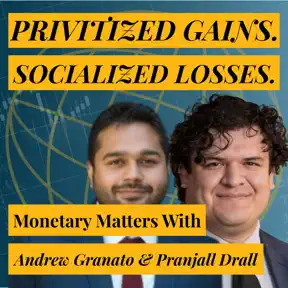
What Actually Happens When a Life Insurer Fails (It's Worse Than a Bank) | Pranjal Drall and Andrew Granato on How Private Equity Turned Life Insurance Into a Taxpayer Backstop
Monetary Matters with Jack Farley
September 6, 2026
Andrew Granato, Assistant Professor of Law at the University of Texas at Austin, and Pranjal Drall, JD/PhD candidate at Yale, join Jack Farley to discuss their paper "Private Credit, State Backstop: How Private Equity Socializes Risk Through Insurers.
Speakers Jack Farley, Andrew Granato, Pranjal Drall
TopicsInvestingBusinessNewsBusiness News
Jack Farley (0:00)
An exceptionally important conversation joined today by Andrew Granato, Assistant Professor of Law at the University of Texas at Austin, and Pranjal Drall, JD PhD candidate at Yale. They are the co-authors of a paper called Private Credit State Backstop, How Private Equity Socializes Risk Through Insurers. Gentlemen, welcome to Monetary Matters.
Andrew Granato (0:22)
Thanks for having us.
Jack Farley (0:24)
Tell us about this paper. You write in the beginning that what we have now is a system that socializes losses more sharply than banking federal deposit insurance. In other words, the life insurance industry is increasingly getting to a state where if private equity and private credit are owning these companies, these life insurance companies, and profiting from them, obviously, and if things go bad, the bailout system is one where the losses will be socialized. Privatized gains and potentially socialized losses. Pranjal, tell us about that.
Pranjal Drall (1:02)
So the basic pitch of the paper is that there's been a lot of concern about private credit, both valuations and how the asset class is doing as a whole.
Underlying that worry is that valuations don't keep up with reality. So since these assets aren't publicly traded, it's hard to ascertain how impaired some of the loans are given certain kinds of shocks. Given that worry, simultaneously, there's been a big trend in insurance, where insurance companies are increasingly owned by private equity companies and they increasingly invest in private credit. So one way of thinking about the paper is that in a normal finance 101 land, if a loan or an asset goes bad, the investors bear the losses.
So if a sophisticated investor is making a bunch of private credit loans and they end up going to zero, the investor loses a lot of money but the public writ large doesn't bear the cost. Our paper points to a setting where that is not the case. So life insurance is sort of this very conservative business historically. You collect a bunch of premiums from policyholders, invested in traditionally investment-grade assets, and then earn a spread and you pay out the policyholders over time. Increasingly, since these insurers are investing in private credit, the public is exposed to the risk of private credit through insurance. And the most shocking and notable part of the story is that when an insurance company goes under, the policyholders are bailed out by its rivals. So if there's two insurance companies in Iowa, insurance company A goes under, insurance company B has to pay the money for the policyholders up to a statutory cap. And whatever they pay to bail out the policyholders, you get, they get tax credit for. So it can be written off over, depending on the state, five to 20 years. So the basic idea is ultimately taxpayers are on the hook for insurance insolvency, which might be driven by excess exposure to private credit.
Jack Farley (3:21)
And just set the stage, the private equity ownership of life insurance by assets was about $23 billion in 2009 By the end of 2024, that was about $700 billion. So it's done like a 35X, 30 to 35X, that growth of private equity ownership of life insurance. And that as of 2024, private equity owned life insurers had between 8% to 14% of life insurance assets. So decent chance that people watching this now, that definitely some percentage of their life insurance assets are owned by private equity companies.
And Andrew, why would private equity companies want to own life insurance companies?
Andrew Granato (4:09)
Yeah, so the theory that various companies have espoused is something that they call permanent capital.
If you want to conduct private equities traditional business, which are these buyout funds, you know, purchases of companies that you are then trying to, you know, flip and resell at higher valuations, it involves a lot of leverage. You have to take out a lot of money in loans to conduct these purchases. And so you can look to external financing for these. But increasingly, what these PE firms have preferred to do is try to finance them internally. So have a different part of the firm issue alone to the, you know, to the companies that are being bought out.
There are multiple ways that you can try to do this. What a lot of private equity firms have done is they have set up private credit funds. So they're, you know, they're the GP in the PE funds, and then they're the general partner in the private credit funds as well. They get backing from institutional investors in both settings to do this sort of work.
But what you could also do is you could buy a life insurance company. And life insurance has various features that make it theoretically attractive for these purposes. What policyholders do is they pay a lot of money upfront, and they expect to receive payouts on the backend. So if you buy a term life or cash for your life policy, you as a policyholder might be paying premiums in for years. And some fraction of those policies will pay out to the beneficiaries, but they won't pay out until this long tail because of the simple actuarial math of people die later. So the insurer has all of this money upfront, that they eventually will need to gradually pay out in the cycle while they're still receiving more payments later.
54 more minutes of transcript below
Thousands of transcripts fetched by people building searchable podcast archives
Fetch the whole transcript
The demo key returns a sample episode in full, no card needed:
curl -H "x-api-key: pt_demo" \
  https://spoken.md/transcripts/1000651996090
Markdown with the speakers named, for your notes, your knowledge base, or anything that makes HTTP calls.
From $0.10 per transcript. No subscription. Credits never expire. Prices exclude VAT, added at checkout for EU customers. Not what you expected? Email us within 14 days with 20 or fewer credits used and we refund the pack in full.
Using your own key:
curl -H "x-api-key: YOUR_KEY" \
  https://spoken.md/transcripts/1000788140251