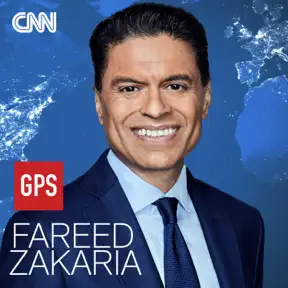
Trump’s Escape, 5 Years of Taliban Rule, AI Mania
Fareed Zakaria GPS
August 16, 2026
Today on the show, President Trump's plane switch after last month's NATO summit was said to be in response to an assassination threat from Iran. It begs the question: How credible are Iran's threats against the president and, more broadly, against the United States?
Speakers Fareed Zakaria, David Sanger, Jason Kander, Ashutosh Padhi, Gina Raimondo
TopicsNews
SPEAKER_1 (0:00)
This podcast is powered by NetSuite. They say that every day your business is late to AI, you fall two days behind. But how do you keep up? The competition is only moving faster. Fortunately, there's NetSuite Next. You may already know NetSuite is the number one cloud ERP business management platform that brings together finance, inventory, operations, CRM and reporting in one unified system. Now there's NetSuite Next. Built with AI at its core, NetSuite Next helps you work in a more natural, intuitive way. Ask questions in plain language, get answers instantly, uncover insights faster, and automate everyday tasks across your business. It's everything you value about NetSuite, enhanced with the power of AI to help your teams move faster, work smarter, and stay ahead of what's next. For the first time ever, you can try NetSuite Next for free. If your revenues are at least in the seven figures, go to netsuite.ai/gps.
Built for every industry, ready for every boardroom. netsuite.ai/gps.
SPEAKER_2 (1:00)
This episode is brought to you by Facebook.
So you were scrolling on Marketplace, and there it was, the bike you'd been searching for. You sent a message, and it turned out the seller was super chatty, kind of funny, and an avid cyclist. The next thing you know, you're in a cycling crew. Well, a community cycling group. The thing about Facebook, you might find more than what you're looking for. From a browse to a bike ride, this summer, find more on Facebook.
Fareed Zakaria (1:31)
This is GPS, the Global Public Square. Welcome to all of you in the United States and around the world. I'm Fareed Zakaria coming to you from New York. Today on the program, we'll look at Trump's Turkey Air Force One switcheroo and the very serious claims behind that highly unusual move.
I'll talk to the New York Times' David Sanger.
Ben, it's been five years since Kabul fell, and the Taliban is firmly in control. So what's become of the Afghans who worked alongside American troops against the Taliban during that war?
I speak with an American veteran of the war in Afghanistan.
Also, is AI coming for your job?
We will look at where job losses are likely, and what can be done about them.
But first, here's my take. Last week, a minor geopolitical earthquake shook the Middle East. Saudi Arabia and Turkey, two nations that have been openly hostile toward each other He. has been a veteran of the war in Afghanistan for much of the last decade, pledged to go to war in each other's defense. Along with Pakistan, they signed the Mecca Joint Defense Agreement, declaring NATO style that an attack on one would be treated as an attack on all. Now, Pakistan and Saudi Arabia have long had close security ties, but Saudi Arabia and Turkey have been bitter regional rivals, clashing over Qatar, Egypt, the Muslim Brotherhood, and most explosively, the murder of Jamal Khashoggi in Istanbul, which Turkish leader Erdogan appeared to blame directly on the Saudi Crown Prince Mohammed bin Salman. So what brought them together?
Donald Trump, or rather the two countries diminishing faith in him and his word. The Iran war has been a master class in how to squander credibility. Recall that Saudi Arabia and Qatar both received security guarantees from Donald Trump only last year. But Trump's word is as solid with his counterparts abroad as it was with his bankers in New York. He has repeatedly declared that a deal with Iran was just days away. By mid-June, one tally counted at least 38 pronouncements that a deal was near or Iran desperately wanted one. Yet this week, an Iranian source told Reuters that negotiations had made absolutely no progress. The world has learned to treat his truth social announcements as a kind of mix of fact and fiction, like some of the AI generated videos he posts. The same pattern is visible in Europe. In May, Trump announced that 5000 American troops would leave Germany and suggested more cuts were coming. The Pentagon then scrapped a plan deployment of roughly 4000 troops to Poland. Days later, Trump announced that an additional 5000 troops would go to Poland. Sometimes he threatens not to defend Europe against Russia. Other times, he says he will. Imagine being a European defense minister trying to construct a 10-year military plan around this.
Trump declared this week that the United States had total control of the Strait of Hormuz, yet ship-tracking data recorded just 14 vessels transiting in one day recently compared with more than 130 a day before the war. This is not simply a matter of presidential style or rhetoric. It goes to the heart of American power. For eight decades, the United States built up something as powerful as aircraft carriers and squadrons of F-35s, credibility. Allies believed American commitments would endure from one administration to the next. Adversaries understood that American threats, while sometimes exaggerated, carried real weight. The system was not perfect. Washington did break promises and make mistakes. But there was a broad presumption that the United States was a predictable actor and the president's words meant something.
30 more minutes of transcript below
Thousands of transcripts fetched by people building searchable podcast archives
Fetch the whole transcript
The demo key returns a sample episode in full, no card needed:
curl -H "x-api-key: pt_demo" \
  https://spoken.md/transcripts/1000651996090
Markdown with the speakers named, for your notes, your knowledge base, or anything that makes HTTP calls.
From $0.10 per transcript. No subscription. Credits never expire. Prices exclude VAT, added at checkout for EU customers. Not what you expected? Email us within 14 days with 20 or fewer credits used and we refund the pack in full.
Using your own key:
curl -H "x-api-key: YOUR_KEY" \
  https://spoken.md/transcripts/1000783661780