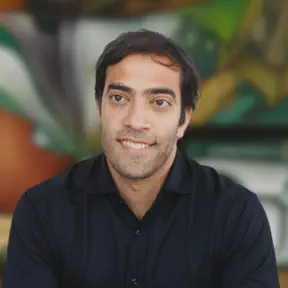
The Revolution in Services: General Catalyst's AI Rollup Strategy, with Marc Bhargava
"The Cognitive Revolution"
August 2, 2025
Marc Bhargava from General Catalyst discusses their Creation Strategy for building AI-enabled roll-ups – companies that start as vertical software startups, then grow by acquiring traditional service businesses and transforming them through AI automation.
Speakers Nathan Labenz, Marc Bhargava, Manu Sharma
TopicsTechnologyBusinessEntrepreneurship
Nathan Labenz (0:00)
Hello, and welcome back to The Cognitive Revolution. Today, I'm excited to be speaking with Marc Bhargava, Managing Director at General Catalyst, about their creation strategy and a fascinating new category of AI company they're building, AI-enabled rollups. These are companies that begin as vertical software startups, but having achieved initial product market fit, grow by acquiring traditional service businesses and transforming them through AI automation. Marc brings a unique perspective to this conversation, having co-founded Togomi, the first prime broker in the crypto space, which was acquired by Coinbase, he has hands-on operational experience. Now, he's helping to found and incubate companies that are targeting not just the $1 trillion software market, but the vastly larger $16 trillion services market, including accounting, legal, IT services, call centers, and much more. These businesses have traditionally run at 5-10% profit margins, much too low for venture capital investment. But, having done a systematic study of the tasks that make up the work across 70 different service categories, Mark and team have identified 10 leading candidate verticals, where they believe that anywhere from 30% to 70% of tasks are already automatable with AI today. Which means that with successful implementation, they could achieve much more software-like margins of 30% to 40%.
From there, they recruit and assemble founding teams, which combine applied AI technical talent with industry veterans who understand service firm operations and have participated in M&A transactions before. These teams then work closely with initial customers to pilot purpose-built AI tools and automation workflows. And then, where the pull factor from customers is strongest, they structure acquisitions that deepen data access and feedback loops and align interests by giving firm owners a mix of cash and equity in the growing rollup entity. For now, the AI transformation at these firms is very pragmatic. You might even call it mundane. Teams shadow workers to map every hour of activity, identifying which tasks fall into automatable categories. Customer support, data entry, content creation, and increasingly complex reasoning. Rather than wholesale workflow redesign, they layer AI into existing processes. An HOA manager, for example, can still email to ask for help creating a board deck, but now an AI agent takes the first pass at the task. The goal, for the short term at least, is not to eliminate jobs, but to enable each person to handle two to three times more work, thereby addressing the chronic labor shortages plaguing many service industries. Overall, I have to say, I am very bullish on this investment and modernization strategy. The end customer value proposition is super compelling. Better service, faster turnaround, more proactive insights, all at similar or lower prices. And this feels like the right way to bring AI transformation to Main Street businesses that simply couldn't build such capabilities on their own. So I do expect General Catalyst and their portfolio companies, including the service businesses they acquire, to do phenomenally well. And yet, at the same time, if there's one overarching theme of this show, it's that we might still all be thinking too small. And as you'll hear, despite the fact that Marc is pursuing one of the few investment and company building strategies that really does meet the AI moment, and could plausibly outcompete big tech offerings indefinitely, I still think there's a good chance he's underestimating just how far this transformation goes. While he believes that most local service firms will ultimately participate, my guess is that only a minority, maybe 20%, have the leadership vision, operational excellence, and cultural adaptability to be genuinely attractive rollup acquisition targets. Beyond that, my guess is that it will make more sense for the AI-enabled compounders to grow by simply taking customers from lagging firms rather than trying to acquire and transform them.
In Bigger Picture, I do struggle with the employment math. Mark's vision is about serving more customers with the same size teams, and that's a great place to start. But when we're talking about 90% plus task automation, potentially in just the next one to two years, do we really need 10 times more accounting, for example, even at lower prices? I'm sure there's some latent demand to be unlocked, but my intuition is that many workers in fields like accounting will ultimately be displaced. And if I had to guess, I would bet on human-centric fields like nursing, child care, elder care, and education, as the sectors with sufficiently elastic demand, so as to potentially absorb those AI refugees. Bottom line, I believe that the land of abundance that Mark envisions is likely to materialize, and I look forward to it, while at the same time expecting that the transition could well be far more disruptive than he projects. Time will tell, of course, but for now, I hope you enjoy this deep dive into the future of AI-enabled services and the art of creating modern compounders with Marc Bhargava of General Catalyst. Marc Bhargava, Managing Director at General Catalyst. Welcome to the Cognitive Revolution.
81 more minutes of transcript below
Thousands of transcripts fetched by people building searchable podcast archives
Fetch the whole transcript
The demo key returns a sample episode in full, no card needed:
curl -H "x-api-key: pt_demo" \
  https://spoken.md/transcripts/1000651996090
Markdown with the speakers named, for your notes, your knowledge base, or anything that makes HTTP calls.
From $0.10 per transcript. No subscription. Credits never expire. Prices exclude VAT, added at checkout for EU customers. Not what you expected? Email us within 14 days with 20 or fewer credits used and we refund the pack in full.
Using your own key:
curl -H "x-api-key: YOUR_KEY" \
  https://spoken.md/transcripts/1000720307327