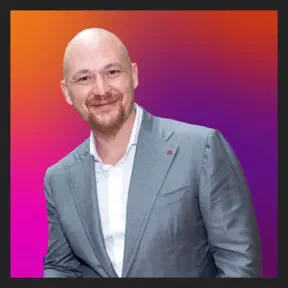
The Interview: Replit CEO on the contradictions at the heart of AI doom
Times Tech
October 3, 2026
This week, Danny speaks to Amjad Masad, co-founder and CEO of Replit, a ‘vibe-coding’ company which enables anyone – coder or not – to build software simply by telling AI what they want it to do.
Speakers Katie Prescott, Danny Fortson, Amjad Masad
TopicsTechnologyNewsTech News
Katie Prescott (0:05)
Hello, and welcome to The Interview from Times Tech. I'm Katie Prescott.
Danny Fortson (0:09)
And I am Danny Fortson. And this week, I have been speaking to Amjad Masad, the founder and CEO of Replit.
Katie Prescott (0:17)
And Replit is a really big deal in Silicon Valley, right? They're a vibe coding platform, a little bit like our lovable over here. So I guess the idea is you can tell them what you want it to build, an app or a piece of software, and then it just spins it up.
Danny Fortson (0:33)
Yes, exactly. And Amjad speaks a lot about how we've kind of lost the fun in computing because no one programs anymore. In fact, he says we are all, quote, at the mercy of Silicon Valley tech. And he has some really interesting things to say about this whole Doomer vibe that is so dominant right now. And he knows of what he speaks. He's been in this world for a very long time, but I think you're really going to enjoy the conversation. Amjad's great. So here he is, Amjad Masad from Replit.
Well, Amjad, thank you so much for taking the time. I know Replit because I'm based out here in Silicon Valley and I cover tech. But for those who don't, what is Replit and how long have you been hacking away at this particular goal phase?
Amjad Masad (1:21)
Replit is the best way to bring software ideas to life. I think if you've ever had an idea for an app or an automation or software agent, now you can build it. And you can build apps of any complexity and especially important on Replit, you can scale them. You can monetize them. And there is increasingly little difference between what any ordinary person is capable of and a software engineer, and a trained software engineer. I've been working on this as a company for 10 years, but as an idea perhaps for 15
It started with my frustration with programming tools being so hard to use, so inaccessible, so archaic. Surprisingly, they still are, even with AI.
The fact that you have to open a terminal to use something like cloud code, I think it's just a travesty. Terminals, or they're like terminal emulators, right? So they're emulating 1950s technology. So it's like, what the hell? And so software development has always been stuck in the past, which is weird because software engineers are building the future. And so there's always been a frustration that I had with like software tools, software programming tools should be joyful, should be collaborative, should be fun. It shouldn't be any different than Canva or using design tools. And finally, we're there. I think Replit is a lot of fun to use.
Danny Fortson (2:59)
So can we go back to, you know, you said you've been thinking about this idea for 15 years, you've been working on it for 10
And we all know the ChatGPT moment and kind of what's happening now when you are anthropic talking about basically, coders are doing less and less coding. And it does feel like, you know, that Rubicon has been crossed. But like the idea of allowing me deeply on technical or anyone else kind of create software, create tools, do whatever they want to do without that expertise. What did that look like 10 years ago? Because it feels like that's like an almost an impossibility, right? If you kind of go back in time, before CHATTPT.
Amjad Masad (3:41)
Actually, we can go back way more in time. And if you think about the early computing pioneers, they never saw a difference between a trained software engineer and a computer user. The idea of using computers was that you would program them. That's what computers are for. And that was true when you bought a computer, I think, in the 80s, like at a Commodore 64
When you bought it, it threw it up to a basic interpreter, and you're expected to program it in order to use it. And I think, popularized by Steve Jobs, this idea of computers should be more intuitive to use, which was a reasonable idea.
But the unintended consequences of it, that it created two classes of computer users. There's super computer users, the programmers, and there's computer consumers. The rest of the world, where you're reliant on computer programmers to build all the software, you need to use your computer.
And this has all sorts of consequences, like there's a commercial economic consequence where we had like a very big, thriving software industry. You might think that's good or bad, depending on your view. But it created, I think, potentially social and political impact that I think is negative, where the idea of manipulating people and their opinions and their views and their, I think is a direct consequence of people not having the freedom to program their computers. And they are at the mercy of kind of Silicon Valley big tech companies to kind of feed you all the information and the software you need to kind of do something. And so by no stretch of the imagination, I'm the first one to kind of articulate these problems. But, you know, I felt them sort of intensely and I felt like the way to use a computer was to actually to programming. And that's how I used computers. And then when I went like Windows and Mac came on the scene, I just felt very indefinitely when iOS and iPhone came on the scene. You're like, I don't even own this computer. Like it is a computer, but I can't program it. Like I have to go to this like app store thing to download apps and mostly junk.
24 more minutes of transcript below
Thousands of transcripts fetched by people building searchable podcast archives
Fetch the whole transcript
The demo key returns a sample episode in full, no card needed:
curl -H "x-api-key: pt_demo" \
  https://spoken.md/transcripts/1000651996090
Markdown with the speakers named, for your notes, your knowledge base, or anything that makes HTTP calls.
From $0.10 per transcript. No subscription. Credits never expire. Prices exclude VAT, added at checkout for EU customers. Not what you expected? Email us within 14 days with 20 or fewer credits used and we refund the pack in full.
Using your own key:
curl -H "x-api-key: YOUR_KEY" \
  https://spoken.md/transcripts/1000793025631