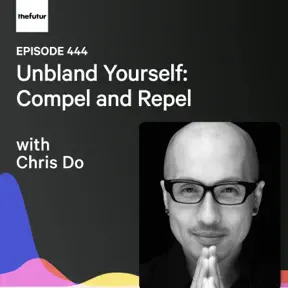
The 3 Rules of Personal Branding Nobody Tells You w/ Chris Do | Ep 444
The Futur with Chris Do
July 29, 2026
Most people build a brand around what they do. Chris Do says that's exactly why no one remembers them.
Speakers Chris Do, Drigo
TopicsMarketingBusinessArtsDesign
Chris Do (0:00)
People are so afraid of alienating everyone that they wind up saying nothing to everyone, and they're just blending themselves into oblivion, into irrelevancy. So when you say something, and you say something that is based on your convictions, not to say it to rile people up, I'm not saying to be a contrarian, to be divisive, but to say things that have meaning to you, it should both compel and repel.
Drigo (0:24)
Chris.
Chris Do (0:24)
Yes, sir.
Drigo (0:25)
Welcome back to the show.
Chris Do (0:26)
Appreciate it.
Drigo (0:27)
You just launched a new workbook, Unblend Yourself. Tell me a little bit about what inspired that.
Chris Do (0:34)
Unblend Yourself comes from philosophically this idea that we have been socialized to blend in to get along. And depending on what culture you come from, it's stronger in some than others. But we're wearing, in my opinion, a very, for some people, a professional mask. You show up, you see certain things and you play your cards. You don't try to upset anybody. And then if you do this for long enough, you don't forget who you are, what your core beliefs are, and you're afraid to go against the grain. And this is amplified across social media. We're so fearful of saying our thoughts, expressing ourselves in our truest self, dressing the way we want to, because we're afraid of the backlash. So Unblend Yourself is a culmination of the last three years of research, testing, experimenting in virtual and in-person, in real life workshops where I'm testing concepts to help people figure this out for themselves. Like, who were they meant to be in this lifetime?
And who were they when they thought to themselves when they're seven years old, this is what I want to be when I grow up, and something happened to that plan.
Drigo (1:31)
Did you always have the thought of making this book versus like a salesbook, or like how did this come together?
Chris Do (1:37)
I realized that my ability to teach as many people as I want is find out if I do it as an in-person experience or even through the price barrier. But I believe this is fundamental to our overall well-being, our sense of self.
I want to be able to do something that's a standalone thing that can be done at your own pace in the privacy and comfort of your own home that you can go through and ask yourself these deeply personal and profound questions that require a really contemplative reflective moment and it's not always conducive to do around people on a certain timetable. So I recommend people go through the book at a certain pace that they feel comfortable with and the goal is not to try to finish it as quickly as possible but to learn about things that you want to bear away deep inside of you and to have some honest conversations with yourself.
Drigo (2:24)
When did you start to unblend yourself?
Chris Do (2:26)
It's been a progression of exploring, is it safe? I'm going to be okay.
I think for me doing video with Jose in 2014 was how I was able to do this at scale. So prior to that point in time, it's not like I was sitting there trying to fit in. I've always been intrigued by this idea of pushing buttons and using the things I say, my actions and the way that I dress to kind of push people's buttons. And this has happened, but now it's happening at a much larger scale. So it's kind of that expression of you can't put the genie back in the bottle. So you do it in measured steps. Like if I showed up and dressed like this and said these things, what is the consequence of that?
And like many things, there's a quote. The quote is something like, the human mind once expanded does not shrink back to its original size. And this is like many things. When you find out that these self-imposed rules that you live by are actually just that self-imposed and not real rules, they're not laws, that you start to be more free. It's this classic story of a dog who wears electric shock collar. And when they approach the perimeter to a fence that they're not supposed to go beyond, send them a little electric signal. After a while, they learn that there's a perimeter and you can just take it off. And they never cross that boundary. And the same is about an elephant who's one since childbirth is held by chain and eventually it's just a string and they never push past.
We are like that. We learn really fast about what we can and cannot do according to certain societal norms. And then we play small the rest of our lives. We never realize that once we leave the city in which we grew up in, or we leave a group of friends that we thought, this is my core group, I must need them always, or the job that we've always had, we learn that the world's much bigger. There's a lot more to us to give. And I think that's one of the most liberating things.
33 more minutes of transcript below
Thousands of transcripts fetched by people building searchable podcast archives
Fetch the whole transcript
The demo key returns a sample episode in full, no card needed:
curl -H "x-api-key: pt_demo" \
  https://spoken.md/transcripts/1000651996090
Markdown with the speakers named, for your notes, your knowledge base, or anything that makes HTTP calls.
From $0.10 per transcript. No subscription. Credits never expire. Prices exclude VAT, added at checkout for EU customers. Not what you expected? Email us within 14 days with 20 or fewer credits used and we refund the pack in full.
Using your own key:
curl -H "x-api-key: YOUR_KEY" \
  https://spoken.md/transcripts/1000778866522