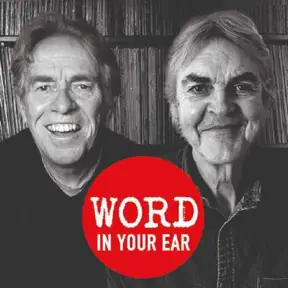
Roxy, Traffic, Nick Drake, Mott the Hoople & the magic of Island Records
Word In Your Ear
October 8, 2026
The third instalment of ‘The Island Book of Records’ is out, another sumptuous, elegantly designed, LP-sized chronicle of every album released on this most fabled of labels, in this case between 1971-72.
Speakers Mark Ellen, Neil Storey, David Hepworth
TopicsMusic CommentaryMusicMusic History
Mark Ellen (0:03)
You're watching or listening to Word In Your Ear. Of course you are, as you're never alone with a show that alights upon everything ever invented in the art of conversation. Whether that's regrettable rock and roll footwear, daft things audiences do, epic stage names, tracks to play at wedding parties or the outer limits of Elmer Gantry's Velvet Opera. Do leave a like or subscribe by going to patreon.com/word In Your Ear to discover further delights on offer.
Neil Storey (0:45)
You're listening to a podcast from The Word.
David Hepworth (0:47)
I don't even remember when you were about nine or 10 years old. There was no greater pleasure than if you were lucky enough to receive an annual, you know, possibly from the Beano or from the Eagle, where you just got, you could gorge yourself on kind of all manner of self-intelligent and trivia in your favorite subject. Well, occupying that space in my life nowadays is The Island Book of Records, volume three of which has just arrived with us. And Mark and I have been enjoying ourselves enormously going through it. And we talked about the previous two volumes with their author, Neil Storey, who joins us now, Neil, from Jamaica. Is that right?
Neil Storey (1:35)
It is. I am Alf Tupper, King of the Track or Tupper of the Track.
David Hepworth (1:39)
Yeah, there you go. There you go.
Neil Storey (1:42)
As soon as you said that, I thought, God, is it Dennis the Menace or is it Alf?
David Hepworth (1:49)
It's an annual.
It fulfills that particular need. I have to explain something about this podcast, which might make it slightly different from normal ones. While talking to you, I'm in a digital queue with the British Museum of Bio-tabestry tickets. So at the moment, I've got 3,413 people in front of me. So if I go quiet for a little while, Mark will take over and we can pick it up. I'm sure you'll forget.
Mark Ellen (2:27)
That's so modern, Dave, isn't it?
Neil Storey (2:29)
Live podcast.
David Hepworth (2:30)
It's very ancient.
Mark Ellen (2:32)
They will sort the cues out by the time you get yours, too, which would be very nice.
Neil Storey (2:36)
I'm hugely impressed.
David Hepworth (2:38)
So, Neil, just explain to anybody who doesn't know, this is The Island Book of Records, huge format, massively weighty, lustrous color product there, which is 1971 to 1972 Explain to anybody who hasn't seen it before, what these books set out to do.
Neil Storey (2:59)
They basically document every record that was released by Island from inception, which is 1959, through to when Chris Blackwell sold the company to what has now become Universal in 1989 So, it's 30 years, or if you like, it's the analog age of Island.
David Hepworth (3:21)
Right. You've gone through the story of every record, so you reproduce the covers, and very often there are many kind of witnesses to those records, and in some cases there aren't, which we'll come to later on, which I found particularly intriguing.
First of all, just give us an idea of where Island was in its kind of growth at that point, 1971 to 1982
Neil Storey (3:48)
It was, oh gosh, that's kind of, I suppose I'm slightly biased, but I would suggest it was probably, even then it was becoming the most important contemporary music label as opposed to an EMI or a Decker or whatever.
An independent label. It was probably the most important independent label at that time. And it continued to be so for a good number of years to come after that.
David Hepworth (4:19)
Give us an idea of their independence at this stage, because I'm kind of intrigued by this. They distributed their own records at this time.
Neil Storey (4:29)
No, EMI was a distributor, meaning that EMI, their factory, sent out the records. So that was a distribution deal that was done. There was a period of time when Island had their own sales force. I was a member of that for a while. But that was really when the company was actually growing, possibly far quicker than it actually should have done. But then, you know, retrospect is a very wonderful thing to look at with.
Mark Ellen (4:59)
Right. I want to just to ask about the quote on the covers, a lovely quote from Richard Williams. And what he says is, is that no record label has ever had its history subjected to this sort of minutely detailed scrutiny.
And I thought it was a really interesting point because what is it? How could you define that about Island that made it the most for Dave and myself, and for loads of other people, the most fabled and romanticized British record label?
31 more minutes of transcript below
Thousands of transcripts fetched by people building searchable podcast archives
Fetch the whole transcript
The demo key returns a sample episode in full, no card needed:
curl -H "x-api-key: pt_demo" \
  https://spoken.md/transcripts/1000651996090
Markdown with the speakers named, for your notes, your knowledge base, or anything that makes HTTP calls.
From $0.10 per transcript. No subscription. Credits never expire. Prices exclude VAT, added at checkout for EU customers. Not what you expected? Email us within 14 days with 20 or fewer credits used and we refund the pack in full.
Using your own key:
curl -H "x-api-key: YOUR_KEY" \
  https://spoken.md/transcripts/1000793846681