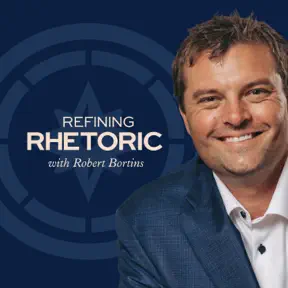
Originalism, Religious Freedom & AI: Abraham Hamilton III
Refining Rhetoric with Robert Bortins
September 9, 2026
What does the Bible have to do with how judges read the Constitution — and why should Christian parents be worried about AI chatbots raising their kids?
Speakers Abraham Hamilton III, Robert Bortins
TopicsChristianityReligion & SpiritualityBusiness
Abraham Hamilton III (0:00)
We live in the United States of America.
We're citizens in the states where we live. We must utilize our citizenship to advance the gospel to the upper echelons as high as we can. And so when we refuse to utilize that, we're basically taking our lamp and putting it under a bushel, which is the exact opposite of what Jesus taught us to do. There is not an area of our lives where the word of God does not address either directly or provide a principle that would apply to that. And because of the truth of God's word, when there are two options available to us, and one is directly opposed to the other, both of them cannot be right at the exact same time.
SPEAKER_2 (0:39)
Your organization is known worldwide and we certainly appreciate every facet that you do.
SPEAKER_3 (0:44)
I do believe in what you're doing because I've seen it in my family.
SPEAKER_4 (0:47)
I'm so excited about all the things that, Robert, you guys do with Classical Conversations. It's been a huge blessing for our family.
Robert Bortins (0:54)
Grateful for the work at Classical Conversations. You're a leader and you have been in this movement for a long time.
SPEAKER_3 (0:59)
We love Classical Conversations. I do feel like I have a debt of gratitude to you, your family, all of CC for just the fruit that has come from CC.
SPEAKER_2 (1:11)
I appreciate all that you guys do both through this wonderful podcast and also through Classical Conversations which I am convinced is the best education resource out there. Thank you very much for all that you do for the cause of Christ and for our families and for our children. Really, really appreciate it.
Robert Bortins (1:26)
Hey, everyone, and welcome to another informative episode of Refining Rhetoric. And I've been looking forward to this episode. I'm talking with Abraham Hamilton III or Abe. He's a husband, father of six wonderful children, homeschool dad, lawyer, Bible teacher, national radio and television talk show host. So he does this for a living. He serves on the American Family Association's General Council and hosts of the Hamilton Corner, which airs Mondays through Fridays at 5 p.m. Central, an American Family Radio network, AFR. He hosts the Hamilton Corner Television program, which airs Friday evenings at 8 p.m. And he has a Juris Doctorate degree. He is an HSLDA board member and he's licensed to practice law in Texas and Louisiana. So he can't sue me here in North Carolina.
I think you'll have to hire some other lawyer to do it. But without further ado, Abe, welcome to the show.
Abraham Hamilton III (2:21)
Thank you so much for having me on the show, man.
Robert Bortins (2:24)
Yeah. So just talk about a little bit. I want to just jump right in. New Testament, biblical literature.
How does that really shape our law today?
Abraham Hamilton III (2:35)
Sure. So there is a principle in the discipline of hermeneutics. It's a big word. It just means literary interpretation. The application of that discipline to the Bible is called biblical hermeneutics. And unsurprisingly, that the exegetical process employed in hermeneutics, it's actually the same process as utilized to understand things like originalism. An approach to constitutional interpretation, legislative interpretation is that you know what the authors of the legislation, author of the statutes meant at the time of their creation of the statute and what the audience or the listeners, the hearers and readers understood those words to mean at that time. Just a short example of that, if I were to tell you in 1985 that I have windows in my house, you would immediately conclude that I have transparent glass panes, that whole deal. But if I say 2007, I have windows in my house, I could be talking about transparent glass or I could be talking about computer software.
So the difference between 1985 versus 2007, to get to what was intended by the statement, is through the process of hermeneutics or exegetical, discerning what was stated at the time that it was stated, and what was meant at the time that it was meant, and what the understanders and the readers heard at the time the statement was made.
Robert Bortins (3:56)
We just celebrated 250 years, and I know of being a country here in the United States, and for our listeners, a lot of conservatives and Christians talk about natural law, an original interpretation of the law, and then we also hear of things like, well, the law needs to grow, or it needs to get with the times and things like that. Where do you land on that and why?
31 more minutes of transcript below
Thousands of transcripts fetched by people building searchable podcast archives
Fetch the whole transcript
The demo key returns a sample episode in full, no card needed:
curl -H "x-api-key: pt_demo" \
  https://spoken.md/transcripts/1000651996090
Markdown with the speakers named, for your notes, your knowledge base, or anything that makes HTTP calls.
From $0.10 per transcript. No subscription. Credits never expire. Prices exclude VAT, added at checkout for EU customers. Not what you expected? Email us within 14 days with 20 or fewer credits used and we refund the pack in full.
Using your own key:
curl -H "x-api-key: YOUR_KEY" \
  https://spoken.md/transcripts/1000788700658