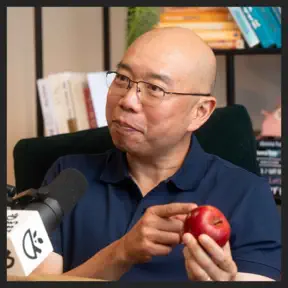
Obesity professor explains 5 reasons why calories don't count and what to focus on instead | Professor Giles Yeo
The Doctor's Kitchen Podcast
September 9, 2026
Next time you look at the calories on the back of a packet or the nutritional breakdown of a recipe, remember that number doesn't tell you the whole story. It says nothing about the nutrients, the quality of the food, how satisfying it'll be, or even how many calories your body will actually absorb.
Speakers Dr Rupy Aujla, Giles Yeo
TopicsMedicineHealth & FitnessNutrition
Dr Rupy Aujla (0:00)
I'm Dr. Rupy, and on this show, I help you feel more in control of your health through food and lifestyle medicine.
The next time you look at the back of a pack of food or read a nutritional breakdown of a recipe online and think to yourself, gosh, that is so high in calories. I want you to remember these five things that Professor Giles Yeo is going to talk us through today, including why calorie labels don't necessarily reflect the energy you actually absorb, and how nutrient quality and the balance of fat, protein, and carbohydrates also impacts this. Giles wrote an incredible best-selling book, Why Calories Don't Count, and works as a professor of molecular neuroendocrinology, researching and lecturing on eating behavior and obesity at the University of Cambridge. Listen to the end as we debunk healthy food options and talk through three strategies to lose and maintain a healthy weight instead of calorie counting. If you have someone in your life that is obsessed with calorie counting, this is the listen for them.
Professor Giles Yeo, I want you to imagine someone who goes on to an Instagram post and sees this delicious recipe, right? Olive oil, avocado, nuts. But then they look at the calorie count and they figure it out and they're like, oh my gosh, this calorie count is so high. If I eat this, I'm going to put on weight. I'm this person. You have about an hour to educate me on all the reasons as to why calories don't necessarily count. So why should we not be counting calories?
Giles Yeo (1:43)
You know, whenever I talk about these things, about whether or not we should be counting calories, people think I'm anti-physics.
You know, like I'm not anti-physics. I do understand that like 200 calories of chips is twice the amount as 100 calories of chips. I think the moment you begin to take these calorie counts, because they're one-dimensional, that they only measure the amount, broadly speaking, then the moment you start to compare different types of food to your point, when you look at calorie dense foods, such as for any number of different reasons, such as nuts and olive oil and avocados, then how are you going to compare that to a donut or to pure sugar or to a can of sugary beverage? That doesn't make any sense. I think ultimately, as a top line summary, calories will give you one piece of information, and that's the amount of food, but they're completely nutrient blind. They don't tell you about the macronutrients, so carbs, fat, protein, and they certainly don't tell you fiber, and they certainly don't tell you anything about the micronutrients, and they certainly don't tell you anything about sugar, salt, or anything else that is there. So that's the summary about why I think that while we do worship the calorie, I think there's a zillion better ways of actually trying to find healthy food, because that's what we're trying to do, improving our diets.
Dr Rupy Aujla (3:12)
Yeah, I think that's a really good kicking off point, and I think we'll come to it a little bit later when we talk about strategies. If not the calorie, then what else? But what I'm hearing from you off the get-go is it doesn't reflect nutrient quality, i.e. the balance of micronutrients, the micronutrients as well, and how this has an effect on your physiology. So that's almost like point number one. It ignores nutrient quality. Great.
Outside of nutrient quality, what else is there about calories as it pertains to how it doesn't actually offer as much information as one has been led to believe?
Giles Yeo (3:49)
Okay. So aside from the fact that they're nutrient blind, I think the issue with focusing on just one single number, because it is a single number, that people have been led to believe for actually quite a long time. So people have been calorie counting since the 1920s. People just don't know this. The first calorie counter in 1920s was a doctor, a Californian doctor, female Californian doctor, in the 1920s, which was incredibly rare, a slightly larger lady of our core called Lulu Hunt Peters. Lulu Hunt Peters. And actually you can get her book. She wrote this book.
She was a syndicated journalist. She was a doctor and journalist. So she was a larger journalist, doctor who wanted to try and lose weight. And the concept of calories with food had just emerged from at water. So the at water calories had just emerged. And so she was a, because she was a medic, so she therefore had some science background. And all she was doing was to say that, well, rather than thinking, she wrote this, I remember this. She, you know, in the book, you can get it from wherever you get your favorite books for like a couple of quid. And she would say like, you know, I don't want you to think about a slice of pie. I don't know why I said it like that. You know, I don't want you guys to think about bacon. I want you guys to think about a hundred calories of pie, a hundred calories of bacon. And she was writing at the time towards women, okay? And these were middle class women at the time, largely white middle class women. But she was syndicated through various newspapers, including the New York Times.
71 more minutes of transcript below
Thousands of transcripts fetched by people building searchable podcast archives
Fetch the whole transcript
The demo key returns a sample episode in full, no card needed:
curl -H "x-api-key: pt_demo" \
  https://spoken.md/transcripts/1000651996090
Markdown with the speakers named, for your notes, your knowledge base, or anything that makes HTTP calls.
From $0.10 per transcript. No subscription. Credits never expire. Prices exclude VAT, added at checkout for EU customers. Not what you expected? Email us within 14 days with 20 or fewer credits used and we refund the pack in full.
Using your own key:
curl -H "x-api-key: YOUR_KEY" \
  https://spoken.md/transcripts/1000788581941