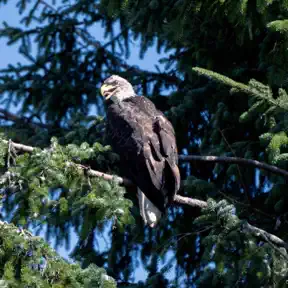
How eagles, bears and salmon keep Alaska wild
Here & Now Anytime
September 7, 2026
At Eagle Beach outside of Juneau, Alaska, salmon, bald eagles, dragonflies and signs of bear are everywhere. Then, the National Park Service turned 110 this year.
Speakers Lindsay Bloom, Chris Bentley, Jeff Reinbold, Chris Ballard, Peter O'Dowd, John Hudson, Bob Armstrong, Jake Kaleck, Scott Tong, Robin Young
TopicsNews
SPEAKER_1 (0:00)
Support for Here & Now Anytime comes from MathWorks, creator of MATLAB and Simulink software, to design and develop engineered systems, accelerating the pace of discovery in engineering and science. Learn more at mathworks.com.
WBUR podcasts, Boston.
Lindsay Bloom (0:21)
Salmon are mind-blowing. They do so many things that are just so awe-inspiring, incredible, I just kind of have to believe that salmon are going to persevere.
Chris Bentley (0:31)
Take a hike with us in Alaska, to a wild place where salmon run free.
It's Monday, September 7th, and this is Here & Now Anytime from NPR and WBUR. I'm Chris Bentley. Today on the show, it is Labor Day, the unofficial end of summer, and the perfect time to enjoy the great outdoors. We've got three stories about spectacular places and things that make us feel alive, and why we should not take them for granted. We'll ask, are we loving America's national parks to death?
Jeff Reinbold (1:16)
While they are extraordinary, they often have some very ordinary needs, and things like roads and bridges, when you have that many visitors coming each year.
Chris Bentley (1:25)
And, we'll find out how ice swimming in frozen lakes brings some people euphoria and community. Just don't stay in too long.
Chris Ballard (1:33)
Brain fog is setting in, your muscles are literally freezing, you are going to start to sink, you're not going to be able to feel your fingers. And so in total, for most humans, you have about an hour.
Chris Bentley (1:44)
But first, I recently got back from a reporting trip to Alaska with Peter O'Dowd. We were in Juneau, covering glacial floods and landslides. These are big problems in Alaska and in many places around the world because of climate change. And you'll hear those stories soon. Click the follow button right now in your podcast app so you don't miss it.
But today, we wanted to share with you a trip that we took into the wild. Peter O'Dowd gets us started.
Peter O'Dowd (2:14)
We went to a place called Eagle Beach where the Eagle and Herbert rivers are fed by melting glaciers with the same names, breathing plumes of silty water into the ocean.
John Hudson (2:28)
What a place. Blue herons, bald eagles, soaring above the spruce, coming down to the shore.
Hey bear.
Peter O'Dowd (2:43)
Hey bear. I came to this spot hiking through the bramble along the riverside with John Hudson and a few of his friends.
John Hudson (2:51)
Oh my God, there's just bear crap everywhere.
Peter O'Dowd (2:55)
Where's the bear?
John Hudson (2:57)
How many are there?
Peter O'Dowd (2:59)
Hudson is mostly unbothered by the carnivores. He's a naturalist with a passion for bugs. With a net slung over his shoulder, it looks like he belongs in a fairy tale.
John Hudson (3:09)
Oh, you got a dragonfly.
Jeff Reinbold (3:11)
Look at that.
Peter O'Dowd (3:11)
Oh my gosh.
John Hudson (3:12)
This is a female paddled-tailed darner, and it's one of seven mosaic darners that are found in Alaska. Can you hear the vibration? Those wings are vibrating pretty rapidly.
Jeff Reinbold (3:30)
Oh, wow.
Peter O'Dowd (3:34)
Hudson lets the little creature go. On much larger wings, a few bald eagles soar in tight circles overhead. They're surfing thermals, rising up on twisting columns of warm air.
Over the years, Hudson's friend, Bob Armstrong, has written and photographed all kinds of books about Alaska's wildlife.
Bob Armstrong (3:52)
I think one of the funniest things I've ever observed in filming a bald eagle nest was a... the parent brought a human's hat in there and laid it down. There were two kids in the nest, and they spent a huge amount of time playing with the hat, turning it over and looking at it and giving it from one kid to the other. And fascinating what goes on in the minds of creatures other than humans.
Peter O'Dowd (4:24)
Armstrong moved to Alaska in 1960, the year after it became a state. He remembers fishing off the coast for halibut and king salmon.
Bob Armstrong (4:34)
I thought I was in heaven.
It was a wonderful experience. And then the people came.
Peter O'Dowd (4:44)
Now, he's in his 90s. He takes his time in the wilderness, walks slowly, quietly, without talking, so that he can stop and observe. Listen, he says, it's an armada of blowflies swarming a mound of bear poop.
As with everything in life, mixed in with all the beauty is so much rot. Everything in this ecosystem is connected. And Chris, I know that's something that you got to see up close too.
Chris Bentley (5:17)
Yes, indeed it is. And Peter, you know, you can actually learn a lot from bear poop.
24 more minutes of transcript below
Thousands of transcripts fetched by people building searchable podcast archives
Fetch the whole transcript
The demo key returns a sample episode in full, no card needed:
curl -H "x-api-key: pt_demo" \
  https://spoken.md/transcripts/1000651996090
Markdown with the speakers named, for your notes, your knowledge base, or anything that makes HTTP calls.
From $0.10 per transcript. No subscription. Credits never expire. Prices exclude VAT, added at checkout for EU customers. Not what you expected? Email us within 14 days with 20 or fewer credits used and we refund the pack in full.
Using your own key:
curl -H "x-api-key: YOUR_KEY" \
  https://spoken.md/transcripts/1000788347480