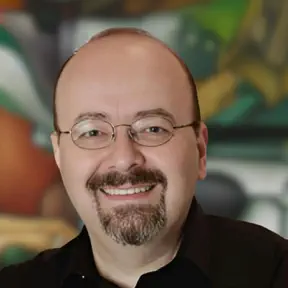
Frontier Models for Frontier Science with Professor Derya Unutmaz,Immunologist & ChatGPT Pro Grantee
"The Cognitive Revolution"
March 6, 2025
In this episode of The Cognitive Revolution, Professor Derya Unutmaz, a biomedical scientist and human immunologist at the Jackson Laboratory, discusses his groundbreaking research in aging and cancer immunotherapy.
Speakers Derya Unutmaz, Nathan Labenz
TopicsTechnologyBusinessEntrepreneurship
Derya Unutmaz (0:00)
To say that AI cannot come out with anything novel or innovative is total nonsense. In fact, I will argue that very soon, AI is going to be much more innovative and creative than we are. Who I see AI is a collaborator. It's almost on my level. It's not even like a student level anymore, like another professor who is very knowledgeable in the field. These are fields that I've actually generated the knowledge, made discoveries on as a scientist. If I'm finding the AI valuable even in those topics, I am finding it very, very difficult to believe that there is anyone in the world who would not get value out of this. I mean, not a single person.
Nathan Labenz (0:46)
Hello, and welcome back to The Cognitive Revolution. Today, my guest is Professor Derya Unutmaz, Biomedical Scientist, Human Immunologist, and ChatGPT Pro grantee, who is aggressively using the latest AI models to aid his research into aging and cancer immunotherapies. Derya is a fascinating figure. He's a medical doctor who has personally advanced the frontiers of biomedical knowledge with many academic papers and patents over the course of his 30-plus-year career, a technology enthusiast who has loved computers and programming since his youth, a visionary who thinks differently enough that he took Kurzweil's vision of a technology singularity seriously long before it went mainstream, and an outspoken critic of those who would deny or delay the contributions that AI can already make to scientific discovery. In this conversation, I tried first and foremost to get a sense for how world-class domain experts like Derya are applying the latest AI models to their work. To my surprise, it turns out that while he is finding value at every step of the scientific process, including hypothesis generation, literature review, experimental design, and data analysis, his approach is actually quite straightforward. He does sometimes use more advanced techniques, like having two instances of a model debate the merits of a particular research direction, but mostly he recommends a natural conversational approach to today's models. What sets him apart, then, from those who are failing to realize value from AI assistance isn't some advanced prompt engineering or scaffolding, but rather an opportunity-oriented mindset that starts with relentless curiosity, embraces trial and error, and is always genuinely looking for ways to make things work. None of that is to say, however, that his results are basic. On the contrary, I think his accounts of AI eureka moments are some of the most compelling that I've heard. In one fascinating example, he asked deep research to analyze gene expression patterns in T cells across young and elderly subjects. A data set that his team had struggled to fully interpret. The AI provided insights that, in Derya's words, recapitulated everything I've done in the past 30 years in one sentence. Identifying how the cells themselves were aging in ways that the team hadn't fully appreciated. Today, Derya views AI systems as intellectual partners that are capable of contributing to frontier professional work. Even going so far as to say that he no longer trusts his own knowledge or ideas without consulting AIs first.
Perhaps most provocatively, Derya argues that it has become now unethical not to use AI in medical contexts, both clinically, as it's been repeatedly demonstrated that AI can help reduce errors and improve outcomes, and also in research, since every day matters to the many millions of people who are waiting for breakthroughs to address their life-threatening conditions. As you might expect, I wholeheartedly agree, and I was really glad to hear that Derya sees resistance gradually giving way to curiosity and even excitement as more and more people see tangible results. As always, if you're finding value in the show, we'd appreciate it if you'd share it with a friend, we'd love a review on Apple Podcasts or Spotify, and we welcome your feedback via our website, cognitiverevolution.ai, or by DMing me on your favorite social network. For now, I hope you enjoyed this scouting report from the cutting edge of AI-assisted science with Professor Derya Unutmaz. Professor Derya Unutmaz, Biomedical Scientist, Human Immunologist at the Jackson Lab, researching aging and cancer immunotherapy. Welcome to The Cognitive Revolution.
Derya Unutmaz (4:19)
Thank you. Pleased to be here.
Nathan Labenz (4:21)
I'm excited for this conversation. You are a ChatGPT Pro grant awardee, and this is part of a small but hopefully growing series of conversations with people that are using the latest AI models in the most forward-thinking ways they can, at really the frontier of human knowledge. You've put out some incredible posts recently that have inspired me, and I'm looking forward to this conversation and sharing this inspirational work with others.
Maybe just for a quick foundation setting, tell us a little bit about your career and maybe the Jackson Lab. People that tune into this feed are paying a lot of attention to AI, but they're probably not, in general, paying nearly as much attention to what's going on in aging and immunotherapy research. So a little primer foundation would be super helpful.
72 more minutes of transcript below
Thousands of transcripts fetched by people building searchable podcast archives
Fetch the whole transcript
The demo key returns a sample episode in full, no card needed:
curl -H "x-api-key: pt_demo" \
  https://spoken.md/transcripts/1000651996090
Markdown with the speakers named, for your notes, your knowledge base, or anything that makes HTTP calls.
From $0.10 per transcript. No subscription. Credits never expire. Prices exclude VAT, added at checkout for EU customers. Not what you expected? Email us within 14 days with 20 or fewer credits used and we refund the pack in full.
Using your own key:
curl -H "x-api-key: YOUR_KEY" \
  https://spoken.md/transcripts/1000698161711