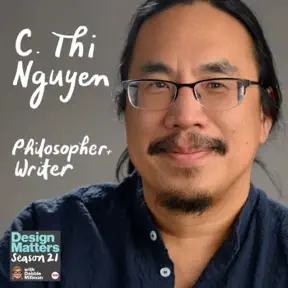
Best of Design Matters: C. Thi Nguyen
Design Matters with Debbie Millman
August 31, 2026
C. Thi Nguyen—philosopher, professor, and author of Games: Agency as Art—joins to discuss his new book, The Score: How to Stop Playing Somebody Else’s Game, and how metrics, from grades to likes, quietly reshape what we value and who we become.
Speakers Debbie Millman, C. Thi Nguyen
Debbie Millman (0:01)
This episode of Design Matters originally appeared in February of 2026
C. Thi Nguyen (0:06)
The fact that I say, I love this game, I want to play it. Why? Because I don't know, it's got weird, deep social vibes. I can't say more, right?
That's permissible, and you can modify games.
Debbie Millman (0:22)
From the TED Audio Collective, this is Design Matters with Debbie Millman.
On Design Matters, Debbie talks with some of the most creative people in the world about what they do, how they got to be who they are, and what they're thinking about and working on. On this episode, a conversation with C. Thi Nguyen about what games teach us about the real world and about ourselves.
C. Thi Nguyen (0:46)
Games are designed to make the beauty and the interest emerge in you, the player.
Debbie Millman (0:57)
Thi Nguyen is a philosopher who has spent much of his life examining the invisible architectures that shape human experience, the systems that tell us what matters, what counts, and how to measure whether we are succeeding.
Thi is a professor of philosophy at the University of Utah and the author of Games, Agency as Art, which has won the American Philosophical Association's Book Prize. His latest book, The Score, How to Stop Playing Someone Else's Game, examines how metrics from grades to social media to professional rankings can narrow our understanding of what makes life meaningful. Thi Nguyen, welcome to Design Matters.
C. Thi Nguyen (1:39)
Thank you. It's good to be here. Your introduction also like stabbed at the heart of my being. You got the soul and everything I'm interested in exactly right. I actually didn't understand this for a long time. I had all these weird obsessions I was writing about in philosophy. I was writing about social media and I was writing about games, I was writing about trust structures, and I was writing about computing, and people had asked me what brought it all together and I didn't know.
Actually, there's this thing called midterm review when you're a young professor, someone else reviews all your work, and this philosopher, Brandon Cook, read everything and he wrote this letter and he said, you might think that Thi's interests are zany and all over the place, but what he cares about is how the outside world, how social structures and technological structures change how we value and think. I was like, oh my God, suddenly I make sense to myself.
Debbie Millman (2:34)
Okay. Well, I'm glad. I'm glad I've spent a lot of time with you over the last couple of weeks, whether or not you realized it. So I love to look for those threads that knit everything together.
However, you do have a somewhat surprising origin story. Is it true you were a teenage movie critic for the San Jose Mercury News?
C. Thi Nguyen (2:56)
You look that up. Amazing. Yeah. That was my-
Debbie Millman (3:02)
Yeah.
C. Thi Nguyen (3:02)
So when I was in high school, the San Jose Mercury News was looking for teenage movie critics, and they held an essay contest, and they got three of us. And I think what they were looking for was like, it was supposed to be the teenage view, and I think they were looking for like kids who would talk about kid action movies. And because they held an essay contest, they got the three most pretentious, artsy, fartsy, like nothing is good, but late Altman weirdos. And so I ended up, yeah, writing a bunch of weird movie reviews that I think if we went back to look at them, which I haven't in years, are probably unbearably pretentious.
That was my first writing gig.
Debbie Millman (3:47)
What kind of films were you reviewing at that point? Like adult movies, kids movies?
C. Thi Nguyen (3:52)
I was 16 or 17, but like, I mean, we would have fights because I was an art kid. I always wanted to like review arty movies. They did let me review like Christoph Kieślowski's Rad, but they also wanted, the teenage reviewer should review like Jurassic Park. I would do that too, but...
Debbie Millman (4:10)
Teenage mutant turtle.
C. Thi Nguyen (4:11)
And I was much less generous back then than I would have been now. I was a much more rigid, fancy artist better kid. I have a more expansive view now.
Debbie Millman (4:21)
Your parents came to the US from South Vietnam. What made them decide to settle down in Southern California?
C. Thi Nguyen (4:28)
I think when you're a Vietnamese war refugee, the government just sends you someplace and you end up there. I think they were going through a lot of local churches to place immigrants with families. And so there was a family that just volunteered to open their home to a refugee family. And they took in my parents. And it happened to be in San Jose. And by an enormous amount of luck, I mean, OK. There are two ways I can tell my story. One way I can tell my story is I'm an immigrant's child. I grew up poor with people that had nothing. And then I fought my way to a fancy college. And I fought my way to a professor gig. Here's another way to tell my story.
60 more minutes of transcript below
Thousands of transcripts fetched by people building searchable podcast archives
Fetch the whole transcript
The demo key returns a sample episode in full, no card needed:
curl -H "x-api-key: pt_demo" \
  https://spoken.md/transcripts/1000651996090
Markdown with the speakers named, for your notes, your knowledge base, or anything that makes HTTP calls.
From $0.10 per transcript. No subscription. Credits never expire. Prices exclude VAT, added at checkout for EU customers. Not what you expected? Email us within 14 days with 20 or fewer credits used and we refund the pack in full.
Using your own key:
curl -H "x-api-key: YOUR_KEY" \
  https://spoken.md/transcripts/1000786941013