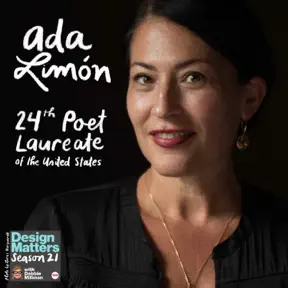
Best of Design Matters: Ada Limón
Design Matters with Debbie Millman
September 28, 2026
Ada Limón—24th U.S.
Speakers Ada Limón, Debbie Millman
SPEAKER_1 (0:01)
This episode of Design Matters originally appeared in March of 2026
Ada Limón (0:06)
Sometimes they come out backwards, sometimes they come out almost done.
And I realized I've been writing it for a long time. And so by the time I got to the page, it's complete. And then sometimes it takes me months, even years, to finish a poem.
SPEAKER_1 (0:26)
From the TED Audio Collective, this is Design Matters with Debbie Millman.
On Design Matters, Debbie talks with some of the most creative people in the world about what they do, how they got to be who they are, and what they're thinking about and working on. On this episode, a conversation with Ada Limón about how she became a poet and the power of poetry to bring people together.
Ada Limón (0:50)
Oh, there are other people that feel this way.
Debbie Millman (1:00)
Ada Limón is the author of seven books of poetry, including The Carrying, which won the National Book Critics Circle Award, and Bright Dead Things, a finalist for the National Book Award. Her most recent poetry collection is Startlement, New and Selected Poems.
In 2022, Ada was named the 24th Poet Laureate of the United States. She served in that role for three years, bringing poetry into classrooms, libraries, and national parks across the country. Her many honors include a MacArthur Fellowship, a Guggenheim Fellowship, and she was named one of Time Magazine's Women of the Year in 2024 for being an extraordinary leader who was working toward a more equal world. Her brand new book is titled Against Breaking on the Power of Poetry. Ada Limón, welcome to Design Matters.
Ada Limón (1:58)
Thank you so much for having me. It's a pleasure to be here.
Debbie Millman (2:01)
Ada, you grew up in Glen Ellyn in Sonoma Valley across from the Calabasas Creek in a landscape of hills, horses, and open land. Yet your pet of choice was a mouse you named Fred.
Ada Limón (2:21)
Yes, I did have a mouse named Fred.
Debbie Millman (2:24)
Tell us how you came to own Fred.
Ada Limón (2:28)
You know, when my parents were divorcing, the nice thing about having a mouse is that you could carry the cage back and forth.
And so for me, Fred was perfect because he was portable and he could come with me to each house. That was important for me to be able to bring my little mouse back and forth.
Debbie Millman (2:50)
Your grandfather emigrated from San Juan de los Lagos in Mexico during the Mexican Revolution and worked hard to assimilate in the United States. And I'm wondering, has that family history influenced you think about heritage and cultural identity?
Ada Limón (3:09)
Yeah. I mean, I think it's hard not to live in the United States without thinking about cultural heritage and identity. I think that, you know, for me, I not only think about his journey and how proud he was of his American citizenship, but also how he struggled to make it in this country. And I find his journey to be both inspirational and a little hard sometimes because he was a very prideful person. And there are times where I know how much he was holding in.
That's something that is a little bit of a family legacy there.
Debbie Millman (3:59)
Your childhood included long stretches of solitude, walking creeks, watching animals, and you spent a lot of time outdoors. And as I was reading about your childhood and the ways in which you engaged with the world, I was wondering, were you lonely?
Ada Limón (4:17)
I don't know if I was lonely. I don't know if I've ever been lonely.
I like to be alone. It's important to me to be alone. I think that I miss people. I miss specific people. But I don't think I was lonely. I think I was sometimes isolated, sometimes felt separate, and maybe had a sense of longing.
But I don't think I was lonely.
Debbie Millman (4:50)
What were you longing for?
Ada Limón (4:52)
I think I was longing for a way to connect with the strangeness that I felt, the surreality of being alive in a body. And I didn't have words for it. And everyone else seemed to be able to function in a way that felt very...
I don't want to use the word normal, but it felt as if everyone had the perfect way to move in the world. And for me, I felt like there was always this moment where I wanted to shout, like, isn't this bizarre?
And I think I still feel that way. And so even as a child, I felt like at any moment, I was going to break out and start shouting. Isn't it so strange to be alive? And where do we come from? And where are we going? And what is this about? And how are we supposed to pretend that this human experience is not deeply strange and otherworldly and in many ways overwhelming?
48 more minutes of transcript below
Thousands of transcripts fetched by people building searchable podcast archives
Fetch the whole transcript
The demo key returns a sample episode in full, no card needed:
curl -H "x-api-key: pt_demo" \
  https://spoken.md/transcripts/1000651996090
Markdown with the speakers named, for your notes, your knowledge base, or anything that makes HTTP calls.
From $0.10 per transcript. No subscription. Credits never expire. Prices exclude VAT, added at checkout for EU customers. Not what you expected? Email us within 14 days with 20 or fewer credits used and we refund the pack in full.
Using your own key:
curl -H "x-api-key: YOUR_KEY" \
  https://spoken.md/transcripts/1000791992967