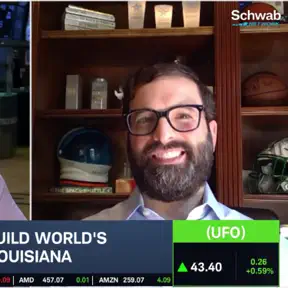
Andrew Chanin on PL Earnings & "Powerful" Tools, SPCX Starship Expectations
Schwab Network
September 3, 2026
ProcureAM's Andrew Chanin turns to earnings in Planet Labs (PL) and ways AI will shape the satellite company's report. He sees Planet Labs holding "powerful tools" in mapping and tracking, the question lies in when it will turn profitable.
Speakers Andrew Chanin
SPEAKER_1 (0:01)
All right, let's go deeper into the space economy now in our tech spotlight. Joining us now is Andrew Chanin, who's the CEO of co-founder at ProcureAM. Andrew, thank you so much for your time today. So the next big test for this space is obviously going to be Planet Labs. Is there anything in particular that you're looking to hear from that report?
Andrew Chanin (0:21)
So we just recently heard a defense deal out in Europe. This company has been doing a pretty good job of winning contracts around the world, not just here in the US. And so people will be looking to see if, despite an expected revenue increase, what the losses will actually look like for this quarter. But another area that people are really interested about is how much demand AI will bring for Earth observation, which is a major part of what this company does.
SPEAKER_1 (0:51)
Yeah, I want to talk about that because it seems like the overarching story for this one really revolves around transition from just like a satellite imagery type of company to more of an AI-powered utility. Can you sort of explain where they're at in that transition right now, and what's important to be watching out for?
Andrew Chanin (1:11)
Sure.
In recent years, Earth observation has been a segment which has been about almost 50 percent of the spending comes from governments and defense. But when you think about Earth observation and what you can do when you start incorporating AI into this massive, massive amount of information and data that you're able to gather from these satellites, is you're possibly able to make some better predictions and observations and things that are actually happening in real-time on Earth and also tracking these various patterns. But utilizing the power of AI, you might be able to unlock significant amounts of trends, whether that be weather, whether that be movement, whether that be erosion and things like that, that climate change focused people might be interested in. But also for businesses, tracking things like maritime, where different things are at different times, in all different areas there. So being able to have the power of being able to view the world and get updates on a daily basis, but coupling that with AI to determine how those things have changed, and where they might be headed based on those changes, could be an extremely powerful tool, relevant to many, many players, beyond just the typical government and defense spending payers.
SPEAKER_1 (2:27)
Oh, absolutely. I mean, you know, I'm thinking about natural disasters. I mean, what's happening in Nepal right now. I'm thinking of agriculture as well. It's so important. As for this company and what it signals about the broader space economy right now. I mean, I was reading about how it was sort of, I guess, penalized previously for its cash burn, but it's kind of trying to change that narrative with turning a corner on profitability. I mean, how does that sort of set the bar for other companies in the business of space, do you think?
Andrew Chanin (3:01)
So I think so many companies had a lot of hype running into the SpaceX IPO. If you look back at the charts, so much of the upwards movement over the last couple of years came around December and into the SpaceX IPO in June. And after a less than stellar IPO for SpaceX, a lot of people started to do what we saw in the post-SPAC boom bus cycle where everyone was just kind of throwing indiscriminately these space names out. And then all of a sudden you started seeing, you know what, some of these companies are starting to build an interesting base. They're starting to show revenues on some of the investments that they've made. And so many projects of space are long term. And so it's tough to really judge some of these companies on a quarterly basis when some of these projects can take years to even a decade to see into fruition. But we're kind of at this stage where we have seen a lot of investment. We're starting to see revenues coming out of a lot of these different projects that these companies have done. And it's happening, all these sell offs in space seem to be happening while these companies are winning some major contracts. So this isn't just a US story. This is a global story.
And this is something where some of these names might have been penalized a little bit harshly and you look at a name like Planet Labs, which is significantly below its 52 week highs.
And to the extent that some of these companies can show, yes, we have growing revenues, our losses are decreasing, we're winning new contracts and we're entering new areas. I think that should be something that a lot of investors may be excited about.
3 more minutes of transcript below
Thousands of transcripts fetched by people building searchable podcast archives
Fetch the whole transcript
The demo key returns a sample episode in full, no card needed:
curl -H "x-api-key: pt_demo" \
  https://spoken.md/transcripts/1000651996090
Markdown with the speakers named, for your notes, your knowledge base, or anything that makes HTTP calls.
From $0.10 per transcript. No subscription. Credits never expire. Prices exclude VAT, added at checkout for EU customers. Not what you expected? Email us within 14 days with 20 or fewer credits used and we refund the pack in full.
Using your own key:
curl -H "x-api-key: YOUR_KEY" \
  https://spoken.md/transcripts/1000787712249