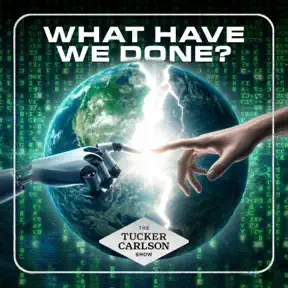
AI Whistleblower: OpenAI Scandal, AI Cults, Neuralink & Our Last Chance to Stop the Tech Oligarchs
The Tucker Carlson Show
September 11, 2026
Nate Soares is a computer scientist who’s worked at Google and the Defense Department. So when he says AI is on the path to killing every person on earth, it’s worth hearing him out. (00:00) Why Is AI Dangerous?
Speakers Tucker Carlson, Nate Soares
TopicsNews CommentaryNewsPolitics
Tucker Carlson (0:04)
Nate, thank you so much for doing this.
You've written the world's darkest book. You've devoted your life to warning the world about the potential dangers of AI. So let's just start by hearing your explanation of why AI is dangerous, in addition to just being annoying.
Nate Soares (0:25)
Yeah, you know, the very basic common sense point is, if you race to make machines that are much smarter than any human, to make machines that are more capable at inventing their own technology than humans are, and you race into this without really knowing what you're doing, the most likely outcome is just that the machines get loose and do their own thing, and that humanity dies as a side effect, just like humanity has, you know, killed lots of other animal species, not because we hate them, but just as a side effect. And in some sense, a lot of people find it sort of obvious or intuitive that if you just like make these really smart, really powerful machines, why would they care about us?
And I think that intuition basically is right, and there's a lot of arguments you can have on each side. You can get in the technical details. But my book is basically just getting into those details and saying like, yep, it sort of holds up if we make smarter machines without knowing what we're doing, it's just going to go poorly.
Tucker Carlson (1:39)
Are we actually going to make machines capable of what you're describing?
Nate Soares (1:45)
You know, the companies are trying to.
They talk about how they are pursuing superintelligence in the true sense of the word. That's Sam Altman's phrase. Dario Modi of Anthropix says they're trying to make the equivalent of a country worth of geniuses in a data center. So these guys are really, these aren't chat bot companies.
They didn't set out to be chat bot companies. They set out to make these machines that can sort of exceed humans in every way. And that's what they're targeting. There's a separate question of whether they will get there.
Tucker Carlson (2:17)
Ask us, why would anyone want to build a machine smarter than people?
Nate Soares (2:22)
I think that a lot of them hope that they'll be able to make the world much, much better. They hope for a cure to cancer and then more than a cure to cancer, they hope for a cure to aging. They hope for a thousand years worth of technological development compressed into two years.
I don't think that they're going to be able to get that really or harness that for good ends, but that's what I think they're shooting for.
Tucker Carlson (3:01)
The core point you're making is these companies did not set out to make consumer products, to make your life better necessarily in the short term with a more efficient search engine.
Nate Soares (3:11)
That's right. Yeah, you know, OpenAI started before the chatbots, the large language models were even a thing.
They were started, forget those late 15 or early 2016, but the paper that unlocked the most recent wave of AI came out in 2017, which was after OpenAI was founded. And these guys are the large language models are a surprise revenue stream. And that revenue stream can fund the creation of even more, even larger data centers for the next level of the technology. But these guys have their eye on the sort of ultimate version of the technology, which is these machines much smarter than humans. And that's sort of the ultimate version, because once the AIs are smarter than the humans, the AIs can carry on the AI research and make the next generation of the AIs, or make the next generation of the AIs. And that's sort of what they're shooting for.
Tucker Carlson (4:12)
What is super intelligence?
Nate Soares (4:15)
We in our book define super intelligence as an AI that is better than the best humans at every mental task.
So anything that a human can do purely mentally, the AI can do that better. One thing people often get cut up on about this is that includes the AI being better at things like persuading humans, at things like charisma. You know, we often think of intelligence as the stuff that the nerds have and that the jocks lack.
Tucker Carlson (4:45)
But you win a chess match.
Nate Soares (4:46)
Right. It's the chess guys rather than the politicians guys or the rock stars. But that's not really what the intelligence and artificial intelligence means. The intelligence and artificial intelligence is about the stuff that humans have and that mice don't.
It's sort of the whole package. You know, like the politician who's very charismatic, it's not that like chess playing happens in your brain and charisma happens in your kidneys, right? They're sort of both mental functions.
95 more minutes of transcript below
Thousands of transcripts fetched by people building searchable podcast archives
Fetch the whole transcript
The demo key returns a sample episode in full, no card needed:
curl -H "x-api-key: pt_demo" \
  https://spoken.md/transcripts/1000651996090
Markdown with the speakers named, for your notes, your knowledge base, or anything that makes HTTP calls.
From $0.10 per transcript. No subscription. Credits never expire. Prices exclude VAT, added at checkout for EU customers. Not what you expected? Email us within 14 days with 20 or fewer credits used and we refund the pack in full.
Using your own key:
curl -H "x-api-key: YOUR_KEY" \
  https://spoken.md/transcripts/1000789082474