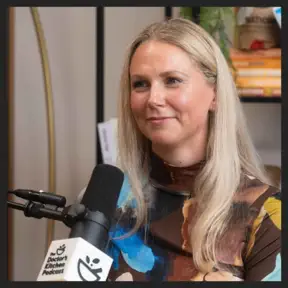
5 signs of low fibre and how to eat 30g a day without getting bloated | Dr Emily Leeming
The Doctor's Kitchen Podcast
July 15, 2026
I’ve been talking a lot about healthy protein and sometimes it can feel like you have to pick a side. Protein or fibre. But for long-term health, you want both on your plate. The problem is, 96% of people still don’t hit the recommended daily fibre target. Even if you eat vegetables at every meal.
Speakers Rupy Aujla, Emily Leeming
TopicsMedicineHealth & FitnessNutrition
Rupy Aujla (0:00)
I'm Dr. Rupy, and on this show, I help you feel more in control of your health through food and lifestyle medicine. 96% of people do not meet the recommended daily target for fibre, even those who eat veg at every meal, which means you might be missing out on big benefits, not only for your gut, but for energy levels, weight, cholesterol, and lowering the risk of cancer. But so many people worry about bloating when increasing fibre. So today, Dr. Emily Leeming, PhD and registered dietician and author of the new cookbook, Fibre Power, is going to break down signs that you're not eating enough, tips to prevent bloating and practical ways to gently increase fibre that's personalised to work with your unique gut, as well as how long it takes to see results, plus a strategy for a high fibre, high protein breakfast and why that balance is so important.
Dr. Emily, what are some signs that your diet is low in fibre?
Emily Leeming (1:15)
There's so many things that fibre influence, so it's really hard to just pinpoint one exact thing. I think the first thing I'd probably go to is if you are having dry, hard poos, so you're struggling with your constipation, you're perhaps then feeling really bloated because of that, you're feeling tired, you're feeling uncomfortable, that can be one key sign. But we also know that fibre impacts so many other areas of our health. We know that fibre is really important for helping our heart health, for helping our blood sugar control, even just helping to keep us feeling fuller during the day and having long, stable energy levels.
All those things can be a sign of they're not going well, that fibre is potentially lacking. Actually, we know from the stats that 96 percent of people are not getting enough fibre in a day.
Rupy Aujla (2:01)
That's shocking, isn't it? The average is what, 15, 16 grams?
Emily Leeming (2:05)
16 grams. That's just over 50 percent of what we should be having, which is 30 grams of fibre a day. Actually, we might potentially even need a little bit more, but we just haven't had the research to fully understand whether that little bit more like say 40 or 50 grams is actually the sweet spot.
Rupy Aujla (2:23)
I guess the number of poops that you have in a week might be telling as well.
Emily Leeming (2:28)
Yeah, exactly. The things we're looking at in terms of your poo is telling you so much about the health of your gut, which is why I so want to encourage people, please do lift the toilet lids, have a regular look because it's just giving you this key sign of how things are going. Yes, it is about frequency, about having that between three times a day to three times a week, whatever is normal within that. But it's also how is the shape of that poo. You want it to be a smooth sausage shape or a sausage with cracks in it. If it's really loose and liquid or perhaps even dry and like rabbit pebbles, that's something you want to take a look at. Usually, it's just a few diet and lifestyle tweaks to make that happen. But it's also, do you feel like everything is coming out? Is it easy?
Is it not taking too long?
I think also really there's so much that our body is telling us in terms of information. How do you feel? Are you having uncomfortable symptoms, like any discomfort, any pain? All those things are sign that perhaps there's something just worth visiting your doctor to have a checkup about.
Rupy Aujla (3:35)
Yeah, I think becoming a lot more intuitive about our own health instead of relying on tools. And I've actually just experimented with removing my wearable. I've been wearing a wearable for like eight years. But I want to be a lot more attuned with what my body is telling me, because actually it's the best data that we can actually tune into.
And one of the things I wanted to double click on there was this idea of cravings and appetite as a potential marker of not having enough fibre.
Emily Leeming (4:05)
Yeah. So when we eat our meal, there's lots of different types of nutrients are within that. You've got your protein, you've got your carbohydrates, you've got your fats. And what has happening is they're going into your body. And when we have fibre as part of that, fibre tends to be quite bulky. And the key part that it's playing in terms of your appetite is it's basically helping to add volume to your stomach and to your gut. So it's adding this sensation that there's more food there.
74 more minutes of transcript below
Thousands of transcripts fetched by people building searchable podcast archives
Fetch the whole transcript
The demo key returns a sample episode in full, no card needed:
curl -H "x-api-key: pt_demo" \
  https://spoken.md/transcripts/1000651996090
Markdown with the speakers named, for your notes, your knowledge base, or anything that makes HTTP calls.
From $0.10 per transcript. No subscription. Credits never expire. Prices exclude VAT, added at checkout for EU customers. Not what you expected? Email us within 14 days with 20 or fewer credits used and we refund the pack in full.
Using your own key:
curl -H "x-api-key: YOUR_KEY" \
  https://spoken.md/transcripts/1000776845749