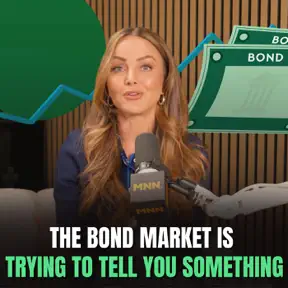
WTF is Going on in the Bond Market?!
Money Rehab with Nicole Lapin
September 21, 2026
The Money School: The Complete Financial Education You Were Never Given My comprehensive book yet, the financial curriculum that should have been taught in school but never was.
Speakers Nicole Lapin, Ray Dalio
TopicsBusinessEducationSelf-Improvement
Nicole Lapin (0:00)
AI has changed so many things in our lives, but one thing we noticed almost right away was the shift in search and how people were actually finding Money News Network. That meant we needed to redo all our websites' stat. And yes, we tried to fight AI with AI, but at the time, the technology just wasn't up to it. We have a dedicated web designer, but she needed extra support temporarily to redesign all our show's pages on short notice. So instead of expanding headcount, we expanded our labor pool and turned to Upwork. You can browse profiles, review past work, and get help scoping the role, so you can hire with confidence and get started quickly. With Business Plus, you can access the top 1% of talent on Upwork. AI-powered shortlisting delivers a curated shortlist of top freelancers matched to your goals in under six hours. No endless searching required. Visit upwork.com right now and post your job for free. That is upwork.com to connect with top talent ready to help your business grow.
That's upwork.com.
Here's a stat that really stuck with me. Sales teams spent up to half their time on admin. Not selling, not building relationships, not closing deals. On admin. And that got me thinking, what if you could get that time back? That's where today's sponsor, Pipe Drive, comes in. An intelligent, AI-powered sales CRM loved by growing sales teams. With their new pre-meeting brief, Pipe Drive automatically pulls deal history, email records, and previous conversations into one place, ready for you before every call. During the call, it also takes notes so you can stay in the conversation. Afterward, it drafts the CRM updates for you to review and approve. Less admin, more selling. Switch to a CRM built by salespeople for salespeople, and join the over 100,000 companies already using Pipe Drive.
My link gets you an exclusive 30 days free instead of the usual 14-day trial. No credit card or payment needed. Just head over to pipedrive.com/mnn to get started. That's pipedrive.com/mnn as in Money News Network, and you can be up and running in minutes.
I'm going to send the alarm today and I'll be up front. It's about the least sexy thing in finance possible, the bond market. But stick with me because this one lands in your wallet. Here's the short version. Over the past few weeks, investors have been dumping US government bonds. And when that happens, the cost of borrowing money goes up for everyone, starting with the government and ending with you and me. As I'm recording this, the 10-year treasury yield is sitting right at around 4.8%.
That's the highest it's been in years. The 30-year recently hit its highest level since 2007 In plain English, the US government is being charged more to borrow money than it has in a very long time. And when Uncle Sam pays more, so do you. Here's why I care enough to drag you into this. I spent years covering markets on CNBC, Bloomberg, CNN, and here's the thing nobody tells you. The stock market gets all the attention, but the bond market is where the real grownups are. It is bigger, it is quieter, and you know what? It's usually right. Stocks are the popularity contest. Bonds are the credit check. And right now, the credit check on the United States is coming back with some questions. That's all a rising yield really means. The people lending our government money want to be paid more to keep on doing it. And here's the reason it matters to you, even if you never, ever buy a bond in your life. Mortgage rates follow the 10-year like a loyal, loyal puppy dog. Freddie Mac says the average 30-year fixed rate is now 6.71%, marching toward 7%. That's the highest it's been all year. So yes, we are venturing into dense bond territory today, but I am going to make it very simple, not dumbed down, but very simple. So what does this actually mean for you? Well, if you've been sitting on the sidelines waiting for interest rates to come down before you buy a house, I have some uncomfortable news for you. They moved in the literal opposite direction. And if you're not out there home buying, don't tune this out because the exact same force is the one that's setting the rate on your next car loan, on your credit card. It moves the bond slice of your 401k, and it decides whether your company can afford to expand this year, or if it quietly stops hiring. So today, I'm going to untangle three things. Why this is happening, what the Mon market actually is, and whether any of this should change your plans. Plus a tip at the end that could save you some real money if you are locking in a mortgage right now. Okay, bond school. I promise this is the five-year-old version. Let's say your friend wants to borrow $10 from you to buy a video game. You say, sure, no problem. You want $11 back next month. Congratulations, you just bought a bond. That extra dollar is the interest, and the interest rate is what Wall Street calls the yield. A bond is basically an IOU with a price tag. That's it. Now swap your friend for the US government. When the government spends more than it collects in taxes, it borrows the difference by selling millions of those IOUs called treasuries. A 10-year treasury is just the government saying, hey, lend me $1,000 and I will pay you interest every year for 10 years, and then I'll hand you your $1,000 back. The yield is the interest rate you're getting on that loan. Higher yield, the government is paying you more to lend to it. Lower yield, it is paying you less. Hold on to that because it's basically the whole episode. And here's what turns that pile of IOUs into a full-fledged market. You don't have to hold on to that bond for the 10 years. You can sell it to somebody else tomorrow, and whoever buys it collects the rest of those interest checks. That happens on a scale that is really hard to wrap your head around. About $1.2 trillion of treasuries change hands every single day. Every day, there is 31.5 trillion of it out there in total, trillion with a T. And because historically the US government has always paid its bills, a treasury is treated as the safest loan on the planet. That makes it the ruler. Everything else gets measured against your mortgage, your car loan, corporate borrowing, all of them. If lenders can get nearly 4.8% from Uncle Sam, think about it, with basically zero risk, they're not going to lend it to you for less. They're going to lend it to you for that plus extra for the risk that you, unlike the US government, might not pay them back. Now, the one thing you really need to understand about bonds, long-time listeners know this one very well because it's in the Money School and I bring it up basically every chance I can get. Bond prices and interest rates move like a seesaw. When one goes up, the other goes down. Back to your friend for a second. Say a new kid on the block starts offering $12 back on every $10 that he borrows. Suddenly, nobody wants your old $11 IOU unless you sell it to them, let's say, for less than $10.
18 more minutes of transcript below
Thousands of transcripts fetched by people building searchable podcast archives
Fetch the whole transcript
The demo key returns a sample episode in full, no card needed:
curl -H "x-api-key: pt_demo" \
  https://spoken.md/transcripts/1000651996090
Markdown with the speakers named, for your notes, your knowledge base, or anything that makes HTTP calls.
From $0.10 per transcript. No subscription. Credits never expire. Prices exclude VAT, added at checkout for EU customers. Not what you expected? Email us within 14 days with 20 or fewer credits used and we refund the pack in full.
Using your own key:
curl -H "x-api-key: YOUR_KEY" \
  https://spoken.md/transcripts/1000791002013