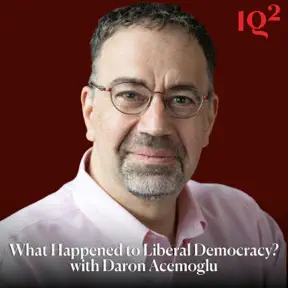
Why Did the Working Class Abandon the Left? With Nobel Economist Daron Acemoglu
Intelligence Squared
September 5, 2026
Liberal democracy was once a radical force. It challenged monarchies, expanded political rights and, at its most successful, helped deliver rising wages and shared prosperity. So how did it become associated with an establishment that growing numbers of voters have turned against?
Speakers Mia Sorenti, Carl Miller, Daron Acemoglu
TopicsSociety & CultureArts
Mia Sorenti (0:00)
Welcome to Intelligence Squared, Where Great Minds Meet. I'm Senior Producer Mia Sorenti.
Why have so many working class voters turned away from the political left? On today's episode, Daron Acemoglu, Nobel Prize-winning economist and Institute Professor at MIT, joins Carl Miller to discuss his new book, What Happened to Liberal Democracy? Remaking a Politics of Shared Prosperity. Together, they explore how inequality, automation and the changing nature of work have weakened liberalism's traditional political coalition. Let's join our host, Carl Miller, now with more.
Carl Miller (0:34)
Daron, very warm welcome back. You were on Intelligence Squared a couple of years ago, where we met actually in London. Just before we dive into the book, I just want to pick up one thread that really stayed with me from our last conversation. I remember we'd spent a lot of time, I imagine some people listening will remember this as well, talking about AI and jobs.
I left feeling very optimistic that all the jobs were not going to be erased from the economy.
How has that been going, do you think? That's something that obviously lots of people remain very concerned about. Do you remain as optimistic that automation isn't going to lead to big job cuts?
Daron Acemoglu (1:16)
I was not advocating that automation won't lead to big job cuts. Actually, Carl, my research shows automation would lead to significant job cuts. But I was making two separate points which were different than that. One is that any automation is going to be slow, and that so far has been the case.
I think it's been three years since we spoke, and we haven't seen much job loss anywhere. Perhaps with agentic AI, it's coming, I wouldn't rule that out. But it's going to be slow still. It's not going to be the accelerated timeline that some people in tech are predicting 60% of entry-level jobs and the significant fraction of all jobs disappearing. I don't think it's going to be that quick.
Second, I was also arguing that there is a direction of AI, which I've called pro-worker AI, which could be much better for job creation. But I was already saying then, and I would say the same thing now, that's not what we're pursuing. So that's an alternative path that would be better. But I wouldn't build my expectations on that because that's not what we're pursuing. But I like to emphasize that over and over again, just like a broken record, because I think it's so much more socially beneficial than the current focus, one might say obsession, with AGI, artificial general intelligence.
Carl Miller (2:55)
Okay. Well, thank you, Daron. We will return to pro-worker AI, I think, a little bit later.
Daron Acemoglu (3:01)
Yeah, whether you want it or not. Yes, I'll bring it up.
Carl Miller (3:05)
But let's now actually turn to the kind of main thesis in question tonight, the kind of the rise and possible fall of liberalism. Something of a group tragedy almost, I think, the kind of narrative. It is, absolutely.
Daron Acemoglu (3:19)
But again, as opposed to Greek tragedy, it is possible that it's rise, fall and rise again. So let's hope. That's the point of my book, calling for that.
Carl Miller (3:30)
Well, let's begin with the rise. I think, kind of, what really struck me at the beginning of your book is, you know, we're all so used to seeing liberalism as a sort of incumbency.
We sort of forget that it was once a radicalism, don't we?
Daron Acemoglu (3:42)
Exactly. 100%. It's a radicalism, and a lot of the good ideas of socialism and the body of achievements of social democracy are within the liberal tent.
And of course, as an oppositional movement, it could be both radical and influential, which it was in the 19th century, for example. But indeed, I think liberalism defined as a broad tent and institutionalized via liberal democratic institutions has been in the establishment, part of the establishment or the mainstay of the establishment over much of the 20th century.
And, you know, being an establishment philosophy is much harder than being an opposition philosophy. So that's why the fall part or the decline part is very important to understand. But exactly like you say, Carl, we have to start with the success. And that's what my book does, first by arguing why the ideas of liberalism provided the best framework for human flourishing and will do so again in the future, related to collective knowledge, its creation, its diffusion, and supporting the situation in which people are each other's equal. They can look each other in the eye, as John Milton said, and build a better society. And then I go through the many successes of liberalism, some because of the aspirations it created and some because in power it did actually deliver on its promises.
21 more minutes of transcript below
Thousands of transcripts fetched by people building searchable podcast archives
Fetch the whole transcript
The demo key returns a sample episode in full, no card needed:
curl -H "x-api-key: pt_demo" \
  https://spoken.md/transcripts/1000651996090
Markdown with the speakers named, for your notes, your knowledge base, or anything that makes HTTP calls.
From $0.10 per transcript. No subscription. Credits never expire. Prices exclude VAT, added at checkout for EU customers. Not what you expected? Email us within 14 days with 20 or fewer credits used and we refund the pack in full.
Using your own key:
curl -H "x-api-key: YOUR_KEY" \
  https://spoken.md/transcripts/1000787881467