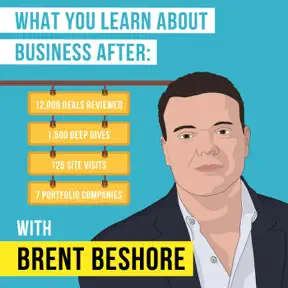
What You Learn About Business Deals After: 12,000 Deals Reviewed, 1,500 Deep Dives, 125 Site Visits, and 7 Portfolio Companies with Brent Beshore
Invest Like the Best with Patrick O'Shaughnessy
August 21, 2018
For the 100th episode, I’ve brought back my good friend Brent Beshore. Brent was the 10th guest on the podcast, after we met because of a mutual interest in capital allocation. I quickly learned that Brent was one of the most unique and thoughtful investors around.
Speakers Patrick O'Shaughnessy, Brent Beshore
TopicsInvestingBusinessTechnology
Patrick O'Shaughnessy (0:04)
Hello and welcome everyone. I'm Patrick O'Shaughnessy and this is Invest Like the Best. This show is an open-ended exploration of markets, ideas, methods, stories, and of strategies that will help you better invest both your time and your money. You can learn more and stay up to date at investorfieldguide.com.
SPEAKER_1 (0:24)
Patrick O'Shaughnessy is the CEO of O'Shaughnessy Asset Management. All opinions expressed by Patrick and podcast guests are solely their own opinions and do not reflect the opinion of O'Shaughnessy Asset Management. This podcast is for informational purposes only and should not be relied upon as a basis for investment decisions.
Clients of O'Shaughnessy Asset Management may maintain positions in the securities discussed in this podcast.
Patrick O'Shaughnessy (0:49)
For the 100th episode, I brought back my good friend Brent Beshore. Brent was the 10th guest on the podcast after we met because of a mutual interest in capital allocation.
I quickly learned that Brent was one of the most unique and thoughtful investors around. He was an entrepreneur from the moment he left school, trying many different things before finding a fit, buying smaller businesses with the intention of owning them forever. What amazes me about Brent is his encyclopedic understanding of business and the nuances of different business models and deal structures. This comes from reps. He and his team have looked at about 12,000 deals over the years at every kind of business that you could imagine. I've been with him when he goes through this process and it's fun to hear what makes certain businesses stand out from others, which is largely the topic of this conversation.
You all know transparency is key for me, so it's important to know that my family and I are investors in a fund called Permanent Equity Fund One, run by Brent and his firm Adventures. To commemorate this milestone episode, I can think of no one better than Brent because he exemplifies what has made this podcast so fun for me, learning from other people who are willing to share what they themselves have learned through fun, blood, sweat and tears. Please enjoy our conversation and thank you so much for coming along on this journey. I can't tell you how much it means to me.
We're going to come back to the story of the Permanent Equity Fund, but given the kind of funding source that you're working with, looking at this part of the market, you mentioned this idea of how to work with the capital stack depending on the deal. Maybe you could talk about the way you think through that for each individual company. If your primary sources of financing are committed equity capital, seller leverage and bank debt, how do you think about that mix, both from a risk perspective and from a return perspective when you're optimizing each deal?
Brent Beshore (2:31)
When you're thinking about structuring a deal, you got to look at what is the company. I think that too often, your mind first goes to how much leverage can you put on a company and how can you make the equity look as good as you possibly can? I think that that game is a dangerous one because it always leads you down to just stacking debt on debt on debt and trying to put in as little equity as you possibly can, which can work. Leverage is merely an amplification of the underlying value of the business. So if the business goes well, it's going to go great with leverage. The challenge is even if the business goes okay, like good, a family that owned it that had no debt on it would be perfectly happy with the performance. You stack enough debt on it and it quickly becomes a really dire situation. And then you start making just really dumb decisions that don't make any sense in the grand scheme of things. But you have no choice. You have to meet covenants. You have to meet your repayment schedule.
And so the first thing we think about is what is the company? What is the industry? What is the cyclicality? And a lot of people, you sort of take the last two or three years and you extrapolate out in the future. Trees are growing to the sky, that whole business.
And it doesn't make any sense. So cycles happen. We're in a current long dated upcycle.
No one has any idea how long it's going to last. And I certainly have no predictions about how long it's going to last. We could enter a downcycle soon or we could go another five, seven, ten years. I have no idea.
Patrick O'Shaughnessy (3:52)
I saw a funny trailer showing Australia hasn't had a recession in 26 years or something. So weird stuff happens.
51 more minutes of transcript below
Thousands of transcripts fetched by people building searchable podcast archives
Fetch the whole transcript
The demo key returns a sample episode in full, no card needed:
curl -H "x-api-key: pt_demo" \
  https://spoken.md/transcripts/1000651996090
Markdown with the speakers named, for your notes, your knowledge base, or anything that makes HTTP calls.
From $0.10 per transcript. No subscription. Credits never expire. Prices exclude VAT, added at checkout for EU customers. Not what you expected? Email us within 14 days with 20 or fewer credits used and we refund the pack in full.
Using your own key:
curl -H "x-api-key: YOUR_KEY" \
  https://spoken.md/transcripts/1000418215911