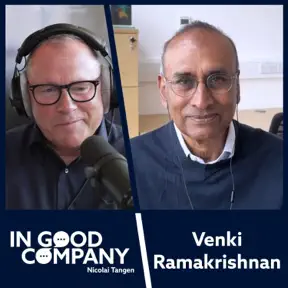
Venki Ramakrishnan: The Science and Hype of Living Longer
In Good Company with Nicolai Tangen
July 22, 2026
How close are we, really, to living forever? Longevity has become one of the hottest topics in the world, drawing huge investment and endless opinions about how to live longer.
Speakers Nicolai Tangen, Venki Ramakrishnan
TopicsBusiness
Nicolai Tangen (0:01)
Hi, everybody, and welcome to In Good Company. I'm Nicolai Tangen, the CEO of the Norwegian Sovereign Wealth Fund.
Now, longevity is one of the hottest topics in the world right now. Billionaires are pouring money into it. You know, when they were young, they wanted to become rich, and when they are rich, they want to become young.
The wellness industry is selling it, and opinions about how to live longer and everywhere. So we wanted to find out what is real, what is hype, and how close are we to live forever. To help us answer this, I'm joined by Sir Venki Ramakrishnan, the Nobel winner in chemistry, former president of the Royal Society, and author of the incredible book, Why We Die. Venki, warm welcome.
Venki Ramakrishnan (0:45)
Thank you.
Nicolai Tangen (0:47)
You start your book with the pharaohs of Egypt, who believe they could transcend death. Why did you begin there?
Venki Ramakrishnan (0:56)
Well, the pharaohs are an interesting story because humans try to avoid death by a variety of strategies. Plan A is simply to try not to die.
Plan B is to try to believe that even if you die, your whole body will be resurrected and you will go to some paradise. And Plan C is that maybe your body will decay, but you will have an immortal soul that will outlast you and you can occupy other bodies and so on.
Nicolai Tangen (1:30)
So now many thousand years later, how close are we to living forever?
Venki Ramakrishnan (1:35)
I think there's no physical or chemical law saying that our lifespan has to be what it is today. I mean, if you look at it today, we can expect at the most to live to be about 110 to maybe 120 years. Only one person has exceeded 120 years.
But saying there's no physical law doesn't mean anything because there's no physical law that we can't eventually colonize other galaxies. But if you look at all of the difficulties involved even in going to Mars, you realize that it's incredibly hard. And so I put this long life extension, hundreds of years, in that category, which is highly unrealistic today, despite what you may hear from various people promoting hype.
Nicolai Tangen (2:33)
Before we kind of dig deeper, how do you define aging?
Venki Ramakrishnan (2:36)
Aging is, I would say, the gradual loss of function of our systems. That is, from our molecules, cells, tissues, to the entire body. It gradually loses function due to accumulation of damage and changes with time.
And that's how I would define aging. Now, it has external manifestations. You know, you can't walk as fast, you're not as strong, you're more susceptible to infections. You know, so there are many external manifestations, but underneath it are these accumulated damages to our cells, tissues, and ultimately it comes from our molecules.
Nicolai Tangen (3:19)
Well, you are 74, I can't see so many external manifestations in you, but...
Venki Ramakrishnan (3:23)
Well, I'm lucky because I have a dark skin in a northern climate. So that gives a superficial, you know, illusion. But if you were to look at the inside of my body, you would find it's quite old.
Nicolai Tangen (3:38)
Well, we should talk about that later. But it seems like two ideas are getting a bit blurred, right? So extending life means slowing the ageing process, and then rejuvenating cells means making old cells young again. So what's the kind of the difference between the two?
Venki Ramakrishnan (3:52)
Okay, so most anti-aging strategies have to do with preventing damage or slowing down the damage and dysfunction, okay? And but some one class of strategies involves trying to get cells to go backward in development. And the way to think about it is a fertilized egg can develop into every kind of tissue in the body. That's what it does, right? And if you look at the early embryo, it has many cells, but each of those cells could become any type of tissue. Those are called pluripotent stem cells. But as the embryo develops, the stem cells become specialized. So some cells can only make cells of the blood system. Others can only make cells of the nervous system and so on. There are many types of cells, but still a small class of cells.
Now, but this process normally never goes backwards, except in real life it does. For example, the child born of old parents, like 30-year-old parents, it starts the clock from zero, right? And in fact, the child born of a 40-year-old woman is not older than the child born of a 20-year-old woman. So at some point, there is this resetting.
33 more minutes of transcript below
Thousands of transcripts fetched by people building searchable podcast archives
Fetch the whole transcript
The demo key returns a sample episode in full, no card needed:
curl -H "x-api-key: pt_demo" \
  https://spoken.md/transcripts/1000651996090
Markdown with the speakers named, for your notes, your knowledge base, or anything that makes HTTP calls.
From $0.10 per transcript. No subscription. Credits never expire. Prices exclude VAT, added at checkout for EU customers. Not what you expected? Email us within 14 days with 20 or fewer credits used and we refund the pack in full.
Using your own key:
curl -H "x-api-key: YOUR_KEY" \
  https://spoken.md/transcripts/1000777814000