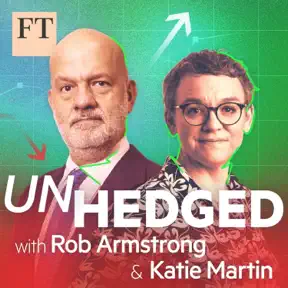
The year ahead: tariffs, taxes and Trump
Unhedged
January 7, 2025
Tariffs. Tax cuts. Geopolitics. Artificial intelligence. Inflation. Mass deportations. Rate cuts or rises. The year ahead is filled with question marks. Meanwhile, markets are historically high.
Speakers Robert Armstrong, Katie Martin
TopicsInvestingBusinessNewsBusiness News
Robert Armstrong (0:06)
Pushkin.
Katie Martin (0:10)
2025 has only just started, but it's demonstrating a pet theory of mine in markets, which is no one has the slightest idea what's going on. What larks?
Shush. Do we get full fat President Trump 2 with massive trade tariffs and huge deportation programs, or were these negotiating tactics and red meat for the voters? There's a lot hanging on those questions for stocks and bonds and all the other stuff in between. And really, truly honestly, we don't know. So buckle up, listeners. It's going to be a lively year one way or another. This is Unhedged, the markets and finance podcast from the Financial Times and Pushkin. I'm Katie Martin, a partied out markets columnist here at FT Towers in London. And I'm joined down the line from New York by Flight Lieutenant Robert Armstrong from the Unhedged newsletter division. Rob, we are back, baby.
Robert Armstrong (1:05)
We're back. You're probably doing Dry January, aren't you? A Dry January girl.
Katie Martin (1:09)
I'm one of those tedious people, yes.
Robert Armstrong (1:12)
Did you drink like a damn pirate over the holiday season to get ready for your sobriety?
Katie Martin (1:18)
I've prepared thoroughly. Now, that reminds me, at an extremely classy and in no way drunken New Year's party that I attended, someone told me that he thought you sounded like a man who drinks martinis.
Robert Armstrong (1:32)
I'm glad it's coming through, because this voice cost me a lot of martinis.
Katie Martin (1:38)
Guilty as charged. Now, not necessarily when we're consuming martinis, but you and I talked to a lot of professional investors and market analysts. And one thing that strikes me as funny at the moment is that everyone's got a really strong narrative around, you know, American exceptionalism, rah-rah US stocks, all that sort of thing. But at the same time, no one ever knows what's going to happen next.
Robert Armstrong (2:05)
Yes. And importantly, the strong opinions we hear don't all agree.
Katie Martin (2:09)
The strong opinions don't agree. And people really, really don't know how this year is going to shape up. I mean, what sort of level of kind of slightly frazzled uncertainty are you coming across?
Robert Armstrong (2:22)
Okay. So the main point where I hear question marks mixed in with divergent strong opinions is on tariffs. So there's two questions. What will they be? And on some wild guess on what they will be, how much impact they will have on A, the economy, and B, corporate profits. The views you hear are all over the map.
Katie Martin (2:50)
They're all over the place. But one thing that is definitely clear is that tariffs in some form are coming. So Donald Trump, one of the things that he's talked about for like as long as I've been alive is trade tariffs. You've got to tax imports.
Robert Armstrong (3:03)
Yes.
Katie Martin (3:03)
And so we know that something is coming.
Robert Armstrong (3:06)
He cannot do nothing. That would look unbearably bad at this point.
Katie Martin (3:11)
Yeah. So that's not going to happen. We know that we're going to get some sort of tariffs, but it's going to vary by from one country to the next. It might vary from one sector to the next. It could be from anything from like 60 percent tariffs on Chinese imports to 20 percent on the rest of the world to-
Robert Armstrong (3:26)
On everything. On everything from coffee to carburetors to circuits. And that's just the things starting with C.
Katie Martin (3:33)
Markets people care about this because all things being equal, that cost will get passed on to consumers and that has to be inflationary. And we had just got to the point where the inflation monster had almost been put back in its box. And this is a big risk to that, right?
Robert Armstrong (3:46)
Okay. It's actually not 100 percent clear how inflationary they are. That's an area of debate. It does increase prices. Somebody has to pay more for something if a tariff comes in. So question number one is how much does the producer pay, in other words, cut their prices to offset the tariff? How much does the consumer have to pay? And that mix will probably vary product to product. Are there substitutes? Can you switch to something domestic? So you have a whole set of questions there. But it may not be inflationary in terms of sparking a persistent rise in prices. It might be a kind of supply shock, one time price increase. The Fed doesn't do anything in response. Central banks don't do anything in response because it's a one time shock, which the theory says they're supposed to ignore. So I'm actually in the camp who says, yes, it makes things more expensive, but no, in the sense of persistent inflation is not inflationary, probably tariffs. That's my guess.
14 more minutes of transcript below
Thousands of transcripts fetched by people building searchable podcast archives
Fetch the whole transcript
The demo key returns a sample episode in full, no card needed:
curl -H "x-api-key: pt_demo" \
  https://spoken.md/transcripts/1000651996090
Markdown with the speakers named, for your notes, your knowledge base, or anything that makes HTTP calls.
From $0.10 per transcript. No subscription. Credits never expire. Prices exclude VAT, added at checkout for EU customers. Not what you expected? Email us within 14 days with 20 or fewer credits used and we refund the pack in full.
Using your own key:
curl -H "x-api-key: YOUR_KEY" \
  https://spoken.md/transcripts/1000683077385