The Trillion-Dollar Industries AI Is Disrupting: Voice, Law & the End of the Billable Hour
All-In with Chamath, Jason, Sacks & Friedberg
July 13, 2026
(0:00) ElevenLabs' $600M ARR Ramp, 600 Employees & Life Without PMs (15:34) Celebrity Voice Deals, Deepfake Impersonation & Racing OpenAI and Anthropic (31:42) Legora's Hypergrowth, Disrupting Law Firms & the Billable Hour (42:31) LexisNexis Decline, Legal Data Moats & Legora's Narrow AI...
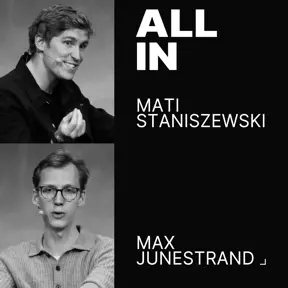
Speakers Jason Calacanis, Mati Stanislawski, Max Junestrand
TopicsTechnologyBusinessEntrepreneurship
Jason Calacanis (0:00)
You're on a bit of a heater, huh?
Mati Stanislawski (0:02)
It's the best time to be building.
Jason Calacanis (0:04)
And revenue has surged, but you face really intense competition. Let's go right at that to start.
If you were building a global financial system from first principles today, you wouldn't build it on 50-year-old legacy rails. You'd build Airwallex. One AI native platform for global accounts, cards and payments is designed to make the entire world feel like a local market. Others are bolting AI onto broken infrastructure. But Airwallex was built for the intelligent era from day one. Stop paying the legacy tax and start building the future at airwallex.com/all-in. Airwallex, built for the future.
350 million in what, two or three years? And I'm hearing numbers five or 600 million now. Tell us about the revenue ramp of the company from the moment you released the software to today. The product's been in market for 40 months, 50 months? You tell me.
Mati Stanislawski (1:00)
Spot on. We started company in 2022 First year was all about building the research and the product to really kickstart the work. We built the first text-to-speech model that finally could sound human, released it in 2023, beginning of 2023
Then it took us roughly 20 months to get to the first 100 million in ARR, roughly 10 months to get to 200, five months to get to 300, and that's how we closed at the end of the last year, and now we are at 600
Jason Calacanis (1:31)
You're at $600 million in revenue. This is extraordinary. How many employees now? Because the company has obviously hit incredible valuations, but you have to fill in that valuation, and you're competing at a very high level for talent. Tell us about how many employees you have now, and how you maintain the culture of the company when revenue is ripping, investors are throwing money at you, showing up at your doorstep, quite literally.
But you've got to run the company. You've got to build a culture. How many employees now, and how are you dealing with these competing priorities?
Mati Stanislawski (2:11)
Yeah, that's the key element of how you all- for us, the element of how we can maintain the culture despite the quick growth is critical and how we optimize both the interview cycle, how we are bringing people on board, how we onboard them. We have 600 people today, so also very quick growth on that people's side. And as a company, we combine research and product. So we are building a communication platform for AI.
On the research side, this includes everything across audio, generating speech, transcribing speech, orchestrating speech for interactions. On the product, this is how we can complete the entirety of the customer journey from marketing and creating assets and localizing them internationally through customer support with voice agents to proactive enablement of how voice agents can help in operations, training and sales. So this requires a lot of different talent.
And part of that revenue growth is actually a reflection of the functions we've grown over time. So from the original team, very research, very engineering heavy. From the first 10 people, we had zero attrition. Everybody is still at the company from those core research and engineering talent building together with us. So far, we've been able to outcompete. And I think the common thread and credit to my co-founder, who is an incredible researcher himself, we've been able to assemble the team that is truly excited about solving audio, solving interaction and building that research. And if they are looking for an opportunity out there and looking for a company to join and solve that, we are one of the leading, if not the leading place to do that.
Jason Calacanis (3:44)
And you started before AI was so impactful at making software. So when you were starting four years ago, five years ago and working on this, building software was limited to low percentage of the population of planet Earth, the number of people could write code. And now here we are, when from Vibe, we had a no code moment, then Vibe coding, and now we actually have people building production code that are not developers. You have developers going 10x and token maxing.
How has building software changed internally? And how do you deal with making sure that the code is really high quality? Because people are paying you this money, but they're going to demand really high quality product since they're spending so much money with you.
Mati Stanislawski (4:35)
Yeah, it's also true that 2022 was still the year where topics of the day were crypto and metaverse. So the building day was also the best time to start because we could actually take a bit of time to focus on what we thought is the future. But the way we are structured is a lot of small teams, especially across the product engineering, but also in how we think about go-to-market optimized for specific industries, telecom, financial services, healthcare. So every unit is very tightly knit together.
42 more minutes of transcript below
Thousands of transcripts fetched by people building searchable podcast archives
Fetch the whole transcript
The demo key returns a sample episode in full, no card needed:
curl -H "x-api-key: pt_demo" \
  https://spoken.md/transcripts/1000651996090
Markdown with the speakers named, for your notes, your knowledge base, or anything that makes HTTP calls.
From $0.10 per transcript. No subscription. Credits never expire. Prices exclude VAT, added at checkout for EU customers. Not what you expected? Email us within 14 days with 20 or fewer credits used and we refund the pack in full.
Using your own key:
curl -H "x-api-key: YOUR_KEY" \
  https://spoken.md/transcripts/1000776685156