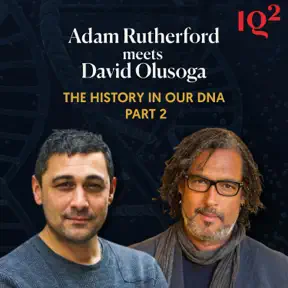
The Secret History in Our DNA: Adam Rutherford Meets David Olusoga (Part Two)
Intelligence Squared
August 30, 2026
Adam Rutherford is a science broadcaster, and author of A Brief History of Everyone Who Ever Lived, which transformed the way we think about human history. By using genetics to uncover the story of our species, it offered a thrilling new perspective on who we are and where we came from.
Speakers Mia Sorenti, David Olusoga, Adam Rutherford
TopicsSociety & CultureArts
SPEAKER_1 (0:01)
This episode is brought to you by Google Chrome. You think you know a browser, but Gemini and Chrome, that's new. It can help you with practically anything on the web, like restoring a vintage motorcycle from a 50-page restoration block, or finally break down that long article you've had open for weeks. Gemini and Chrome is here for it. Ready to make anything online make sense? There's no place like Chrome. Check responses set up required, compatibility and availability varies 18 plus.
Mia Sorenti (0:26)
Welcome to Intelligence Squared, where great minds meet. I'm Senior Producer Mia Sorenti. What can our DNA tell us about who we are, where we come from and the histories we share? In this episode, we return for part two of our recent live event with science broadcaster and author Adam Rutherford and award-winning historian David Olusoga. Together, they explore how advances in genetics can transform our understanding of human history and what our DNA can and cannot tell us about race, ancestry and identity.
If you haven't heard part one, do just jump back an episode to catch up.
A quick note before we rejoin the conversation. This episode contains some mature language.
David Olusoga (1:10)
To move away from our moment from history, you point out in the first edition, you say this, the number of diseases that have been cured as a result of gene therapy, zero. Ten years later, is that the case?
Adam Rutherford (1:29)
This is genuinely why we do this. The reason I wrote that in the first book was because the Human Genome Project was one of the most expensive and biggest and most hyped biological science projects in history.
David Olusoga (1:41)
With people constantly criticizing the cost.
Adam Rutherford (1:43)
Constantly criticizing the cost? I mean, I'm not an apologist for it. I think it was the only way that science could make progress. However, there were a number of problems with it, and the cost was actually pretty low for what it was. So the idea that the scientists around the world came together, they had spent the last 10 or 15 years looking at the genes of individual diseases, and working in a lab where you worked on cystic fibrosis, and so you were looking at the gene for cystic fibrosis. This team worked on Duchenne muscular dystrophy, this team worked on Huntington's. The Wellcome Trust and a couple of other organizations said, we can't keep doing that because there are tens of thousands of diseases, we don't know how many genes there are, but what we need to do is to not look at, not try and read individual genes, we need to read the whole genome and then use that as a database from which we can begin to look at other genes.
David Olusoga (2:34)
And just to explain, could you just explain the complexity of the size of the human genome?
Adam Rutherford (2:39)
Well, no, because the answer to that question is... The human genome is the single most complex data set in the known universe. And the first complete read of it, published in 2001, was not in any way complete, and it was a starting point for what continues to happen. Because every single human genome that has ever existed and that ever will exist is unique. And that's just a facet of the numbers, of the stats.
The number of possible permutations, even identical twins, they start with identical genomes when the first cell splits into two, but from that point on, they begin to diverge. So identical twins do not have identical genomes. So it is the most complex entity in the known universe.
And our job was to read it, to solve it. So the criticisms at the time were very valid. I was at the end of my PhD, just down the road at Great Ormond Street, when it was announced. And there was, I don't know whether any of you remember this, but it was June, I think it was July 2001, and it was a big press conference from the White House. And it was the two scientific leaders, Bill Clinton on stage, and Tony Blair was on a TV in the background, which made him look really irrelevant. But he was sort of nodding along as they were all talking. Anyway, that's just a... He's only got more irrelevant. You may think that, I couldn't possibly comment.
And they announced, they said some crazy things. Bill Clinton said, today is the day that we read the language of God. And I was working on a gene in the Human Genome at the time, and I didn't know which direction it faced, whether it read one way or the other. And we were literally in the lab, and he said this, and we all went, what the fuck is he talking about? Right?
27 more minutes of transcript below
Thousands of transcripts fetched by people building searchable podcast archives
Fetch the whole transcript
The demo key returns a sample episode in full, no card needed:
curl -H "x-api-key: pt_demo" \
  https://spoken.md/transcripts/1000651996090
Markdown with the speakers named, for your notes, your knowledge base, or anything that makes HTTP calls.
From $0.10 per transcript. No subscription. Credits never expire. Prices exclude VAT, added at checkout for EU customers. Not what you expected? Email us within 14 days with 20 or fewer credits used and we refund the pack in full.
Using your own key:
curl -H "x-api-key: YOUR_KEY" \
  https://spoken.md/transcripts/1000786879101