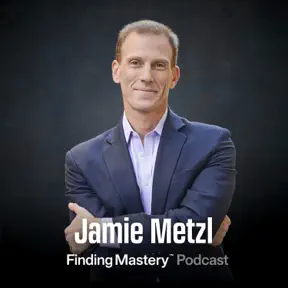
The Psychology of The 10 Commandments| Jamie Metzl
Finding Mastery with Dr. Michael Gervais
September 9, 2026
What moral code do we need when our tools can reshape intelligence and biology itself? Jamie Metzl is a technology and healthcare futurist and geopolitical expert, founder and chair of OneShared.World, and a Senior Fellow at the Atlantic Council. He has served on the U.S.
Speakers Jamie Metzl, Michael Gervais
TopicsSelf-ImprovementEducationHealth & FitnessMental Health
Jamie Metzl (0:00)
We have our Ten Commandments, and we should value them. But when you read them literally, it's like, well, don't covet your neighbor's ox or man servant or wife. It's like, well, I live in an apartment in New York City. My neighbor has a wife, doesn't have an ox or a man servant. Eight out of 10 are really hard to justify. How about it?
Michael Gervais (0:20)
You and Moses, dueling.
Are the Ten Commandments going to hold up in the age of AI? And are we brave enough to ask and explore and challenge this moral code?
Jamie Metzl (0:30)
I deeply, deeply value the Ten Commandments as I value the five pillars of Islam and the fivefold path and the eight noble truths. And every tradition has these core principles. But my question was, is there a way to see all of our traditions together?
Michael Gervais (0:47)
Welcome back or welcome to the Finding Mastery Podcast, where we dive into the minds of the world's greatest thinkers and doers. I'm your host, Dr. Michael Gervais. Today's guest is Dr. Jamie Metzl, technology and healthcare futurist, geopolitical expert, and one of the leading voices helping us understand the future of AI, genetics, biotechnology, medicine, and human values. Jamie has served in the US. National Security Council and is the author of Hacking Darwin, Superconvergence, and his latest book, The AI Ten Commandments, A New Moral Code for Humanity.
Jamie Metzl (1:21)
This is a story about ethics and values. And then the logical next question is, well, where do the ethics and values come from? And my answer was...
Michael Gervais (1:34)
With that, let's jump into this week's conversation with Dr. Jamie Metzl.
Jamie, it's been a while since we last saw each other. And this is the first time we've had a conversation in person. So welcome back to Finding Mastery.
Jamie Metzl (1:52)
Well, thanks. I'm really thrilled about it. We've had such nice conversations virtually, but there's something nice about being with somebody physically. I feel like you don't have these long conversations every day in your life with every person. So I already had felt like we had this connection, but humans are physical beings. So it's nice to meet.
Michael Gervais (2:13)
And it's perfectly or eloquently timed because of what you're writing about, you know, AI and the future of AI. And so before we get into kind of the guts of what you've come to understand, let's just kind of get a big picture first. You capture your profession as a futurist.
First and foremost, very cool. What does it mean?
Jamie Metzl (2:34)
Well, future, it's kind of this funny title. Like if somebody is a dentist, you go to their office and say, oh, you're a dentist and they have like a little degree on the wall. If somebody is a futurist. I mean, I was the opening keynote speaker at the Dubai Future Forum, which was the largest gathering of futurists in history held in Dubai. So I guess I must be a futurist, but I have no clue what a futurist actually is. So I've been speaking and writing for many, many decades and I didn't used to call myself a futurist, but I'd be speaking about the future and then somebody would speak after me and they would say that they'd say, oh, here's a futurist. I'd say, oh, what's a futurist? And nobody could answer the question. And then one day I used to say, well, I must be a futurist because so as a futurist, whatever that means, what I try to do is look at the world around me and around us and say, well, if this is true now, where is it going? And what does it mean? And what will it mean for technology? But more importantly, what will it mean for us as humans? And I try to be as methodological as possible and analytical as possible, but it's impossible to be perfect. And so it's, I write, as you know, fiction and nonfiction. And the reason I do that is because thinking about the future, it can't just be nonfiction. We are telling a story about what the future might look like. And in a way, it's not dissimilar from the work that you do with these athletes. And you're saying, well, here's where you are now.
Tell a story of where you would like to be and tell that story to yourself, and can you occupy that story? And so for me, as a quote unquote futurist, it's not just about saying, here's what the future might look like. It's to say and talk with other people about, here's what the future could look like. And if we want to occupy that future, what are the things that we're going to have to do now, not so we can perfectly predict that future, so that we can be ready for what's coming and prepared and as thoughtful as possible about how to build the kind of world we'd like to inhabit.
72 more minutes of transcript below
Thousands of transcripts fetched by people building searchable podcast archives
Fetch the whole transcript
The demo key returns a sample episode in full, no card needed:
curl -H "x-api-key: pt_demo" \
  https://spoken.md/transcripts/1000651996090
Markdown with the speakers named, for your notes, your knowledge base, or anything that makes HTTP calls.
From $0.10 per transcript. No subscription. Credits never expire. Prices exclude VAT, added at checkout for EU customers. Not what you expected? Email us within 14 days with 20 or fewer credits used and we refund the pack in full.
Using your own key:
curl -H "x-api-key: YOUR_KEY" \
  https://spoken.md/transcripts/1000788615355