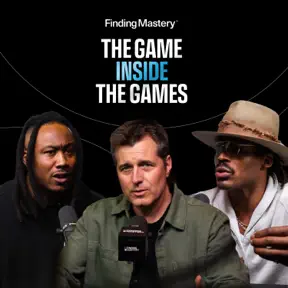
The Loudest Voice in the Stadium: Cam Newton on Self‑Talk
Finding Mastery with Dr. Michael Gervais
February 6, 2026
The noise at the Super Bowl can be overwhelming—tens of thousands of voices colliding into a single roar. But the loudest voice a player hears isn’t coming from the stands. It’s the one inside their own head.
Speakers Michael Gervais, Brandon Marshall, Cam Newton
TopicsSelf-ImprovementEducationHealth & FitnessMental Health
Michael Gervais (0:02)
The Super Bowl becomes everything. There is so much noise.
SPEAKER_2 (0:07)
You have three hours to tell everybody what you know about this game.
Michael Gervais (0:12)
The game is everywhere.
Welcome to The Game Inside the Games. I'm Dr. Michael Gervais, by trade and training a high-performance psychologist. In Seattle, the 12th man is the crowd. It's the noise, the energy, the intensity that roars from the seats. But in the Super Bowl, there's another force at work, another voice that can be louder than the crowd. It's not in the stands, it lives inside the athlete. It is what you say to yourself when everything is on the line, self-talk. One screams from the stadium, and the other is this little whisper inside your head. So in this episode, Brandon Marshall and I, we explore why self-talk can decide football's biggest moment, and why the athletes who master it are the ones who rise when the lights are brightest. Okay, self-talk. When you hear self-talk, you're one of the premier athletes in the league for 13 seasons. When you hear the idea of self-talk, where do you naturally go?
Brandon Marshall (1:20)
You know what? I think that's one of the most powerful things that we can lean into from a performance standpoint. When I say performance, I'm not just talking about sports. I'm talking about life. But you can go deeper. The most important part of it is the actual feeling of it. Yeah. Okay. To me, that changes the game when you're sitting there and I'm talking to myself and I'm like, it's I'm going to be in this moment. It's going to be the fourth quarter. Game is on the line. Brandon Marshall catch the ball.
Michael Gervais (1:51)
Do you speak to yourself?
Brandon Marshall (1:51)
Brandon Marshall scores the touch. Absolutely. I'm talking like that.
Michael Gervais (1:54)
But you speak to yourself in third person?
Brandon Marshall (1:56)
Yeah. Well, it's not me. It's the announcer.
Michael Gervais (1:59)
That's okay. That's great. Let's open that up because the research is really clear that if you're going to talk to yourself, to back yourself, to build yourself, to really find that credibility, that the research is that we are better served when we talk to ourselves in third person.
Brandon Marshall (2:15)
Yeah. And let me because I was about to go to level four or five of this mastery thing. Right. First thing of self-talk is that. Right. Kyrie Irvin last year, he tears his ACL and at the free throw line finishing it off, he's sitting there talking to himself and you can read his lips. Cristiano Ronaldo is about to do a PK and you see him says, you're the greatest player, greatest player in the entire world. That's self-talk. Right. That is so important.
Michael Gervais (2:43)
He's like totally locked in and you see his, you see everything where he's building and backing himself about being great in this moment.
Brandon Marshall (2:49)
That's right. Words of affirmation. I'm this, I'm that. Like you have to speak life over yourself. It's that powerful. And then you go into where I was just at, maybe that's level 1B or maybe it's level 2 and I'm in the moment. I'm in the moment and it's not just me talking to myself. I hear the crowd, I hear the coach, I hear my quarterback, right?
I hear it all. They're talking to me, I'm talking to them, right? And then the next level to that is the feeling of that. Like I can feel the hairs on my neck standing up, I can feel the breeze go by, I feel the pig skin when the ball jumps into my gloves, right? I feel that. I feel the feeling of scoring that touchdown in that moment, overcoming that high pressure situation. And to me, that is the final part of this whole thing is the feeling of it. Do you actually feel it? What you're saying, do you feel it?
Michael Gervais (3:45)
So that what you're pointing to is exactly where we want to help people get to is that idea. So when you say something to yourself, if it's not real, if it's not credible, if it's not honest, if you haven't earned the right to say it, you start to get like kind of light with it.
Brandon Marshall (4:00)
That's right.
Michael Gervais (4:00)
But when you know that you've earned the right to say, I'm a finisher, I'm a whatever fill in the blanks that worked for you.
Brandon Marshall (4:08)
That's right.
Michael Gervais (4:08)
Then you start to have that vibe and then everything starts to quiet down. So you can put all your attention at the task at hand. Who taught you how to speak to yourself?
23 more minutes of transcript below
Thousands of transcripts fetched by people building searchable podcast archives
Fetch the whole transcript
The demo key returns a sample episode in full, no card needed:
curl -H "x-api-key: pt_demo" \
  https://spoken.md/transcripts/1000651996090
Markdown with the speakers named, for your notes, your knowledge base, or anything that makes HTTP calls.
From $0.10 per transcript. No subscription. Credits never expire. Prices exclude VAT, added at checkout for EU customers. Not what you expected? Email us within 14 days with 20 or fewer credits used and we refund the pack in full.
Using your own key:
curl -H "x-api-key: YOUR_KEY" \
  https://spoken.md/transcripts/1000748465944