The Industry That Explains the World
Foreign Policy Live
September 9, 2026
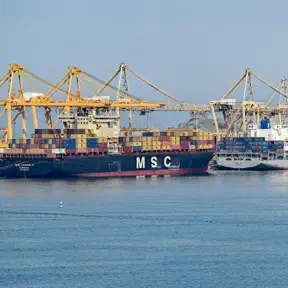
Behind every major decision, whether by a family buying a home or a shipping company deciding to transit the Strait of Hormuz, lies the judgment of the insurance markets. How do insurers evaluate risk, and what can we learn from how they attach a premium to conflict or natural disasters?
Speakers Ravi Agrawal, John Doyle
TopicsNews CommentaryNewsPolitics
SPEAKER_1 (0:00)
LinkedIn is pretty amazing at helping you grow your small business. We cannot stop your new clients from emailing you at 3 a.m. We can help you sell, market and hire in one place. We cannot help you be in three places at once.
And while we can't help you organize your calendar, LinkedIn can help you land more clients so you have a calendar to organize. Grow your small business on LinkedIn. Learn more at linkedin.com/smallbusiness.
Ravi Agrawal (0:31)
Hi, I'm Ravi Agrawal, Foreign Policy's Editor-in-Chief. This is FP Live.
You often hear on this show that the world is becoming a more risky place. Well, how do you measure risk? How do you price it? And once you do those things, how do companies and ordinary people get better prepared for a risky world? Well, this week, I will speak with a corporate leader who has spent decades at the top of the insurance industry. That is coming up, but first, a programming note. We have an Ask Me Anything episode coming up next Tuesday. We've gotten some great questions on China, on Iran, on Ukraine. Keep them coming on the site or by emailing live at foreignpolicy.com. I'll try and take as many as I can. And since we have that AMA in the works, I'm going to skip my usual read on a big story and instead tell you about our new print issue that just dropped. It is called How to Survive in a World Without Rules. And it is, if I may say so, a great cover and an even better package of essays. Personally, I'm tired of all the hand-wringing about how the liberal international order is over. The question is really what to do about it. Last week, I shared one proposal on this show by Charles Kupchan, which was about riding the wave of regionalization globally, while also creating a top-down brain trust inspired by the 19th century concert of Europe. That essay has now dropped online, and we will share a gift link in the show notes. Also in the issue, Hal Brands, with an actual survival guide for companies and countries, Mariano Mazzucato on how to rebuild the IMF, World Bank, and other institutions with what she calls the common good in mind, and Michael Beckley on how the countries that are cash rich but labor poor, need to strike a grand bargain with the ones that are cash poor but labor rich. All of that plus an essay by me on how Trump has peaked. I'm actually going to share my thoughts on that one in a bonus episode later this week.
Anyway, lots of gift links for you in the show notes today. Check them out and don't forget the AMA. But on to this week's conversation now. I have been increasingly curious about how geopolitics is making insurance premiums jump. As I learned from the interview you're about to hear, insurance for a route through the Strait of Hormuz, for example, used to cost about a quarter of a percentage point of the value of the goods being transported. At the height of the Iran War, it peaked at 15%.
That is as much as a 60x jump. And that's just the Strait of Hormuz. If you add in the Black Sea, which has been affected by the Ukraine War, and then you add in cyber attacks, climate change, natural disasters, you really have a recipe for heightened geopolitical risk and real costs to the economy.
Now, we often have policy makers and academics on this show. I thought it would be useful to try something different this week. John Doyle worked for many years at AIG, where he rose to become CEO of its commercial insurance division. He joined Marsh Risk in 2016, and is today the president and CEO of its parent company Marsh, which is not only the world's leading insurance broker, but also a major player in risk, people and investments. Let's dive in.
John, welcome to FP Live.
John Doyle (4:25)
Thanks Ravi. It's great to be with you.
Ravi Agrawal (4:27)
Pleasure's ours. So, I mentioned that Marsh is the world's biggest insurance broker.
Tell us what that means.
John Doyle (4:35)
Sure. Well, first of all, thanks for having me. But Marsh is more than an insurance broker. We're a global professional services firm, and we're advising clients on a range of issues, not just risk, but also how to find opportunity, particularly in complex moments like these.
But being the world's largest insurance broker means we're advising many businesses. We help them understand their risks. We help them develop a plan to mitigate or manage risk as best they possibly can. Then we help them risk finance some of the key risks. We finance the risks that they choose to go and move off of their balance sheet, if you will.
23 more minutes of transcript below
Thousands of transcripts fetched by people building searchable podcast archives
Feed this to your agent
Try it now — copy, paste, done:
curl -H "x-api-key: pt_demo" \
  https://spoken.md/transcripts/1000651996090
Works with Claude, ChatGPT, Cursor, and any agent that makes HTTP calls.
From $0.10 per transcript. No subscription. Credits never expire. Prices exclude VAT, added at checkout for EU customers. Not what you expected? Email us within 14 days with 20 or fewer credits used and we refund the pack in full.
Using your own key:
curl -H "x-api-key: YOUR_KEY" \
  https://spoken.md/transcripts/1000788725208