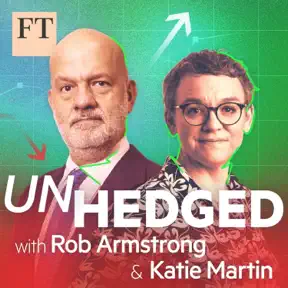
The Fed: will it be 25 or 50?
Unhedged
September 10, 2024
Will the US central bank lower interest rates by 25 or 50 basis points? Fed chair Jay Powell has hinted rates are coming down, but not by how much. Today on the show, Katie Martin and Rob Armstrong take sides and argue the case for the expected 25 basis point cut, and a larger 50 basis point cut.
Speakers Katie Martin, Rob Armstrong
TopicsInvestingBusinessNewsBusiness News
Katie Martin (0:09)
The Federal reserve meets to set US interest rates next week, and the pressure is building thanks to signs that the labour market is in a bit of a tough spot. So sure, you know, the economy is adding jobs, but at a much slower pace. Suddenly, team recession is in the ascendancy again. Now, they've been wrong before, and so help them. They'll be wrong again. But today on the show, we're going to talk about what the argument is that a recession really is looming this time, and ask, will the Fed do what it normally does and just cut interest rates by a little bit, or will it go large? This is Unhedged, the Markets and Finance podcast from the Financial times and Pushkin. I'm Katie Martin, a markets columnist here at the FT in London, and I've got a bit of a cold, so excuse any sniffles. I'm joined by that guy with the loud voice, Rob Armstrong, Senior Executive Vice president of the Unhedged Newsletter, and he's so loud that we can hear him all the way from New York City. How are you going, Rob?
Rob Armstrong (1:11)
I'm doing fine. I don't know what you're talking about about my voice though.
Katie Martin (1:19)
Well, that's all of our listeners shooed away.
Rob Armstrong (1:21)
If I wasn't tall and loud, I never would have succeeded.
Katie Martin (1:26)
You'd have no personality at all.
Rob Armstrong (1:29)
Those are my only defining characteristics. unless you count baldness.
Katie Martin (1:34)
That's a character trait. That's what my husband tells me. Oh dear. I hear the world is ending over there in the states. does it feel like it?
Rob Armstrong (1:45)
If it's ending, it's the whimpery kind of ending, not the explosion kind of ending.
Katie Martin (1:51)
Not the bang kind of ending.
Rob Armstrong (1:53)
The jobs report for August was actually better than the jobs report for July, but not better enough was the issue.
Katie Martin (2:07)
We need more good.
Rob Armstrong (2:08)
We need more better. So going back in time, everyone was terribly shocked by the July report. We've talked about this on this show. That was one of the starting guns.
Katie Martin (2:20)
So this is the non-farm payrolls report, right? The big mac daddy of the global data calendar.
Rob Armstrong (2:25)
Indeed. And you will remember last time when it hit in July, that was the starting gun for the quite severe, but ultimately totally pointless market panic. And that stocks went crazy. And then it was like it was as if nothing happened four days later.
Katie Martin (2:45)
Yeah.
Rob Armstrong (2:46)
Anyway, that number, that was 114,000 jobs added and an unemployment rate of 4.3. That was much worse than people expected. There was a great whaling and rending of garments.
Katie Martin (3:01)
And gnashing of teeth.
Rob Armstrong (3:03)
And there was extremely high hopes that what had happened is that July, there was like a hurricane in Texas, whether it generally was poor. Maybe it was all a statistical anomaly. It was the unemployment rate, that 4.3 that got people particularly worried. Although the jobs created number wasn't great. these two pieces of data, by the way, come from different surveys. So they're kind of independently.
Katie Martin (3:30)
Just to be annoying.
Rob Armstrong (3:31)
Just to be annoying.
Katie Martin (3:31)
So the latest number that we got on Friday.
Rob Armstrong (3:34)
yes. 4.2. Better. But unfortunately, those of us who are so hopelessly nerdy that we look at multiple decimal places, will have noticed that the difference between 4.3 and 4.2 was like the change actually wasn't as big as the change in the single decimal point number would have suggested. So that wasn't very good.
And horribly, the bad July number was revised down again. So it had been 114,000 jobs created. That was revised down to 89 So July got worse. Even as August got better, it was 140,000 jobs or something like that.
Katie Martin (4:19)
Now the thing is like there's a lot of numbers there, but really you don't need to pay too much attention to any of them in the sense that like the headline payrolls number is a sufficiently random walk. Like, you know, it's incredibly difficult to be precise about this.
Rob Armstrong (4:36)
It is difficult and you have to look. One month doesn't tell you a lot and you have to look at a kind of multi-month series.
And when you look at that multi-month series, what you see is slowing. The direction of travel in the labor market is not under debate here. It is cooling. The unemployment rate is rising and the job creation rate is falling.
13 more minutes of transcript below
Thousands of transcripts fetched by people building searchable podcast archives
Fetch the whole transcript
The demo key returns a sample episode in full, no card needed:
curl -H "x-api-key: pt_demo" \
  https://spoken.md/transcripts/1000651996090
Markdown with the speakers named, for your notes, your knowledge base, or anything that makes HTTP calls.
From $0.10 per transcript. No subscription. Credits never expire. Prices exclude VAT, added at checkout for EU customers. Not what you expected? Email us within 14 days with 20 or fewer credits used and we refund the pack in full.
Using your own key:
curl -H "x-api-key: YOUR_KEY" \
  https://spoken.md/transcripts/1000669071114