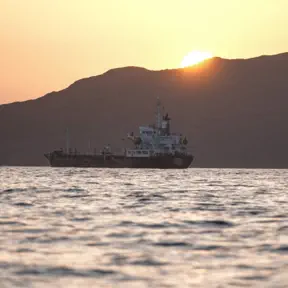
Strait talk: Why the oil crisis is getting worse
The Indicator from Planet Money
September 17, 2026
A vital artery for Saudi oil exports is under siege and it’s not the Strait of Hormuz. Today on the show, we explain what’s going on in the Bab el-Mandeb shipping lane connected to the Red Sea, why it’s important, and why the global oil crisis is poised to get even worse.
Speakers Rachel Ziemba, Patty Hirsch, Ricky Mulvey
TopicsBusiness
Rachel Ziemba (0:01)
N-P-R.
Patty Hirsch (0:08)
Welcome to Strait Talk, where we break down what's happening in the world's most important trade choke points and strategic seaways.
Ricky Mulvey (0:16)
Strait Talk, so serious, Patty.
Patty Hirsch (0:18)
This is serious business, Ricky.
Ricky Mulvey (0:19)
No argument here, so let's get into it. By now, after more than six months of war with Iran, you probably know all about the Strait of Hormuz. It's the vitally important gateway to the Persian Gulf.
Patty Hirsch (0:31)
Today, we're going to introduce you to another strait, about 1300 miles away, called the Strait of Bab el-Mendeb.
Rachel Ziemba (0:37)
The Bab el-Mendeb is a narrowing of land with some islands in the middle that basically controls the southern access of the Red Sea.
Patty Hirsch (0:50)
That was economist Rachel Ziemba. This is The Indicator from Planet Money. I'm Patty Hirsch.
Ricky Mulvey (0:56)
And I'm Ricky Mulvey. On today's show, the Bab el-Mendeb Strait. What it is, why it's in the news, and how it might change the game in the war with Iran.
Patty Hirsch (1:05)
It's Strait Talk from The Indicator, coming up after the break. The Red Sea is that long, narrow waterway that stretches between northeast Africa and the southwest of the Arabian Peninsula.
Ricky Mulvey (1:19)
It's a seriously important stretch of seaway. In normal, unturbulent times, almost 15% of the global seaborne trade passes through the Red Sea. That includes 30% of the world's container traffic, 12% of the world's oil traded by sea, and 8% of the world's liquefied natural gas.
Patty Hirsch (1:37)
At the top end of the Red Sea, you've got Egypt and the Suez Canal, which leads to the Mediterranean. And at the bottom end, there's a narrow stretch of water that leads to the Indian Ocean and the Asian trade routes.
That stretch of water is the Strait of Bab al-Mendeb.
Rachel Ziemba (1:52)
Until recently, the Yemeni government had been controlling some of that area.
Patty Hirsch (1:59)
Rachel Ziemba covers global political and economic risk at the Center for a New American Security.
Rachel Ziemba (2:05)
Now we have a circumstance where the Houthis, whom the government's been battling for a long time, seem to have seized that land.
Ricky Mulvey (2:13)
Seem to have? I need straight talk, Rachel.
Patty Hirsch (2:16)
Sounds like spin to me.
Ricky Mulvey (2:18)
The no spin zone.
Patty Hirsch (2:19)
It's a straight no spin.
Ricky Mulvey (2:20)
The Houthis, they are a rebel group that's been slowly taking over control of large parts of the country of Yemen since at least 2014
They're allied with Iran. Some call them a proxy. And they're fiercely opposed to Israel's existence in the way Israel is conducting the war in Gaza.
Patty Hirsch (2:37)
In November 2023, the Houthis began targeting Red Sea shipping as a way to put pressure on Israel. They hijacked some ships and attacked others with drones and missiles.
Ricky Mulvey (2:47)
US forces punished them for this with a bombing campaign, and things seemed relatively quiet in the Red Sea for a while. But at the end of last week, the Houthis made their move, possibly in support of Iran, and seized control of a swath of Yemen's Red Sea coast.
Patty Hirsch (3:03)
That includes an island right in the middle of the Bab el-Mandeb Strait, Barim Island, what the military calls key terrain, because it dominates the strait, which is only about 18 miles wide at its narrowest point.
Rachel Ziemba (3:15)
Whoever controls that choke point can have say over which vessels can pass through.
Ricky Mulvey (3:22)
Red Sea traffic has already slowed down thanks to those Houthi attacks on shipping prior to the war with Iran. Initially, it dropped by 50% and it has never fully recovered. Now, the capture of Barim Island threatens to stop that traffic altogether.
Patty Hirsch (3:36)
Rachel says, this is a particular problem for Saudi Arabia. The Saudis have been using the Red Sea and the Bab el-Mandeb Strait as an alternative oil shipping route after Iran closed the Strait of Hormuz more than six months ago.
Last week, the Saudis' pipeline to the Red Sea was attacked by drones. Then this week, the Saudis suspended oil shipments from a Red Sea port.
Rachel Ziemba (3:57)
They had been using their East-West pipeline to get fuel to market even as the Strait of Hormuz was disrupted. This puts more pressure on what had been a lifeline for the Saudis and indeed for the global economy of getting fuel out through another channel.
Ricky Mulvey (4:17)
The Houthis could close the Bab el-Mendib Strait at any time. So far, they haven't. But Rachel says just the fact that they can close it is having an effect.
4 more minutes of transcript below
Thousands of transcripts fetched by people building searchable podcast archives
Fetch the whole transcript
The demo key returns a sample episode in full, no card needed:
curl -H "x-api-key: pt_demo" \
  https://spoken.md/transcripts/1000651996090
Markdown with the speakers named, for your notes, your knowledge base, or anything that makes HTTP calls.
From $0.10 per transcript. No subscription. Credits never expire. Prices exclude VAT, added at checkout for EU customers. Not what you expected? Email us within 14 days with 20 or fewer credits used and we refund the pack in full.
Using your own key:
curl -H "x-api-key: YOUR_KEY" \
  https://spoken.md/transcripts/1000790202874