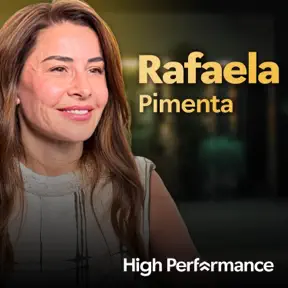
Rafaela Pimenta: The Super Agent Negotiating Deals for Haaland, Foden & Mora (E428)
The High Performance Podcast
July 27, 2026
Rafaela Pimenta is one of football's most influential agents, representing some of the biggest names in the game, including Erling Haaland, Phil Foden and Gilberto Mora. She joins Damian to reveal what it really takes to protect, develop, and lead elite athletes at the very highest level.
Speakers Damian, Rafaela Pimenta
TopicsSportsHealth & Fitness
Damian (0:03)
This week on High Performance, we welcome super agent Rafaela Pimenta, a lawyer by training, a deal maker by trade, Forbes listed, fiercely selected, and representing stars including Erling Haaland, Phil Foden, and Gilberto Mora.
Damian (0:22)
So Rafaela, you're on the Forbes list, you represent the biggest names in world football, you're behind some of the most important deals in sport, and yet still people are surprised when you walk into a room. Tell us why.
Rafaela Pimenta (0:36)
Very probably because they want to downplay the fact that a woman is doing the job.
I don't believe anybody can be genuinely surprised at this point, but I think whoever plays this game is really to try to unbalance me the moment I get there, because they know that this could be an issue for a woman, that they make you feel like you're the odd one out, in what some people still want to be, the Rovinces that should be perceived as a man's universe. So I do think by now that it's a theater, although I don't doubt this would be true for other women, not because I'm better than they are, but because everybody knows me at this point. Why should they be surprised? They shouldn't. But I don't doubt that when somebody that is coming to this universe as a woman would be treated as, oh, I'm so surprised you're a woman. No, you just want to undermine her and make her feel bad. That's what I think.
Damian (1:44)
I love that idea of it being a theater. So how do you define your role in it then?
Rafaela Pimenta (1:49)
Yeah, I think so. And we all, I think it's, we all play a theater at one point or another in this job, especially in negotiation rooms. Sometimes you realize we're doing this as a theater. Sometimes some people are just dumb and believe what they're doing.
But there is a bit of a theater in the sense that, you know, at the end of the day, we should all know these are negotiations. And if we are professional enough, this shouldn't be taken personally. And that's what I think sometimes needs to be developed in football. That is, this is not personal.
This is a job where you represent somebody, where somebody gives you a mission. And the mission may be, I want to stay, I want to go, I've had enough, I need better conditions. Whatever that is, it's a mission somebody gave you. And it's your job to represent that mission. And sometimes in that mission, towards the same club, this can be the best club ever, or the worst club ever, depending who you're representing. Because some clubs are good for a player and bad for another. And if we understand that you're fulfilling a mission, it is not how you feel about the club, but how your client is feeling about the club. And that's the shirt you have to wear when you sit on that table. I don't think a club should expect from you always the same perception about the job they do. They should expect always the same behaviour. You should be professional, you should be coherent, you should be serious. But sometimes you will be serious in criticising them. Sometimes you will be serious in acknowledging they are great. Because for one they're great and for another they suck.
Yeah.
Damian (3:32)
So when you go into a situation like that, I imagine that it is personal, because you have relationships that will explore with players, but then you talk about this isn't personal. How do you sort of step into that place of being able to uncouple emotions, to be able to focus on the mission?
Rafaela Pimenta (3:49)
Well, what I think I mean when I say it's not personal, it means that what I feel is irrelevant.
It is absolutely irrelevant if I like you or if I like the club. It is relevant what the player feels about the club. And that's what a few clubs or directors still fail to understand.
That when I say this player needs to leave, it's not because I don't like you, it's because he's not okay there.
And I've seen, I've had an episode two, three years ago where a player should go to a specific club. And that was a good deal in place. And the director said to me, and I'm not kidding, he said to me, I will never let him go there. And why not? I don't like that guy, the director of the other club. I had a fight with him, I don't know when, 300 years ago. That's not my problem, that's not the problem of your club, that's not the problem of the other club. If you had a fight with him, go hate him in your private life, and I don't know, have a coffee with him and sort it out to whatever you want.
59 more minutes of transcript below
Thousands of transcripts fetched by people building searchable podcast archives
Fetch the whole transcript
The demo key returns a sample episode in full, no card needed:
curl -H "x-api-key: pt_demo" \
  https://spoken.md/transcripts/1000651996090
Markdown with the speakers named, for your notes, your knowledge base, or anything that makes HTTP calls.
From $0.10 per transcript. No subscription. Credits never expire. Prices exclude VAT, added at checkout for EU customers. Not what you expected? Email us within 14 days with 20 or fewer credits used and we refund the pack in full.
Using your own key:
curl -H "x-api-key: YOUR_KEY" \
  https://spoken.md/transcripts/1000778470074