Nvidia's crazy day
Unhedged
November 20, 2025
In the morning, Nvidia’s earnings report seemed to have cured the market of its jitters about an artificial intelligence bubble. And then it didn’t. Today on the show, Katie Martin and Rob Armstrong try to figure out if the chipmaker’s numbers are soothing or scary.
Speakers Rob Armstrong, Katie Martin
TopicsInvestingBusinessNewsBusiness News
Rob Armstrong (0:06)
Pushkin.
Katie Martin (0:09)
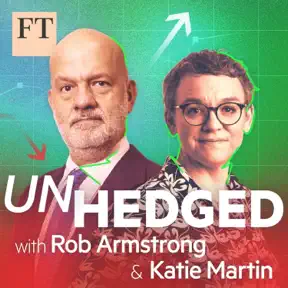
We've had quite the vibe shift in markets over the past few weeks, from la la la, everything is awesome, to this is nuts, when's the crash? Riding to the rescue is chips mega monster, Nvidia, which put out yet another set of Cracker Jack earnings earlier this week. Today on the show, we're asking, has Nvidia just saved us from a massive market crash? This is Unhedged, the Markets and Finance podcast from the Financial Times. I'm Pushkin. I'm Katie Martin, a markets columnist at FTHQ in an increasingly wintery London, and I'm joined down the line from New York City by the big man, Rob Armstrong, off of the Unhedged newsletter. Rob, listeners can now see our little faces in the podcast box, can't they?
Rob Armstrong (0:57)
There's been an alarming, if predictable number of correspondents have written to say, I expected Rob to be much better looking. And I've replied to all of them, so did I.
Katie Martin (1:21)
Yeah, my friend Al texted me at the weekend saying that he was under the impression that you look like John Hamm.
Rob Armstrong (1:31)
That's what I thought too. And still I saw that photograph. Whose chin is that?
Katie Martin (1:37)
God. The voice of George Clooney, ladies and gentlemen, the face of Rob Armstrong.
Now, let's get down to business, right? So markets have been looking pretty wobbly. Everyone's been getting pretty nervous. Bitcoin down 28% from the peak, all that stuff. And then boom, along comes Nvidia, world's biggest, most gigantic, most ginormous chips company in the States. And it put out incredible earnings. Like, it's just making insane amounts of money. And that has kind of lifted the mood again. It's made everyone think, oh, maybe the AI trade is still on. Let's just carry on as we were. Rob, what do you reckon to that? Has Nvidia just like soothed all the ill of the world here?
Rob Armstrong (2:25)
It just ain't that simple. This is actually quite a complicated situation. There is something a bit paradoxical going on here, Katie, which is like, Nvidia comes out with once again, incredibly strong numbers. Their revenues grow 60% or whatever it was, and it's $500 billion in revenue a quarter, and they can't make their products fast enough, and et cetera, et cetera. And everyone says, see, all that bubble talk was crazy.
Katie Martin (2:54)
Exactly, exactly. And that was pretty much exactly what Chief Executive Jensen Wang said to analysts.
Rob Armstrong (3:02)
He said, people are talking AI bubble. I don't know what they're talking about. I'm selling tons of this stuff.
Katie Martin (3:07)
Yeah, I'm worth a trillion dollars. It's like, yeah, are you helping here, Jensen? Or no, I'm not sure.
Rob Armstrong (3:16)
I mean, people always, I think, misspeak when they say things like, Nvidia is overvalued. The worry is not Nvidia's price to earnings ratio or anything like that. The worry is that the revenue that it's earning and the growth rate of that revenue is ultimately unsustainable. At the current growth rate and level of revenue, Nvidia's valuation makes perfect sense, right? The question is whether the revenues are going to keep going like this. So the headlines should have read this morning, there still might be an AI bubble, but it's not popped yet, right? Something like that.
Katie Martin (3:52)
Well, like you, I spend a disproportionate amount of my life speaking to fund managers, people who manage other people's money for a living. They all say something along the lines of, look, if it walks like a duck, it quacks like a duck, you know, this thing is a bubble. Like everyone can see there's bubbly stuff going on here. There's like huge amounts of money all chasing this one thing. And there's some like crazy projects that are getting signed off. And there are just overly large numbers kicking around. And everyone can see that there's froth and exuberance here. But, and I think we may have spoken about this on the show before, you don't want to be early.
You don't want to say, okay, I'm getting out of these names, or I'm going to short them. Because the pain, when you have that final, you know, push higher in these stocks, which could be another 10, 20 percent. I mean, hey, I'm guessing.
Rob Armstrong (4:43)
Could be 50 percent, right?
Katie Martin (4:45)
Yeah.
Rob Armstrong (4:45)
No problem. Could be 50 percent, right?
Katie Martin (4:48)
So you just don't want to be that person who's not in it.
Rob Armstrong (4:51)
Yeah. Because if you are, you're just fired. It's as simple as that. That's what happens. You're fired.
16 more minutes of transcript below
Thousands of transcripts fetched by people building searchable podcast archives
Fetch the whole transcript
The demo key returns a sample episode in full, no card needed:
curl -H "x-api-key: pt_demo" \
  https://spoken.md/transcripts/1000651996090
Markdown with the speakers named, for your notes, your knowledge base, or anything that makes HTTP calls.
From $0.10 per transcript. No subscription. Credits never expire. Prices exclude VAT, added at checkout for EU customers. Not what you expected? Email us within 14 days with 20 or fewer credits used and we refund the pack in full.
Using your own key:
curl -H "x-api-key: YOUR_KEY" \
  https://spoken.md/transcripts/1000737681786