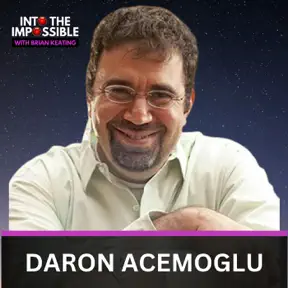
Nobel Economist Daron Acemoglu WARNING: AI's Payoff Is NOT What You Think
Into the Impossible With Brian Keating
October 5, 2026
Nobel laureate Daron Acemoglu says AI's real productivity gain is an order of magnitude smaller than the industry claims. The bigger danger is not the machine. It is that a handful of people are deciding how it gets built.
Speakers Brian Keating, Daron Acemoglu, Ryan Reynolds
TopicsNatural SciencesSciencePhysics
SPEAKER_1 (0:00)
Chronic migraine is 15 or more headache days a month, each lasting four hours or more.
SPEAKER_2 (0:04)
Botox, on a botulinum toxin A, prevents headaches in adults with chronic migraine before they start. It's not for those with 14 or fewer headache days a month. It prevents on average eight to nine headache days a month versus six to seven for placebo.
SPEAKER_3 (0:17)
Prescription Botox is injected by your doctor. Effects of Botox may spread hours to weeks after injection causing serious symptoms. Alert your doctor right away as difficulty swallowing, speaking, breathing, eye problems or muscle weakness can be signs of a life-threatening condition. Patients with these conditions before injection are at highest risk. Side effects may include allergic reactions, neck and injection site pain, fatigue and headache. Allergic reactions can include rash, welts, asthma symptoms and dizziness. Don't receive Botox if there's a skin infection. Tell your doctor your medical history, muscle or nerve conditions including ALS Lou Gehrig's disease, myasthenia gravis or Lambert-Eaton syndrome and medications including botulinum toxins as these may increase the risk of serious side effects.
SPEAKER_1 (0:54)
Why wait? Ask your doctor, visit botoxchronicmigraine.com or call 1-800-44-BOTOXX to learn more.
Brian Keating (1:00)
Great, Daron. It's great to welcome you on. I will only try one phrase in Turkish that I know which is banditurkum.
Yeah, an old friend told me that at Brown University here. All his Turkish friends get together for lunch as you know the Turkish will, and they all thought I was Turkish, I guess, for some reason.
Daron Acemoglu (1:18)
So they taught you the sentence.
Brian Keating (1:20)
They taught me that sentence. Okay. Great. So this book has so much in it.
We need multiple podcasts to talk about it. I really loved it. I love the audio book, and I love your tweets. And I think we're going to start with just the most basic foundation. You teach at MIT, and you undoubtedly have a great facility with science, and science plays a huge role in this book. Is science possible without liberal democracies?
Daron Acemoglu (1:48)
Yes, a little bit, but I think liberal democracy provides a much better foundation for science, and also a much better platform for us to decide which scientific ideas are a better basis for further inquiry and better for applications. And it also enables them to spread in society in a healthier way. In particular, I think liberalism, at its best, celebrates inquiry, experimentation, and admits the fallibility of everything, including scientists, and established truths. So that's very important because science sometimes, often, faces resistance from authorities.
So you have to take those authorities with a grain of salt. Sometimes science faces resistance from previous scientific advances. And again, the fallibility, the recognition that we are continuously learning and adjusting to our environment is a great basis for making further scientific advances.
Brian Keating (3:09)
Well, of course, you qualify that by stating that it's not maybe a sufficient condition because the counter example is, of course, China. And your recent fellow Nobel Prize winner, Omari Agdi, of UC Berkeley, he actually left the UC system to go to China. Is that a mistake or is that driven by economic considerations or political?
I know you can't get into his mind, but what do you think would cause someone to leave a liberal democracy to go to an illiberal autocracy?
Daron Acemoglu (3:39)
Well, I think I would not be comfortable in China because of constant surveillance and restrictions on what you can say, including in universities where these are actually quite severe. In Hong Kong, they have become even more severe.
But if I was working, say, on RNA, and suddenly my funding was cut here, I could see how it would be attractive to go to China when much better conditions are being promised. Promise is the important word. I'm not sure when all of that will be delivered, but they're being promised. The other thing that's very important is, I've always been very critical of the Chinese regime, and I still think that their growth trajectory, so impressive, has many problems. But right now, they are really investing in AI, robotics, manufacturing technologies, and they have built a tremendous engineering workforce that is so important for further progress in many of these fields. So China is not staying idle. It's not just copying the United States.
Brian Keating (4:59)
I study for a lot of the research I do in astronomy. I try to follow in the footsteps of my great mentor, Galileo Galilei. He's a finger puppet of him. Now, he worked in an extremely illiberal autocracy. Also, the Catholic Church was every bit as totalitarian as any of their worst fears, and yet science flourished in the Renaissance. In fact, he had many permissions that were granted by these illiberal forces. As long as he didn't teach it, he could study it.
26 more minutes of transcript below
Thousands of transcripts fetched by people building searchable podcast archives
Fetch the whole transcript
The demo key returns a sample episode in full, no card needed:
curl -H "x-api-key: pt_demo" \
  https://spoken.md/transcripts/1000651996090
Markdown with the speakers named, for your notes, your knowledge base, or anything that makes HTTP calls.
From $0.10 per transcript. No subscription. Credits never expire. Prices exclude VAT, added at checkout for EU customers. Not what you expected? Email us within 14 days with 20 or fewer credits used and we refund the pack in full.
Using your own key:
curl -H "x-api-key: YOUR_KEY" \
  https://spoken.md/transcripts/1000793303975