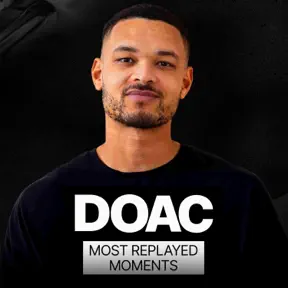
Most Replayed Moment: Is Milk Healthy? The Truth About Dairy, Sugar, Fruit And Fasting
The Diary Of A CEO with Steven Bartlett
June 12, 2026
Dr Mark Hyman is a physician and bestselling author specialising in food, longevity and metabolic health.
Speakers Steven Bartlett, Mark Hyman
TopicsBusinessSociety & Culture
Steven Bartlett (0:00)
For the last couple of years, I've been working on something that I realised every podcaster listening to this, but actually probably every creator listening to this might just need. Podcasting is difficult for many reasons. And one of them is that these hosting platforms don't give you much information. And also, because they're so fragmented, you kind of have to go through every single platform, uploading it to YouTube, and then taking the same big old video file and uploading it to Spotify's platform. It takes huge amounts of time, and that friction means most of us don't do it. That is the problem we set out to solve. And so we built something called Flightcast, which you can find at flightcast.com. And today, Flightcast is also one of our show sponsors, and some of the world's biggest podcasters are now using our platform to run their shows because it gives you an edge, it saves you time, it gives you analytics most people won't typically get, it allows you to use AI to be more informed on your show, and it has growth tools that other hosting platforms don't have, so podcasters that are using Flightcast have this unfair advantage. So go to flightcast.com/doac now.
I got told the other day, which helped me understand myself, I got told that when we're hungry, especially when it's sort of like late at night, the logical center of our brain, like the prefrontal cortex, is less active and the amygdala, the sort of emotional part of our brain that wants the dopamine is much more active. And it helped me to understand why maybe late at night, if I haven't planned my food, I'm much more susceptible to make a bad food choice that I then regret. I'm much more acceptable to lean in for sugar or something that's like super high in carbs or whatever. That really helped me. And this is why the planning thing makes a lot of sense, because I can use my prefrontal cortex, my logical center of my brain, to make the food choice in the morning, so that I don't find myself making a mistake.
Mark Hyman (1:45)
It's so important, Steven, because people have to understand that willpower is not the answer. You cannot use willpower to control your food behavior. It's part of your ancestral evolutionary, limbic, reptile, dinosaur brain.
And so when your blood sugar drops, you're going to eat whatever in front of you. If there's a vending machine, if there's a doughnut, if it's cookies, it doesn't matter. Even if you know better, and I've experienced this, you're just going to eat whatever, because it's a life-threatening emergency. Your body doesn't know that there's grocery stores and restaurants. It means you're going to go out and try to hunt and gather and do something. It's like an emergency. So when you have that food emergency and you don't have the right food on you, you're in trouble.
Steven Bartlett (2:28)
I have that all the time. I have this constant fight with myself where this one voice is like, do the fucking right thing, and then this other part of my brain is like, just today, break the rule. But obviously that voice is louder sometimes than others, and typically late at night, it's louder.
Mark Hyman (2:42)
Sleep deprivation, stress, sleep deprivation, all that increases your appetite, it increases cortisol, it increases ghrelin, which is a hunger hormone. I mean, you can take young, healthy college kids and sleep deprive them, and they're going to crave carbs, they're going to crave sugar, and they're going to gain weight.
It's not rocket science.
Steven Bartlett (3:05)
What about for someone that doesn't have any money at all, so they can't, they don't have the ability to, a lot of the privileges that me and you have, what are some of the very basics that they should be thinking about in order to remain healthy in a world where every convenience store is trying to sell you something cheap and sugary?
Mark Hyman (3:25)
Yeah, it's a really good question. I think the economics of being healthy is a problem, and we know that there's a huge disparity in health.
But it's not only economic, it's education. I met with a woman who was the doctor at a clinic in Bed-Stuyvesant, which is in Brooklyn, it's a very underserved area, and in a very low socioeconomic status group, very unhealthy, and she said, you know, Mark, did you know the number one predictor of health?
Is it money? No, it's education. So even people who were wealthy but haven't been educated still have issues. So for me, it was really about education, and so people can be educated to do the right thing, and it doesn't have to be expensive. I was part of this film 10 years ago called Fed Up, that looked at childhood obesity in our food system and the advent of sugar and marketing and processed foods, and we visit a lot of families, and I work with a family in South Carolina easily. It's one of the poorest areas in America, and it has the worst called the food deserts. So one of the worst food deserts in America, basically where there's not a lot of healthy options to choose from, and there's something called the Retail Food Environment Index. How many healthy grocery stores are there to fast food and convenience stores, and there was like 10 to 1, it was terrible.
19 more minutes of transcript below
Thousands of transcripts fetched by people building searchable podcast archives
Fetch the whole transcript
The demo key returns a sample episode in full, no card needed:
curl -H "x-api-key: pt_demo" \
  https://spoken.md/transcripts/1000651996090
Markdown with the speakers named, for your notes, your knowledge base, or anything that makes HTTP calls.
From $0.10 per transcript. No subscription. Credits never expire. Prices exclude VAT, added at checkout for EU customers. Not what you expected? Email us within 14 days with 20 or fewer credits used and we refund the pack in full.
Using your own key:
curl -H "x-api-key: YOUR_KEY" \
  https://spoken.md/transcripts/1000772315764