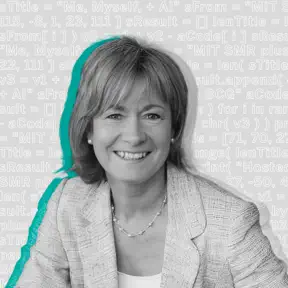
Leveling the Playing Field With AI: Special Olympics's Mary Davis
Me, Myself, and AI
December 3, 2024
Mary Davis, CEO of Special Olympics, wants the people she represents to “have a seat at the table” as AI evolves.
Speakers Shervin Khodabandeh, Sam Ransbotham, Mary Davis
TopicsTechnologyBusiness
Shervin Khodabandeh (0:00)
Stay tuned after today's episode to hear Sam and I break down the key points made by our guest.
Sam Ransbotham (0:07)
Artificial intelligence offers the promise of extreme personalization that may help all of us learn better. But we need to make sure that all of us really means all of us. On today's episode, find out how one organization is using AI tools to empower diverse student populations and the emotional benefits that that can bring to all of us.
Mary Davis (0:29)
I'm Mary Davis from Special Olympics, and you're listening to Me, Myself, and AI.
Sam Ransbotham (0:36)
Welcome to Me, Myself, and AI, a podcast on artificial intelligence and business. Each episode, we introduce you to someone innovating with AI. I'm Sam Ransbotham, Professor of Analytics at Boston College. I'm also the AI and Business Strategy guest editor at MIT Sloan Management Review.
Shervin Khodabandeh (0:55)
And I'm Shervin Khodabandeh, Senior Partner with BCG and one of the leaders of our AI business. Together, MIT SMR and BCG have been researching and publishing on AI since 2017, interviewing hundreds of practitioners and surveying thousands of companies on what it takes to build and to deploy and scale AI capabilities and really transform the way organizations operate.
Sam Ransbotham (1:22)
Hey everyone, thanks for joining us. Today, Shervin and I are talking with Mary Davis. She's the CEO of the Special Olympics. Thanks for being here today, Mary.
Mary Davis (1:31)
Great time. I'm delighted to be here.
Sam Ransbotham (1:34)
What we found interesting about your work is not just the mission of Special Olympics, which maybe we're all a little bit familiar with, but also the work you're doing in schools. But before we get into that, let's get some background. First, explain what Special Olympics is, what the organization's mission is, and how that ties to education.
Mary Davis (1:55)
We're a global sports movement. We're a large organization existing around the world. We're in 200 countries altogether. We have over 4 million athletes involved in our program, over a million volunteers. We offer 30 Olympic-type sports. We have nearly 60,000 games and competition events every year. So, you can imagine how much of a grassroots program we are. And of course, we have the big events. We've world games that happen alternatively every two years, both summer games and winter games similar to the Olympics. But really, what differentiates us is the grassroots nature of our program and the programs that we offer in terms of not just sport, but education. And really, we're here to end discrimination of people with intellectual disability. And we do that through using the power of sport and programming in other areas like education, that you mentioned, health and leadership. And we use that to foster acceptance of all people. So, basically, what we do is create an environment whereby our athletes, through our sports training and competition events, can be the very best that they can be and that they can excel. But the other thing we do is create an environment whereby the rest of the population. So if we say there are 3%, which there are people with intellectual disability in the world, then how do we work with the other 97% so that we can live in a world where people with intellectual disability are valued, are accepted, are respected for the skills and talents and abilities that they have and that they bring to society and that benefit society hugely? We're in schools and we have, again, through the power of sport, an amazing Unified Champion Schools program. So it's like an inclusive education program for children and students with them without intellectual disability, so that students without intellectual disability can benefit from those talents and skills that our athletes show. The other thing that we know is that it works across all cultures, all geographies.
So our programming is the same, whether it's in the US., in China, in India, in Kenya, or in Greece. And it benefits the students in exactly the same way.
Sam Ransbotham (4:39)
Well, our show, of course, is Me, Myself, and AI. So we're particularly interested in how that might intersect with artificial intelligence. Those are wonderful objectives, and I see the appeal of them. But what I didn't see was a connection between what you're doing and artificial intelligence, but I know there's a connection. Fill us in.
Mary Davis (5:00)
Yeah, absolutely, there's a connection. Well, AI is coming down the tracks for all of us, no matter whether we like it or not. What we really want to ensure, as it does progress, and there are more and more platforms and policies and programs in AI, is to ensure that people with intellectual disability are included, that we have a seat at the table when it comes to AI. Is anybody considering the needs or the perspectives of people with intellectual disability? Oftentimes, what we find is attention in these areas are given to physical disability, which is critically important, of course, that it is and it should be. But our intellectual friends are forgotten, are not counted, because they're not seen, they're not as visible as, say, people with other disabilities. So we sort of went searching to see, was anybody considering the inclusion and the perspectives of people with intellectual disability? And to be honest, we didn't find very much information in that regard. So we took upon it ourselves then when we couldn't identify anything, we decided to do some research ourselves. And we found that very useful in terms of our whole community. For example, we found that our athletes were incredibly excited by the opportunity to be involved in discussions around AI. Our community of parents and teachers recognize the enormous potential that AI can play and how it can help a young person with intellectual disability. And a significant majority of parents, in fact 84% and teachers believe that it's important for young people with intellectual disability to develop AI skills for their future development.
21 more minutes of transcript below
Thousands of transcripts fetched by people building searchable podcast archives
Fetch the whole transcript
The demo key returns a sample episode in full, no card needed:
curl -H "x-api-key: pt_demo" \
  https://spoken.md/transcripts/1000651996090
Markdown with the speakers named, for your notes, your knowledge base, or anything that makes HTTP calls.
From $0.10 per transcript. No subscription. Credits never expire. Prices exclude VAT, added at checkout for EU customers. Not what you expected? Email us within 14 days with 20 or fewer credits used and we refund the pack in full.
Using your own key:
curl -H "x-api-key: YOUR_KEY" \
  https://spoken.md/transcripts/1000679018548