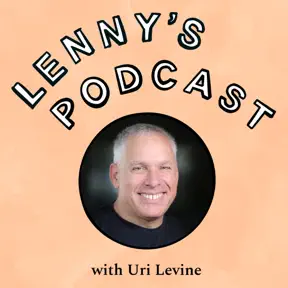
Lessons from a two-time unicorn builder, 50-time startup advisor, and 20-time company board member | Uri Levine (co-founder of Waze)
Lenny's Podcast: Product | Career | Growth
June 9, 2024
Uri Levine is the co-founder of Waze, the world’s largest community-based traffic and navigation app, acquired by Google for over $1 billion. He’s also founded nine other companies, been on the board of 20 companies, and advised more than 50 companies.
Speakers Lenny Rachitsky, Uri Levine
TopicsTechnologyBusinessEntrepreneurship
Lenny Rachitsky (0:00)
You've co-founded 10 different companies. You've been on the board of 20 You've also built two unicorns, including Waze. The biggest startup lesson you seem to have taken out of that is to Fall in love, fall in love, fall in love, fall in love with the problem.
Uri Levine (0:12)
And then actually what you're trying to do is engage everyone else to fall in love with the same problem, to go into this journey, into this path and follow your leadership there.
Lenny Rachitsky (0:20)
Anything you wanted to share around the hiring and firing?
Uri Levine (0:23)
Every time that you hire someone new, mark your calendars for 30 days down the road and ask yourself one question. Knowing what I know today, would I hire this person? If the answer is no, fire them immediately.
Lenny Rachitsky (0:36)
Let's actually talk about fundraising.
Uri Levine (0:37)
Most people are missing the most important slide of their presentation, is the first slide. This slide is going to be presented for the longest period of time. This is the place that you're going to put your strongest point. The second most important slide is the last one.
Lenny Rachitsky (0:55)
Today my guest is Uri Levine. Uri is the co-founder of Waze and nine other companies. He sold two companies for over a billion dollars. He's also been on 20 different startup boards, including a dozen he's still currently on. He's also advised over 50 founders and startups over his career. More recently, he wrote a book that summarizes all of his advice for founders called Fall in Love with the Problem, Not the Solution, a Handbook for Entrepreneurs.
In the foreword to the book, Steve Wozniak said, This book will change your life and become your Bible if you are an entrepreneur. And I cannot disagree with that. This book is very tactical with amazing stories and walks you through the ideation phase all the way to exiting your company.
In my conversation with Uri, we chat about many of my favorite chapters, including why falling in love with the problem is so important, how to find product market fit, a really clever tactic for firing people who aren't a fit for your company, a ton of really genius tactical advice for improving your fundraising pitch, and so much more. With that, I bring you Uri Levine. And if you enjoy this podcast, don't forget to subscribe and follow it in your favorite podcasting app or YouTube. It's the best way to avoid missing future episodes and it helps the podcast tremendously.
Uri, thank you so much for being here. Welcome to the podcast.
Uri Levine (2:17)
Thank you. Happy to be here.
Lenny Rachitsky (2:18)
Okay. So here's what I've gathered about your career. And let me know if I've missed anything. You've co-founded 10 different companies, including 4 you're still operating.
You've been on the board of 20 companies.
You've advised 50, maybe more companies. You've also built two unicorns, including Waze, which you sold for over a billion dollars, which back then was an astronomical amount of money, it still is. So does that all sound right? Is there anything big I missed about your career?
Uri Levine (2:48)
That sounds about right.
Lenny Rachitsky (2:49)
I think what's really interesting to me is that from all of that experience, the biggest startup lesson you seem to have taken out of that is to fall in love with the problem. It's what your book is called. You have a t-shirt that you're wearing right now that you wear in every podcast that says that exactly.
Clearly this lesson has struck a big chord with you. I'm curious if there's a moment where you realize that that's the core and that's something that every founder needs to get right. Is there an aha moment or is it kind of this progressive like, oh wow, maybe this is the secret?
Uri Levine (3:19)
I'm not sure that this is a certain moment. I think that that was evolving over time and realizing that, look, at the end of the day, the entrepreneurship journey is about value creation.
The simplest way to create value is solve a problem. That's the simplest way.
In my background, I am an engineer always looking for the simplest way and solve a problem is the simplest way. This is where Fall in Love with the Problem coming from. In people occasionally would confuse the T-shirt with the book. Now, the T-shirt is about 10 or even more years old, and the book is only two years old. I was wearing those T-shirts for a long while before I wrote the book. When I wrote the book, that was obvious that this is going to be the name of the book. But they are way more into that. When you fall in love with the problem, then what happened is that the problem is going to serve as the north star of your journey. And when you have a north star, you're going to make less deviation from the course, and you are way more likely to become successful. But also, the story that you are about to tell is way more compelling. Just imagine that we will be here in 2007, just before I started Waze, and I will tell you I'm going to build an AI crowd-source-based navigation system, and you're going to say, oh yeah, very interesting. But you don't care.
69 more minutes of transcript below
Thousands of transcripts fetched by people building searchable podcast archives
Fetch the whole transcript
The demo key returns a sample episode in full, no card needed:
curl -H "x-api-key: pt_demo" \
  https://spoken.md/transcripts/1000651996090
Markdown with the speakers named, for your notes, your knowledge base, or anything that makes HTTP calls.
From $0.10 per transcript. No subscription. Credits never expire. Prices exclude VAT, added at checkout for EU customers. Not what you expected? Email us within 14 days with 20 or fewer credits used and we refund the pack in full.
Using your own key:
curl -H "x-api-key: YOUR_KEY" \
  https://spoken.md/transcripts/1000658349563