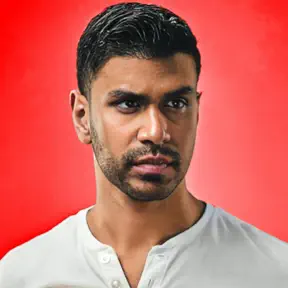
Jacob Tsimerman: He Won Math's Highest Prize. Then Announced the End
Theories of Everything with Curt Jaimungal
August 10, 2026
Ten days after winning the Fields Medal — math's highest honor — Jacob Tsimerman joins to explain why he's leaving academia temporarily for OpenAI's AI safety team, and why he's grieving even as he does it.
Speakers Jacob Tsimerman, Curt Jaimungal
TopicsPhysicsScienceSociety & CulturePhilosophy
SPEAKER_1 (0:00)
This episode is brought to you by Accenture. When you're advertising operations fall out of sync, everything else follows. Spotify and Accenture are working together to reinvent the rhythm of ad sales. Using automation, analytics, and smarter workflows to simplify campaign delivery and access better data across the business. The result? Less time spent on operations, more time connecting brands with the moments and fandoms that matter most. Learn more at accenture.com/spotify.
Jacob Tsimerman (0:30)
We're living in crazy time. It's not going to be business as usual.
Curt Jaimungal (0:34)
This is an exclusive, Jacob Tsimerman's first podcast. Ten days prior to filming this, he was awarded the Fields Medal, Math's highest honor. That same day on stage, he announced he's leaving temporarily to OpenAI and AI safety.
Jacob Tsimerman (0:49)
I'm definitely grieving. I think it's going to hit math.
Curt Jaimungal (0:52)
That medal was for all minimality, taming some monsters of geometry and analysis. Partially, this is the territory I explored with Edward Frenkel on the Langlands program. Since most other interviews will dwell there, we decided to talk about something different.
Jacob Tsimerman (1:04)
Part of me thought it would be in academia forever.
Curt Jaimungal (1:06)
On this channel, I, Curt Jaimungal, interview researchers regarding their theories of reality with rigor and technical depth. We talk about so much in this episode, such as how AI is revolutionizing math, potentially to its own depth, what advice Jacob has for students graduating in fields, where AI may be displacing them, and along the way, we bond over our shared comedy past, my standup and his improv, and of course, the University of Toronto.
Jacob Tsimerman (1:31)
I think I'm leaving to do what I think is most important.
Curt Jaimungal (1:35)
You're grieving.
Jacob Tsimerman (1:38)
Yeah, a little bit. I've talked about how math is changing.
There's AI is affecting many different things about our world, one of those that's happening quicker is mathematics. That's a little bit counterintuitive, I think, to many people, including me earlier on, because one would sort of expect what humans find easier to be affected more quickly, and math is generally seen to be one of the harder topics to broach. But because math is a closed system, you can sort of think about math with just your mind. You don't need experiments, you don't need materials. AI has been very good at it. In fact, just, I think, two days ago, OpenAI released the solution to 10 more conjectures. I don't know most of them very well. One of them, non-selfie groups, the construction of those, is a very big deal.
So yeah, there's something about math itself is going to go through a very exciting time, hopefully, because you're going to be able to do it in a much more powerful way. But mathematicians, such as myself, are used to a certain working style, and a lot of my working identities tie to having year-long projects, decade-long projects sometimes, working at the edges, slowly figuring things out, having those aha moments. I think that's going to go away. So there's something about that that I think I'm definitely grieving.
Curt Jaimungal (3:09)
Are you concerned more for mathematicians than mathematics?
Jacob Tsimerman (3:13)
Yes, at the moment. I think mathematics is going to have to change, but I do think we'll navigate that change. At the moment, I think, as far as the field is concerned, it's more the people, especially the young people, who are going in, sort of looking to a PhD, and to go about their business as usual in terms of the profession. And I think that's being upended.
Curt Jaimungal (3:38)
So what's going to happen to math in four years? Is there going to be an AI Fields Medalist?
Jacob Tsimerman (3:42)
Now, there's two things about the question. One is that four years seems like an insanely long time to me. AI is changing so fast that even speculating two years from now seems very, very difficult. So I don't know is the main answer. And I don't know how society will react because, often when I've been saying these predictions of mine for a while now, that AI is going to become robustly superhuman at the act of doing mathematics as we do it today. People often label me a pessimist or they infer certain values they have about math. And really all I'm saying is that I think this will happen. And how society chooses to react is both a harder question and it's also not set in stone. We have the power to decide. So I'm involved in certain workshops, the first one next week, where bringing together mathematicians of various levels doing various types of work to try and figure out how to restructure the field, what it's going to look like going forward.
80 more minutes of transcript below
Thousands of transcripts fetched by people building searchable podcast archives
Fetch the whole transcript
The demo key returns a sample episode in full, no card needed:
curl -H "x-api-key: pt_demo" \
  https://spoken.md/transcripts/1000651996090
Markdown with the speakers named, for your notes, your knowledge base, or anything that makes HTTP calls.
From $0.10 per transcript. No subscription. Credits never expire. Prices exclude VAT, added at checkout for EU customers. Not what you expected? Email us within 14 days with 20 or fewer credits used and we refund the pack in full.
Using your own key:
curl -H "x-api-key: YOUR_KEY" \
  https://spoken.md/transcripts/1000782010724