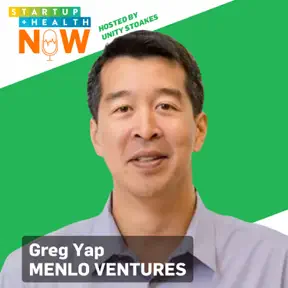
Investing in AI-Native Healthcare with Menlo Ventures' Greg Yap and Unity Stoakes
StartUp Health NOW Podcast
September 10, 2026
What does it take to build a health AI company that actually gets funded right now? Greg Yap, Partner at Menlo Ventures, sits down with StartUp Health co-founder Unity Stoakes to unpack how a 50-year-old venture firm is investing across the health AI l...
Speakers Greg Yap, Unity Stoakes
TopicsEntrepreneurshipBusinessHealth & Fitness
Greg Yap (0:04)
I've never been the inventor of the technology, but it's always been trying to commercialize, trying to find the right applications, and then kind of bring those technologies to market. And sometimes it's been, you know, just the right moment. You know, sometimes we've been too early, you know, it's the, you're either on the cutting edge or you're on the bleeding edge, and sometimes you're doing the cutting, and sometimes you're doing the bleeding, and I've definitely done both.
But it's always been kind of novel technology, high-throughput technology, AI machine learning, and then some breakthrough application that we've been chasing, and that kind of led me to investing, right?
Unity Stoakes (0:53)
Welcome, everyone. I'm Unity Stoakes, co-founder of StartUp Health, and I am excited to welcome Greg Yap, partner at Menlo Ventures, to today's fireside chat. Menlo, as many of you probably already know, is one of the world's leading VCs, and Greg really brings, I think, an extraordinary and valuable perspective to the StartUp Health community. So excited about today's conversation, because before becoming an investor, Greg spent two decades as a founder and operator himself across therapeutics, diagnostics, digital health, and health care technology. Today, Greg invests across life sciences and health care at Menlo and backing a lot of companies really across the intersection of biology, software, AI, and care delivery.
So we're going to be exploring where Greg sees the biggest opportunities in health innovation, what Menlo is looking for, and really what early stage founders need to know to build and get funded in this rapidly changing market. As always, this is meant to be an interactive conversation, so please post your questions in the chat, and when we open it up for questions in a few minutes, we'll do our best to call on you. Ask your questions early, as we often run out of time. We'll call on you, and if you could please introduce yourself before asking your question. So Greg, welcome.
Greg Yap (2:30)
Thank you, Unity. It's great to be here. It's nice to see you all.
Unity Stoakes (2:33)
To kick things off, I thought we'd start by getting to know you, as you spent two decades as a founder, as an operator, and you've been at big institutions. But before becoming an investor, maybe just a bit about your background to give us some context and how that experience shapes what you look for as an investor today.
Greg Yap (2:56)
Yeah, so I've spent my whole career basically at the intersection of new technology and health care.
I have been involved in a variety of different perspectives on that market, but I've been a founder a couple of times. I helped start and run a therapeutics company and a digital health company.
I worked at Roche for several years and ran their cancer diagnostics life cycle. So I've been through the FDA six different times, Class 2, Class 3, run clinical trials in most of the different regions of the world. And then have spent a number of years at Affymetrix in the early days of genomics. I started and ran two businesses for them, the genetics business. And then I started the genetics business and then ran the diagnostics business. And again, kind of early days of genomics. I've kind of seen the industry from different angles. They've bought smaller companies from the smaller company side, have helped to sell smaller companies. And then it's also been, a common through line has always been kind of novel technology being developed, typically very high throughput technology. And then, often, almost always kind of AI, machine learning to analyze that flood of data. And then some novel application in life sciences and health care.
And while I've worked in, as you mentioned, therapeutics and genomics and diagnostics, and digital health, it's always been kind of that through line of trying to help find. I've never been the inventor of the technology, but it's always been trying to commercialize, trying to find the right applications, and then kind of bring those technologies to market. And sometimes it's been just the right moment. Sometimes we've been too early. It's the you're either on the cutting edge or you're on the bleeding edge, and sometimes you're doing the cutting and sometimes you're doing the bleeding. And I've definitely done both. But it's always been kind of novel technology, high-throughput technology, AI machine learning, and then some breakthrough application that we've been chasing. And that kind of led me to investing, right? It's I now have been in the privileged place the last eight or nine years or so at Menlo, where now I basically work across all the areas that kind of the additives and as an operator, I now get to invest across. And that's been a tremendous privilege and responsibility.
16 more minutes of transcript below
Thousands of transcripts fetched by people building searchable podcast archives
Fetch the whole transcript
The demo key returns a sample episode in full, no card needed:
curl -H "x-api-key: pt_demo" \
  https://spoken.md/transcripts/1000651996090
Markdown with the speakers named, for your notes, your knowledge base, or anything that makes HTTP calls.
From $0.10 per transcript. No subscription. Credits never expire. Prices exclude VAT, added at checkout for EU customers. Not what you expected? Email us within 14 days with 20 or fewer credits used and we refund the pack in full.
Using your own key:
curl -H "x-api-key: YOUR_KEY" \
  https://spoken.md/transcripts/1000788887718