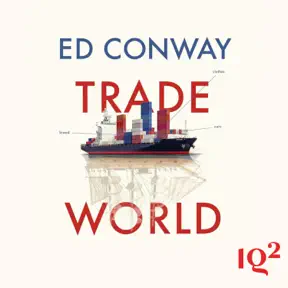
How Trade Shapes Our World, With Ed Conway
Intelligence Squared
September 3, 2026
Trade has shaped human civilisation for thousands of years. From the copper used in Mesopotamian ploughs to the silicon inside our smartphones, vast networks have evolved to move the materials and products on which modern life depends.
Speakers Mia Zarenti, Carl Miller
TopicsSociety & CultureArts
Mia Zarenti (0:00)
Welcome to Intelligence Squared, where great minds meet. I'm Senior Producer Mia Zarenti. Why has trade become one of the defining geopolitical issues of our time? What happens when governments intervene in supply chains? On today's episode, Ed Conway, economics and data editor, Sky News, joins Carl Miller to explore how trade has shaped our world and how the global economy responds when those networks are ruptured.
Let's join our host, Carl Miller, now with more.
Carl Miller (0:30)
Welcome to Intelligence Squared, everyone. I'm Carl Miller, and our guest today is Ed Conway. He's the economics and data editor at Sky. He's a columnist for The Times and the Sunday Times. His book, you might have read it, Material World, was a bestseller, and he's back with another one, Trade World, the ties that bound our past and can unravel our future. Ed, very warm welcome to you. Thank you. Nice to be here. Ed, this is the second book, I think, that you've written where you show us that no one understands the systems that sustain us and keep us alive. What draws you? Almost as if no one was listening the first time around.
What draws you to these unfathomably complex, essential realities of economic life that are both so important to us but also so difficult for us to get our heads around? Well, thank you for having me on, first of all.
I mean, gosh, I guess I'm a journalist and I'm a contrarian, and ultimately that's the main thing it comes back to. And I think if there is a kind of conventional wisdom that we're often being told about how the way the world works, I'm always somewhat naturally inclined to try to see it from a different perspective. And it so happens that with Material World, I kind of began to find quite a useful way of looking at the world from an alternative vantage point. I mean, there's nothing intensely original about it. Basically, the point behind Material World was to say, well, we think we've dematerialized, but actually physical things still matter. And it so happened that the book came out kind of when people were thinking, trying to think, I guess more deeply, both about supply chains and how the world fits together, and also about things like the energy transition and how do we actually make net zero a reality while also maintaining our standard of living.
This book is just different in that, to some extent, it builds on that and is looking at the nature of how we're all so much more interconnected than we might assume we are.
But I think that the thing that's, I guess, maybe that we forget about is the extent to which literally everything in your life is a product of trade. And so in the same way that everything in your life is a product of physical things, pretty much everything, even AI, even our ability to talk to each other, it's the product of physical things like sand being turned into fiber optics, which allow the internet to exist. In much the same way, pretty much every physical thing you have around you, which is the foundation for every bit of economic activity in the universe, basically, is the product of relationships that span borders. And if we are in the process right now, which is happening, it's been happening since Brexit, it's been happening since Trump, it continued to happen under Biden, of raising questions about trade, of imposing barriers on our nearest trading partners, then this stuff really matters. And we forget the extent to which our entire lives around us are dependent on the passage of trade around the world. And so it started really with the effort just to say, okay, well, how can we begin to understand that in a way that doesn't feel, you know, hideously abstract? Because I think trade economics and the trade war is often depicted in a way that feels quite dry.
And I kind of went back to what felt familiar in this case, which was, okay, rather than looking from the top down, why don't I look at this story through just a few everyday items which, which, may, small though they may be, and everyday though they may be, and humdrum though they might seem, allow you to suddenly see the entire universe around you? It's that kind of thing. It's the same thing. By looking deeply in, kind of, you know, in a penetrating way at something really simple around you, sometimes you actually have these enormous, kind of jaw-dropping revelations that, hold on, I'm starting to fathom how it really works. And that's definitely the revelation for me, in the same way that my eyes were open to this other universe when I started writing Material World and researching it. It's kind of been the same thing this time around, except it's not just physical stuff. It's not just rocks coming under the ground. It's everything. And yeah, I guess ever since I started looking at the world in that different way, I've kind of become a little bit addicted to it. And so this is another journey around that merry-go-round, but in a slightly different perspective.
40 more minutes of transcript below
Thousands of transcripts fetched by people building searchable podcast archives
Fetch the whole transcript
The demo key returns a sample episode in full, no card needed:
curl -H "x-api-key: pt_demo" \
  https://spoken.md/transcripts/1000651996090
Markdown with the speakers named, for your notes, your knowledge base, or anything that makes HTTP calls.
From $0.10 per transcript. No subscription. Credits never expire. Prices exclude VAT, added at checkout for EU customers. Not what you expected? Email us within 14 days with 20 or fewer credits used and we refund the pack in full.
Using your own key:
curl -H "x-api-key: YOUR_KEY" \
  https://spoken.md/transcripts/1000787437494