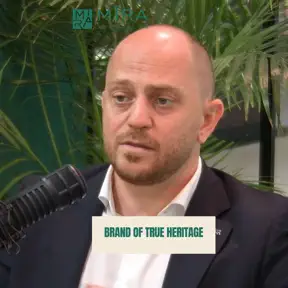
How Do You Keep a 130 Year Old Business Relevant?
Morning Drive
July 11, 2026
Tim Elliott speaks with Nahel Selo, Creative Director of Sedar Global, about how a company founded in 1892 continues to thrive.
Speakers Tim Elliott, Nahel Selo
TopicsInvestingBusinessManagement
Tim Elliott (0:01)
Heritage businesses next on the Morning Drive. So, from shifting consumer habits to digital transformation, economic uncertainty, businesses across this region are kind of being forced into this position where they have to rethink how they're going to grow. So for companies with decades of history, maybe centuries of history, staying relevant means balancing tradition with constant innovation. Now, joining us this morning is Nahel Selo, who is Creative Director at Sedar Global. He had to talk about how a business with more than 130 years of history continues to expand across international markets, adapt to changing customer expectations, and navigate the future of retail and design. Nahel, it's good to meet you. Thank you.
Nahel Selo (0:52)
It's a pleasure.
Tim Elliott (0:53)
Good to have you here. You know, it's remarkable. I said to you off air just now, I know you guys as kind of the blinds guys, Venetian blinds, you know, window dressing and all that kind of stuff. And I was racking my brain to try to think of somebody else that does that, and I couldn't come up with a label. So there's a compliment, I suppose.
Thank you. More than 130 years in business is something to shout about, for sure. But I'd say lots of companies, particularly 130-year-old companies, struggle to innovate because of...
You know, just it's the way things are in lots of instances. So how do you balance that kind of sense of history, the roots that you have, with this need to be functioning in a digital, retail, modern design world?
Nahel Selo (1:46)
So I'm not going to lie, it was a bit of a challenge. We had, you know, when we first came into the business, when I personally came around 15 years ago, it was a bit of a challenge trying to convince the older generation, in this example, my father and my uncle, that, you know, it took some time for us to kind of get the swing of things, and then for them to trust us, and for them to slowly let go and show them that, okay, you know, we have learned so much from them, whether it's about the company or in our personal life as well, because, you know, family businesses, they're all kind of intertwined together.
Tim Elliott (2:23)
They're pretty closely connected, yeah.
Nahel Selo (2:25)
Exactly. So they were able to kind of teach us how to just keep things together.
We wanted to, it's always a bit of a struggle to just, we know that we are very, our heritage is a solid foundation with what we have, and then we want to work more on that to become more relatable to the market. People in the past used to say like, oh, but Sedar, you know, they're such an old, they've been around for so long, they're a bit outdated or something, you know what I mean? So that's one of the challenges that we had, and then we were able to really tackle that by showing them that we have come such a long way and we're very proud of our heritage, but we also are a modern company that can switch around.
Tim Elliott (3:10)
I mean, this is the thing, I just, I pronounce your company name wrong, so Sedar, I'm saying cedar, like the tree.
Nahel Selo (3:16)
It's all right.
Tim Elliott (3:17)
I apologize for that, but it's this thing, isn't it, that you're brought up in the company, the family business, so you understand the way things have always been done, and that's working, and it's all great. And then you, off you go to college, and you come back, and the decision might be, okay, I'm going to be in the family business. You're fourth generation, it was your great-grandfather, right?
Nahel Selo (3:36)
My great-grandfather.
Tim Elliott (3:37)
Yeah, and you're bringing your new-fangled business ideas, so we're going to have an app, are we going to do this? And your dad's like, no, hold on, hold on, hold on. Okay, so you have to bring that, so that dynamic's hard.
Nahel Selo (3:50)
Yes, and then moving down the line, it's important for, to also have, for in order for a family business to be successful and to continue the legacy, there needs to be a form of like a succession plan as well.
Tim Elliott (4:04)
Yeah, yeah.
Nahel Selo (4:05)
We need to know who, before that, who does what, and I think that's something that my father and my uncle did very well, is that they allocated the roles quite clearly within their own, like for example, I wanted to study advertising. That's something that no one influenced. But then when I moved into the business, they were like, okay, well, this is great. Then, you know, if this is what you want to do, how about you handle this, you know? And obviously, there was someone there as well that I learned a lot from.
18 more minutes of transcript below
Thousands of transcripts fetched by people building searchable podcast archives
Fetch the whole transcript
The demo key returns a sample episode in full, no card needed:
curl -H "x-api-key: pt_demo" \
  https://spoken.md/transcripts/1000651996090
Markdown with the speakers named, for your notes, your knowledge base, or anything that makes HTTP calls.
From $0.10 per transcript. No subscription. Credits never expire. Prices exclude VAT, added at checkout for EU customers. Not what you expected? Email us within 14 days with 20 or fewer credits used and we refund the pack in full.
Using your own key:
curl -H "x-api-key: YOUR_KEY" \
  https://spoken.md/transcripts/1000776349190