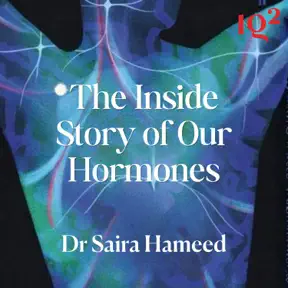
How Do Hormones Shape the Way We Feel, Think and Age? With Dr Saira Hameed
Intelligence Squared
June 9, 2026
In this episode, science broadcaster Dr Güneş Taylor speaks with endocrinologist Dr Saira Hameed about her new book Signals: The Inside Story of Our Hormones.
Speakers Mia Sarenti, Güneş Taylor, Saira Hameed
TopicsSociety & CultureArts
Mia Sarenti (0:00)
Welcome to Intelligence Squared, where great minds meet. I'm producer Mia Sarenti.
How much of the way we feel, think and age is shaped by hormones? And why do we still understand so little about the complex chemical signals that govern our bodies and minds? On today's episode, Dr. Saira Hameed, consultant endocrinologist and author, joins Dr. Gneş Taylor to discuss Hameed's new book, Signals, The Inside Story of Our Hormones, and what the latest science reveals about the hormonal system influences everything from mood and the metabolism to fertility and aging. Let's join our host, Dr. Gneş Taylor, now with more.
Güneş Taylor (0:38)
Welcome to Intelligence Squared. Dr. Saira Hameed, we are very, very honoured to have you here today to talk to us about your new book, Signals. It's got a fantastic cover. I wish I had my copy on hand at the moment to show our listeners and, well, to show our viewers and make our listeners envious.
This is your second book, I believe, I've got this right. Can I just start by asking you, Saira, why did you write this book now? Like, why now? Why this book? It's quite different to your last book as well. So what was your motivation?
Saira Hameed (1:12)
Well, firstly, Güneş, so nice to be in conversation with you and thank you for inviting me on. It's lovely to be speaking to you. This book is really the synthesis of 30 years of my clinical work. So it really spans the time from right back to when I was thinking of applying to medical school to the present day.
Medicine in itself is a fascinating career. You get these glimpses of people's lives, their turn of phrase, the way they're dressed, the way they're expressed themselves. They tell you their story. You see the impact of illness on their life. That in itself is a pretty great way to spend the day.
There's also, I think, what I've learned over the years is what medicine is about or my reflections on what it means to me. It's something that certainly evolved within me. My thoughts on it now are very, very different to when I was applying to medical school in 1996 Gosh, I look back and I think, did I really know what I was letting myself in for? So sharing that aspect of medical memoir, I thought, was helpful. Endocrinology is the specialism concerned with the body's hormones and glands and the illnesses that occur when they go wrong.
Hormones are having a bit of a moment right now. So definitely when I became an endocrinologist in 2006, I'd sit next to someone, I don't know, dinner. They say, what do you do? I say, I'm an endocrinologist. They're like, well, can I talk to you about my hernia? I'm like, no, I'm not that kind of doctor.
So they say, what does that mean? I say, it's hormones.
People kind of knew about HRT then, maybe a little bit. It wasn't as much discussed as it is now. Bit by bit, hormones have kind of infused into the public discourse and the public zeitgeist. Lots of people have questions about hormones. Sometimes as endocrinologists, we'll come across things in the media or on social media, our patients will ask us things. I read, someone told me and you think, hmm, there's a lot out there that isn't quite sort of correct. And it would be great to have something expert written for the public. So we can dispel some of the vibes that are going around at the moment. Some hormones have become like rock stars, cortisol, testosterone, GLP-1. So those are the ones I kind of wanted to major on. And what's interesting is when they go wrong, somebody really feels it. And so to be able to convey what those hormones do, not in a textbook-y way, but in this is the story a patient would tell me. I think as humans, we love stories. So that's the way I wanted to write about it. You, the reader, are sitting alongside me in the clinic room. And we're listening to this story. And now we understand, well, this is how a woman feels when her oestrogen goes down at menopause. Or this is how somebody feels if their cortisol level is running far too high. And I think we remember it far more. It's far more hard hitting when we can think, okay, well, that's how that patient seemed when they came. I think the third thing that sort of, I try to weave into all the stories is where did all this settled science come from? So I can tell you with sort of great certainty, cortisol does this or oestrogen does that. But where did this come from? And who were these amazing pioneers, our forebears who did that work to come up with these conclusions? I have to confess that before I started researching the book, I didn't know much about the history of endocrinology. And I just thought that maybe some of these breakthroughs were sort of multi-million pound scientific grants and big teams and glistening institutions. Yes, sometimes that's the case. But actually, maybe unexpectedly for me is that many of these breakthroughs, they were these plucky underdogs who had a really good idea and they saw the problem in a completely different way to other people, sometimes really disparaged at the time.
31 more minutes of transcript below
Thousands of transcripts fetched by people building searchable podcast archives
Fetch the whole transcript
The demo key returns a sample episode in full, no card needed:
curl -H "x-api-key: pt_demo" \
  https://spoken.md/transcripts/1000651996090
Markdown with the speakers named, for your notes, your knowledge base, or anything that makes HTTP calls.
From $0.10 per transcript. No subscription. Credits never expire. Prices exclude VAT, added at checkout for EU customers. Not what you expected? Email us within 14 days with 20 or fewer credits used and we refund the pack in full.
Using your own key:
curl -H "x-api-key: YOUR_KEY" \
  https://spoken.md/transcripts/1000771859817