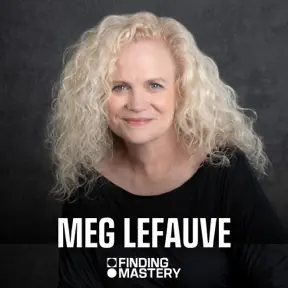
How Creativity Can Help Us Unlock Our Potential | Writer of Pixar's Inside Out, Meg LeFauve
Finding Mastery with Dr. Michael Gervais
January 22, 2025
What does it take to create stories that resonate with millions—and what can those stories teach us about ourselves? Meg LeFauve, Academy Award-nominated screenwriter of Pixar’s Inside Out and Inside Out 2, has spent her career unlocking the magic of storytelling.
Speakers Michael Gervais, Meg LeFauve
TopicsSelf-ImprovementEducationHealth & FitnessMental Health
Michael Gervais (0:00)
Finding Mastery is brought to you by our very own Finding Your Best Course. Okay, 2025, obviously it's officially begun. I hope you've set a clear intention for the year, and maybe you haven't, and you're still finding your rhythm. Totally cool. But whatever it is, right now is a great time to invest in yourself. Now, if you really want to set yourself up for success, to live towards your fullest capabilities, one of the best things that you can do is to deeply invest in training your mind. So that's why we designed the program. And to help kickstart your 2025, we're offering a special limited time offer on our flagship psychological training course, where we've pulled together the best practices to meet the unique intersection of high performance and well-being. It's called Finding Your Best. And in it, we take you through 16 essential principles and skills for you to train your mind in the same way that we train world-class athletes and executives, so that you can consistently perform towards your unique edge, to be your best in any environment. So right now, it's $75 off the Finding Your Best Online course. To sign up for the course and receive that discount, just head to findingmastery.com/course and enter the code EPIC2025 at checkout. This offer is only going to last through January 31st, so be sure to sign up as soon as possible. That's findingmastery.com/course and use the code EPIC2025 at checkout for $75 off the Finding Your Best Online course. What does it take to tell stories that move millions? Stories that explore the depths of human emotion while capturing the imagination of audiences worldwide. Welcome back or welcome to the Finding Mastery Podcast, where we dive into the minds of the world's greatest thinkers and doers. I am your host, Dr. Michael Gervais, by trade and training a high-performance psychologist. Today, I am thrilled to welcome Meg LeFauve to the show. Meg is an Academy Award nominated screenwriter, known for her work on Pixar hits Inside Out and Inside Out 2 When I watch those movies, they nailed it. I had to meet her. She and they did an incredible job. Meg is a storyteller who spent her career exploring the power of vulnerability, collaboration, and the craft of iteration. And in this conversation, we dive into the psychology of creativity, how anxiety and sensitivity can become a superpower, why vulnerability is essential for crafting meaningful stories and the art of making characters and ourselves come alive. Meg's insights into storytelling are more than just about movies. They're lessons for living a deeply creative and connected life. So with that, let's dive right into this incredible conversation with Meg LeFauve.
Meg, this is a real treat. I, I'll tell you how this started, is that I think I was just like, love slobbing all over, you know, like Inside Out 1 and Inside Out 2, and I just, I loved your movies. And as I was talking about Ad Nauseam, our head of creative here, Kevin Lay, goes, oh, I know Meg.
Meg LeFauve (3:29)
Yes.
Michael Gervais (3:29)
You know, I know who did that movie. And so I was like, please. So we've we've really been looking forward to having you here. So thank you for coming in.
Meg LeFauve (3:38)
Oh, thanks for having me. I was really looking forward to being here. Talking with you.
Michael Gervais (3:42)
Oh, my God. OK. So one of the reasons I loved it so much is as a trained psychologist with a specialization in performance, you nailed it. You got it. And I'm friends with one of your what's it called consultants, one of the psychologists that was was helping you. So good job to Dachner.
Meg LeFauve (4:05)
Dachner.
Michael Gervais (4:06)
Yeah. I mean, he's so good. So, OK, how how did you get so good at writing stories, at telling stories, at at pulling out the genius of an arc where the viewer or listener is just compelled to want to get to the next arc or to the next note? How did you do that?
Meg LeFauve (4:26)
It's so funny to start the question with how did you, you know, get so good because I think every writer I know has fraud syndrome. So, immediately my brain is like, am I? Is that good? It's just so funny. The way your brain immediately tries to buffer that. I think partly that's just because we're sensitive, creative beings and we're always kind of finding our place. I also think that I keep wanting to evolve as a writer and try new things and push myself.
So, I think that in for these specific movies, I am so honored to say that it's my movie but it's not just my movie. It's Pete Docter is the originator, a genius of Inside Out as the first director and I wrote with him on Inside Out. And then of course we have the second movie of Kelsey Mann, the director. And Pixar is a place of collaboration. So, you're definitely writing. You're writing a script and you're writing a script when both movies, each script had three different story lines going at the same time. And they have to play with each other like music. If something happens in one story line, like let's say with Joy Down in the Mind, it has to also affect Riley, it has to also affect what's happening in headquarters. So, it's very much three-dimensional chess that we were playing with both movies. So, but in terms of your question, how do you get to that level of storytelling? One is you work at a place like Pixar, where their only motto is fail fast. They really want you out pushing to the edge of your ideas, the edge of what you think you can do or what the movie or the story could possibly do, and a place that really taught me to iterate. I realized after about three months in the first movie of when I got there, that this is a building full of artists and they have been drawing in sketchbooks, probably since they could hold a pencil. So, they are very used to iteration, iterate, iterate, iterate, do it again, go again, go again. As a writer, we can get a bit protective of our work and fearful that, but this is a great scene. What if I can't write another great scene?
75 more minutes of transcript below
Thousands of transcripts fetched by people building searchable podcast archives
Fetch the whole transcript
The demo key returns a sample episode in full, no card needed:
curl -H "x-api-key: pt_demo" \
  https://spoken.md/transcripts/1000651996090
Markdown with the speakers named, for your notes, your knowledge base, or anything that makes HTTP calls.
From $0.10 per transcript. No subscription. Credits never expire. Prices exclude VAT, added at checkout for EU customers. Not what you expected? Email us within 14 days with 20 or fewer credits used and we refund the pack in full.
Using your own key:
curl -H "x-api-key: YOUR_KEY" \
  https://spoken.md/transcripts/1000684961909