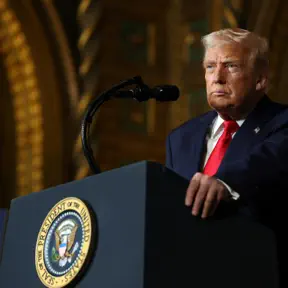
Has Trump Peaked?
Foreign Policy Live
September 11, 2026
In this bonus episode, host Ravi Agrawal presents his recent essay arguing that U.S. President Donald Trump has peaked.
Speakers Ravi Agrawal
TopicsNews CommentaryNewsPolitics
SPEAKER_1 (0:09)
Scan the QR code on a Sprite or Sprite Zero Sugar to see the full breakdown. Obey your thirst, Sprite.
Ravi Agrawal (0:16)
Hi, I'm Ravi Agrawal, Foreign Policy's Editor-in-Chief. This is FP Live.
I wrote a piece recently called Trump Has Peaked. You might agree, you might disagree, but this one's a perspective that I felt needed to be aired out. And it's one of several essays in our latest print issue. We'll share a link in the show notes. The thesis is this. Trump's coercive powers, his ability to get people, companies and countries to do his bidding have peaked.
He still has that ability, but it is declining. And that is important because that very realization means that the nature of Trump's power will change. And with that, so will our analysis of the future of world order and other big questions. I'm going to explain why, but it might help to first understand what the peak was. I see that peak as the start of this year, 2026 There is now a lot of reporting on this, especially by Maggie Haberman and Jonathan Swan in the New York Times and in their book, Regime Change. But if you go back to New Year's Eve, right as 2026 was starting, Trump felt on top of the world. He threw his big annual bash at Mar-a-Lago. He got Israeli Prime Minister Benjamin Netanyahu to fly in. He had all kinds of celebrity guests there. But more than that, as he looked around the room, he knew that his first year in his second term in office had largely gone to plan. He had picked a cabinet full of loyalists, unlike his first term. He had signed more executive orders in his first 100 days than any other president in US history. He had deployed the Justice Department to go after his enemies. He had come in with a real plan and executed it. And this was so different from Trump 1 He had even orchestrated a global vibe shift. Leaders from around the world had understood that US power was concentrated in the hands of one man, Trump. Lobbying firms were advising them that the way to get anything done was by flattery or expensive gifts. Even Silicon Valley was on board with CEO after CEO flying to the White House to kiss the ring.
Then on January 3, Trump launched Operation Absolute Resolve. The world's mightiest military swooped into Caracas to capture Venezuelan leader Nicolás Maduro. The mission was daring and impressive. It was also illegal, unconstitutional, and lacked long-term payoff. But for Trump, it was an affirming display of strength. He was belatedly realizing the full extent of the awesome power wielded by a commander in chief, and what good was power that couldn't be exercised? It could not have escaped Trump's notice that his actions generated limited national or international blowback. Maduro was a corrupt dictator, he had no real allies, and his arrest did little more than provide yet another example of a growing void in international law.
Very soon after Venezuela, an emboldened Trump proposed taking Greenland. But if we don't do it the easy way, we're gonna do it the hard way. A Danish territory. This was a threat that could have destroyed NATO, the world's biggest military alliance. And as CEOs and world leaders gathered in Switzerland for the World Economic Forum later that month, there was little else one could discuss. Will he or won't he? On everyone's lips, it was Trump, Trump, Trump.
I remember those moments at Davos. And looking back, I now know that that was peak Trump, in terms of how the world saw him and how the man saw himself. Because right after that came the decision to attack Iran.
I think it's reasonable to have a debate about America's Iran policy and to what extent the use of force should be on the table. But what is increasingly becoming clear from the past six months of conflict is that it is almost irreparably damaging the White House's foreign policy toolkit.
Start with some basic missile math. Before the war, the United States had about 2,300 Patriot missiles, the best in class mobile interceptors. By August, just six months into the war, the inventory had dropped to about 800
The Pentagon publicly disputes this accounting, but given how it is currently running polygraph tests on its own senior officials, you know the ballpark estimate is likely correct. Now, a single one of these Patriot interceptors costs $4 million, and more importantly, takes two years to build.
America produces 600 a year. It plans to make more, but that's the manufacturing base right now. So do the math. It would take years just to get back to where things were. And remember, even before the Iran War, the United States was saying it didn't have enough Patriots to give Ukraine. So if you're in Kiev or in Taipei or in Moscow or Beijing or Tehran, the missile math tells a real story. It tells you that America is militarily weakened. And by the way, this is just one type of munitions. CSIS, which tracks these things, shows six other key defensive and offensive munitions used by the United States military as being significantly depleted.
6 more minutes of transcript below
Thousands of transcripts fetched by people building searchable podcast archives
Feed this to your agent
Try it now — copy, paste, done:
curl -H "x-api-key: pt_demo" \
  https://spoken.md/transcripts/1000651996090
Works with Claude, ChatGPT, Cursor, and any agent that makes HTTP calls.
From $0.10 per transcript. No subscription. Credits never expire. Prices exclude VAT, added at checkout for EU customers. Not what you expected? Email us within 14 days with 20 or fewer credits used and we refund the pack in full.
Using your own key:
curl -H "x-api-key: YOUR_KEY" \
  https://spoken.md/transcripts/1000789034111