Ep. 599 - Exploring the Plant Vibroscape
In Defense of Plants Podcast
October 11, 2026
Plants don't have ears, a nervous system, or any sort of brain-like organ, yet they have the capacity to detect and respond to sounds. Moreover, the vibrations they are exposed to, AKA their 'vibroscape,' is highly complex and we are only beginning to understand this on a deeper level.
Speakers Matt Candeias, Luke Bowles
TopicsNatural SciencesScienceNature
Matt Candeias (0:00)
Hello everyone, and welcome to the In Defense of Plants Podcast, the official podcast of indefenseofplants.com. What's up? This is your host, Matt. Welcome to the show. How is everyone doing this week? I'm doing great because we are diving into a world that may seem a little strange, and that is plant eco-acoustics. How do plants sense and respond to vibrations in their environment, AKA the vibroscape? This is a topic that really has suffered a lot from sort of the new agey ways of thinking about vibrations, plant responses to music. It's its own weird world that really polluted the actual science of understanding this, but that doesn't mean people aren't picking up the baton and running with it in ecologically meaningful ways.
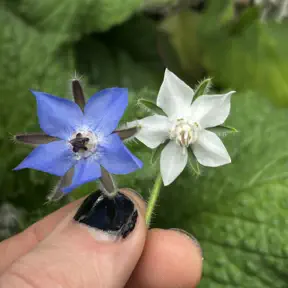
Joining us to talk about this is grad student, Luke Bowles, who is working with borage and bumblebees. What he's finding and the way he thinks about how plants perceive their environment is absolutely incredible. I don't want to keep you from it any longer. Let's just jump right into it. Without further ado, here's my conversation with Luke Bowles. I hope you enjoy.
All right, Luke Bowles, welcome to the podcast. It is so great to have you here. Let's start off with an introduction. Tell us a little bit about who you are.
Luke Bowles (1:18)
Hey, Matt. It's great to be here. I grew up in a really, really small town in rural Mississippi. That's definitely how I got interested in ecology, and nature, and wildlife more broadly. But I took a really long winding road, and to put it in short, growing up in the South, there were a lot of political and social realities that made me ask a lot of really big questions about the world. I ended up getting really interested in philosophy.
When I went to college at the University of Georgia, I was dead set on becoming a philosophy professor. But the longer and longer that I studied philosophy at the University, the more I realized how little we ever discussed animal minds and evolution and biology, which I thought was really interesting because to me, it seems like philosophy and biology can now, can really inform each other and in a lot of ways have always informed each other. So I was like, I really want to start studying animals and wildlife and biology and evolution. I want to understand, especially because I was so interested in the philosophy of mind, I wanted to understand the evolution of minds and the evolution of thought.
That's what pushed me to join my first research lab and start studying ecology, and I started studying ants.
Matt Candeias (2:45)
Nice.
Luke Bowles (2:46)
It turns out, ants are crazy. Anyone who studies entomology, biology, ecology knows insects are crazy, but ants are the king of the crazy insects. They are so interesting and fascinating and complex.
Eventually, that led me to go to grad school, and that led me to end up in the lab of Rex Cochroft, where I'm a master's student now. I was originally going to study vibrational communication between ants and one of their mutualist tree hoppers. But in the process of learning more and more about animal vibrational communication, I found out that people also study vibrations in plants, including my advisor in the past. There was one study at the time that showed that flowers, specifically the Beech Evening Primrose, would make sweeter nectar if it received vibrations from bee wingbeats. And I thought this was just crazy. It's crazy, right?
Matt Candeias (3:50)
Yeah.
Luke Bowles (3:51)
But also looking at all the other vibrational evidence and vibrational responses in plants, it did sound plausible too. Like, it didn't sound possible to me, but I just thought it was extraordinary that someone had thought to test this, and it had actually gotten a positive result. So I was like, you know what? Forget the ants, forget the bugs.
I really want to know, can plants do this? Especially because plants are just so interesting from a philosophical perspective too.
Matt Candeias (4:21)
For sure. Yeah. I mean, if it's philosophy of the mind and how organisms other than human get around, that kind of attracts you to science, like plants become quickly, it's like a science fiction journey. I say this time and time again, like we have aliens among us because it is truly a different form of life that establishes itself so long ago and has to make a living in a way that even we can empathize with a mouse or an insect. They have eyes, they have ears, they can move around, right? Plants don't do any of that stuff, but yet still have to live in the same world as us.
50 more minutes of transcript below
Thousands of transcripts fetched by people building searchable podcast archives
Fetch the whole transcript
The demo key returns a sample episode in full, no card needed:
curl -H "x-api-key: pt_demo" \
  https://spoken.md/transcripts/1000651996090
Markdown with the speakers named, for your notes, your knowledge base, or anything that makes HTTP calls.
From $0.10 per transcript. No subscription. Credits never expire. Prices exclude VAT, added at checkout for EU customers. Not what you expected? Email us within 14 days with 20 or fewer credits used and we refund the pack in full.
Using your own key:
curl -H "x-api-key: YOUR_KEY" \
  https://spoken.md/transcripts/1000795284412