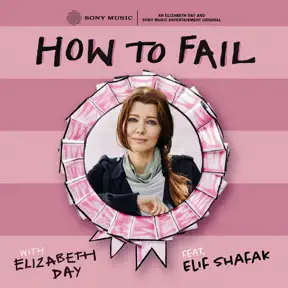
Elif Shafak - ‘There’s only one thing that scares me - and that’s indifference’
How To Fail With Elizabeth Day
July 31, 2024
I could listen to Elif Shafak speak for HOURS. The eloquence of this woman! She speaks like most of us would aspire to write. I cannot get over it.
Speakers Elizabeth Day, Elif Shafak
Elizabeth Day (0:10)
Welcome to How to Fail, the podcast that firmly believes you learn just as much from failure, if not more, than you do from success. Before we begin, I just want to remind you about my subscriber series, Failing with Friends, where every week, my very special guest and I go through problems, failures, questions that you, our lovely listeners, have. And this week, with the marvellous Elif Shafak, to everyone out there, here's a taster.
Elif Shafak (0:38)
This is the age of speedy consumption, you know, short attention span. Everything is just narrowed down to snippets of information, which I find dangerous because I think it's the exact opposite of knowledge.
Elizabeth Day (0:52)
I would be thrilled to hear from you. Follow the link in the podcast notes to share your failures now. I just wanted to remind you that for the first time ever, How to Fail is going on tour and will be presented by Hey You! The Home of Reality TV. Each show, I'll have a very special guest sharing their three failures on stage, so you can expect the usual uplifting, hilarious and moving conversations. Tickets are on sale now. Head to fayn.co.uk or follow the link in the show notes.
On the social media platform X, Elif Shafak describes herself as a storyteller, reader, learner, human rights advocate, feminist, introvert and citizen of humanity. On the first count, she's being modest. Not just a storyteller, Shafak has in fact published 19 books, 12 of which are novels, several of which have been shortlisted for major literary awards including the Booker Prize. She's been translated into 57 languages and is an honorary fellow at St Anne's College Oxford. Her 20th novel, There are Rivers in the Sky, is published this August and is an epic tale of one lost poem, two great rivers and three remarkable lives, all connected by a single drop of water. Shafak was born in Strasbourg, France, but was taken to Turkey by her mother after her parents separated. When her mother became a diplomat, Shafak moved around with her, including a spell at school in Madrid. This itinerant existence is perhaps why Shafak has always identified with the role of the outsider in her work, and also partly explains her extraordinary facility with language. She writes fluently in both Turkish and English. An outspoken critic of repressive regimes, her political activism has not come without cost. In 2006, she was put on trial for insulting Turkey after the publication of her book, The Bastard of Istanbul, which referenced the Armenian genocide. Had she not eventually been acquitted, Shafak would have faced a maximum prison sentence of three years. And yet her belief in the power of stories to change the world remains more fervent than ever. As she wrote in her powerful 2020 manifesto, How to Stay Sane in an Age of Division, Stories Bring Us Together, Untold Stories Keep Us Apart. Elif Shafak, welcome to How to Fail.
Elif Shafak (3:34)
Thank you so much. What a beautiful introduction. Thank you.
Elizabeth Day (3:38)
Well, I'm so honored that you are sitting opposite me today. You are a personal inspiration of mine and I know for many women and men across the world. And I wondered if I could begin by asking you quite a big question, which is whether you feel writing has always been a political act at some level for you.
Elif Shafak (4:01)
If you come from a country such as my motherland, Turkey, and you happen to be a storyteller, you don't have the luxury of saying, I'm only going to write my stories. I'm not going to be interested in what's happening outside the window. I am a feminist and I've learned lots of things from past generations of women's movement. And of course, one of the crucial things that they have been telling us is that, wherever there's power, there is politics. In that regard, you might be writing about marriage or sexuality, or seemingly unpolitical things, gender, identity, body. All of that can be quite political as well. So, wherever there is inequality, some type of injustice, power imbalance, there is politics there. And in that regard, I think a novelist cannot be apolitical or non-political. That doesn't mean, however, that politics is the guide. That doesn't mean that at all. For me, what matters is to be able to ask questions in my fiction and then leave the answers always to the reader. Because every reader is going to come up with their own answer.
And I have to respect that diversity. So I don't like the kind of fiction that tries to preach or teach or lecture at all. I don't know the answers myself. All I know is I care about the questions, including difficult questions. Some of those questions can be political questions.
29 more minutes of transcript below
Thousands of transcripts fetched by people building searchable podcast archives
Fetch the whole transcript
The demo key returns a sample episode in full, no card needed:
curl -H "x-api-key: pt_demo" \
  https://spoken.md/transcripts/1000651996090
Markdown with the speakers named, for your notes, your knowledge base, or anything that makes HTTP calls.
From $0.10 per transcript. No subscription. Credits never expire. Prices exclude VAT, added at checkout for EU customers. Not what you expected? Email us within 14 days with 20 or fewer credits used and we refund the pack in full.
Using your own key:
curl -H "x-api-key: YOUR_KEY" \
  https://spoken.md/transcripts/1000663732126