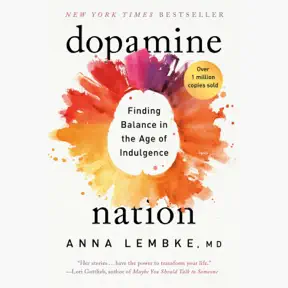
Dopamine Nation Summary | Anna Lembke, MD
Best Book Summaries | Self-Help, Business & Nonfiction Books in Minutes – StoryShots
July 19, 2026
Chasing constant pleasure actually fuels chronic pain. This book summary reveals how the brain pleasure pain balance traps people. Dopamine Nation by Anna Lembke, MD, the key ideas in minutes. Follow the show and a new book lands in your feed every day.
TopicsBusinessEducationSelf-Improvement
SPEAKER_1 (0:00)
Introducing Meta Glasses.
SPEAKER_2 (0:02)
You have questions, they've got answers.
SPEAKER_1 (0:05)
Hey Meta, what's the capital of Peru?
SPEAKER_3 (0:08)
Lima.
SPEAKER_2 (0:09)
How do you say, where's the restroom in Spanish?
SPEAKER_1 (0:12)
Dónde está el baño?
SPEAKER_3 (0:14)
Hey Meta, is a hot dog a sandwich?
SPEAKER_2 (0:17)
Technically, no.
SPEAKER_1 (0:18)
Spiritually, yes.
SPEAKER_2 (0:20)
Hey Meta, what should I do with my life?
SPEAKER_3 (0:23)
That's one of life's biggest questions.
SPEAKER_1 (0:25)
What do you think?
SPEAKER_3 (0:27)
Ask anything with the new Meta Glasses.
SPEAKER_2 (0:30)
Telling one hard truth to one person can loosen an addiction's grip.
SPEAKER_1 (0:36)
Dopamine Nation, Finding Balance in the Age of Indulgence by Anna Lembke, Audiobook Summary and Review by StoryShots. Introduction.
SPEAKER_2 (0:47)
You are not weak. You are running old wiring inside a world built to overload it. That gap explains almost everything you cannot seem to stop. That is the thesis of Dopamine Nation.
Finding Balance in the Age of Indulgence by Anna Lembke, a Stanford addiction psychiatrist. This deep dive covers eight key ideas, from the seesaw in your brain to the strange cure of chasing pain on purpose.
SPEAKER_1 (1:16)
Who is this for?
SPEAKER_2 (1:18)
This is for the person who reaches for the phone before both eyes are open, for the high achiever who cannot sit through one quiet evening without a screen. It is for anyone whose comfort has quietly hardened into compulsion.
And for anyone who wants to know why more pleasure keeps buying less joy.
SPEAKER_1 (1:41)
About the author.
SPEAKER_2 (1:42)
Anna Lembke runs the dual diagnosis clinic at Stanford. She treats people whose addictions arrive tangled with other illness. Her earlier book traced how doctors helped light the opioid fire.
Many readers first met her in the Netflix film, The Social Dilemma. This book is her field report from inside the clinic.
SPEAKER_1 (2:04)
Your brain was built for scarcity, not abundance.
SPEAKER_2 (2:08)
Picture the most addictive thing you own. Its power does not live in the object. It lives in your reward pathway. Dopamine is the measuring stick. Scientists gauge how addictive anything is by how much dopamine it releases in the brain. More dopamine, more pull.
A cigarette machine in 1880 went from 4 cigarettes a minute to 20,000. Morphine ran 10 times stronger than opium, and fentanyl runs 50 to 100 times stronger than morphine. Every drug keeps getting stronger and closer. The biggest driver of addiction is not character. It is access.
Supply has created demand, as we all fall prey to the vortex of compulsive overuse. History backs it. When alcohol was banned, public drunkenness and liver disease fell by roughly half, and the drop held for decades cut the supply, cut the harm.
What sits one tap away for you that used to take real effort? That collapse of effort into instant is the whole story of modern craving, and it starts a chain reaction inside a single organ.
The Pleasure-Pain Balance in Your Brain Here is the machine underneath every urge. Imagine a seesaw with pleasure on one side and pain on the other. It wants to sit level. Tip it toward pleasure, and it doesn't stay tipped. Little gremlins hop onto the pain side to level it out, and they do not climb off the moment the pleasure fades. So the balance overshoots into pain. That overshoot is the come down, the craving, the itch for one more. Repeat the same hit, and the gremlins multiply. Now you need more just to feel normal, and less of it feels good. Push far enough, and you reach anhedonia, the inability to enjoy anything at all.
The paradox is that hedonism, the pursuit of pleasure for its own sake, leads to anhedonia, which is the inability to enjoy pleasure of any kind. One measure of the stakes. One hit off a meth pipe delivers about ten times the dopamine of an orgasm. The bigger the spike, the harder the crash. Notice one pleasure that lately leaves you flatter than it used to. That flatness is the balance quietly resetting against you, which is exactly why numbing the discomfort only deepens the whole.
Why Running from Pain Makes It Worse A depressed student from South Korea spent every waking hour plugged into a device. The prescription was almost insulting. Walk to class with nothing in your ears. She reported back four words.
I started noticing the trees. We have turned every flicker of discomfort into a problem for a pill or a screen. More than one in four American adults now takes a psychiatric drug daily and use climes highest in the wealthiest countries. Here is the twist that should stop you cold. Those same rich countries report the most anxiety and the most pain. In a 30-country survey, 34% of Americans felt pain often against 13% in Switzerland. The reason we are all so miserable may be because we are working so hard to make money.
9 more minutes of transcript below
Thousands of transcripts fetched by people building searchable podcast archives
Fetch the whole transcript
The demo key returns a sample episode in full, no card needed:
curl -H "x-api-key: pt_demo" \
  https://spoken.md/transcripts/1000651996090
Markdown with the speakers named, for your notes, your knowledge base, or anything that makes HTTP calls.
From $0.10 per transcript. No subscription. Credits never expire. Prices exclude VAT, added at checkout for EU customers. Not what you expected? Email us within 14 days with 20 or fewer credits used and we refund the pack in full.
Using your own key:
curl -H "x-api-key: YOUR_KEY" \
  https://spoken.md/transcripts/1000777451756