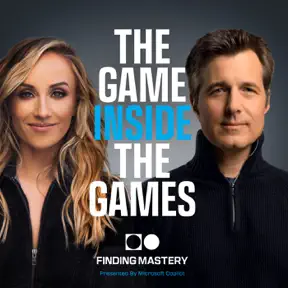
Day 3 – Lindsey Vonn on Overcoming the Weight of Gold and Expectations | The Game Inside The Games
Finding Mastery with Dr. Michael Gervais
July 28, 2024
Do other people’s expectations make or break an athlete’s Olympic dream? On day 3 of The Game Inside The Games, Dr. Michael Gervais and Nastia Liukin sit down with one of the most decorated athletes in skiing history, Lindsey Vonn, to explore how expectations impact performance.
Speakers Michael Gervais, Nastia Liukin, Lindsey Vonn
TopicsSelf-ImprovementEducationHealth & FitnessMental Health
Michael Gervais (0:00)
Day three from Paris. How do expectations impact an athlete's performance at the Olympics? Let's dive in.
Welcome back or welcome to The Game Inside the Games on Finding Mastery. I'm Dr. Michael Gervais, by trade and training, a high-performance psychologist.
Nastia Liukin (0:17)
And I'm Nastia Liukin, Olympic gold medalist, and we are here in Paris for the Olympic Games. And in this special series, we unlock the psychology of pivotal, often unseen moments that can make or break an athlete's dream.
What's it like to focus a lifetime of experience into one performance, a single moment?
Michael Gervais (0:34)
What goes on inside the minds of the brightest Olympic stars while the whole world is watching? Welcome back to Paris, and let's dive into the game inside the games.
Nastia Liukin (0:44)
Do expectations make or break an athlete's Olympic dream?
Michael Gervais (0:48)
That's a great question. And today we are going to talk with Lindsey Vonn, one of the most decorated athletes in skiing history, to better understand how expectations impact Olympic performances. Lindsey, welcome to the game inside the games. And before we get started, I just want to take a moment here.
You don't need an introduction, but a gold medal in the downhill in the 2010 Winter Olympics, bronze medal in the Super G in the 2010 Olympics, bronze medal in the downhill in the 2018 Olympics, 82 World Cup race victories, and four overall World Cup titles. That's a lot.
Congratulations on a huge body of work. And we're really excited to have you here.
Lindsey Vonn (1:33)
Thanks for having me.
Nastia Liukin (1:34)
Appreciate it.
Yeah, we're gonna get right into your post yesterday. So talk a little bit about that. I'm gonna first read the caption because it really made me emotional kind of knowing the emotion that you had just based upon your caption without talking to you. But I've always wanted to hold an Olympic flame. And today I became a torch barrier for the first time with many of my fellow Olympians.
The flame is so much more than a fire. It's a symbol of hope, which we desperately need right now. What does that mean to you? Like, can you further explain that a little bit more?
Lindsey Vonn (2:05)
Well, it was interesting. I mean, when we were kind of rehearsing for the torch relay, we all went through and talked about what sport we were in and what it meant for us to hold the torch.
And it was so moving. I mean, it just, it was, you know, I don't know how many athletes it was, maybe 16 athletes, 10 athletes. And we were just talking about, you know, the emotional part of it. And when you retired, it's different. Like, it hits you harder.
And the Olympics are what you grow up dreaming about. You know, it's not, you don't grow up dreaming about a World Cup race. You know, that's what you do for, you know, on a daily basis, but the Olympics are something bigger and it represents something bigger. And, you know, unity doesn't mean that we all agree on everything. It means that we come together to do something.
And so that's what I felt like we were doing. And it represents, like I said, so much more than just a flame. It's hope and unity and peace. And there's so much of that that we need in the world right now that I just felt lucky to be a part of it.
Michael Gervais (3:11)
Was gratitude a big part of how you approached competition and life in general?
Lindsey Vonn (3:15)
Yeah.
Michael Gervais (3:15)
Or is that relatively new for you?
Lindsey Vonn (3:17)
No, so my mother had a stroke when she had me. And so she had a lot of physical disabilities because of it. And I had four siblings after that. So she was Wonder Woman basically.
But I always had the perspective that, you know, I was lucky to be in the position that I was. My mother would have loved to ski with me and to do all the things with me, but she couldn't.
And so I felt I had a responsibility to her and to my family to always do my best.
And I think also because my sport is so dangerous, because I crash often, I think you have to be able to bounce back. You have to be resilient. You have to have a better perspective. Otherwise, when you crash, you won't get back up again. So that's always been the way I thought about it. But I think especially since my mom passed away, it's just really reinvigorated that sense of urgency for me to live my life and to explore and to do and to be and to never have regrets. I think having regrets are probably one of the worst things in life, and so if I fall trying my best, then so be it. But I'm never gonna crumble under pressure because I got scared.
16 more minutes of transcript below
Thousands of transcripts fetched by people building searchable podcast archives
Fetch the whole transcript
The demo key returns a sample episode in full, no card needed:
curl -H "x-api-key: pt_demo" \
  https://spoken.md/transcripts/1000651996090
Markdown with the speakers named, for your notes, your knowledge base, or anything that makes HTTP calls.
From $0.10 per transcript. No subscription. Credits never expire. Prices exclude VAT, added at checkout for EU customers. Not what you expected? Email us within 14 days with 20 or fewer credits used and we refund the pack in full.
Using your own key:
curl -H "x-api-key: YOUR_KEY" \
  https://spoken.md/transcripts/1000663579108