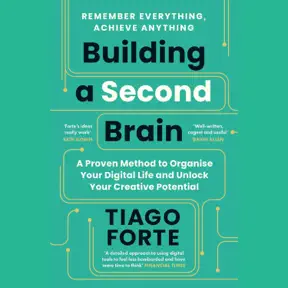
Building a Second Brain in 5 Minutes | Tiago Forte
Best Book Summaries | Self-Help, Business & Nonfiction Books in Minutes – StoryShots
July 20, 2026
Forgetfulness isn't a personal failing. This book summary reveals why willpower is not the real problem for productivity. 🎯 FREE Audiobook Summary of Building a Second Brain by Tiago Forte 🎧 More than 500,000 downloads a month. Big ideas from the world's best nonfiction.
TopicsBusinessEducationSelf-Improvement
SPEAKER_1 (0:00)
This episode is brought to you by Accenture. When you're advertising operations fall out of sync, everything else follows. Spotify and Accenture are working together to reinvent the rhythm of ad sales. Using automation, analytics, and smarter workflows to simplify campaign delivery and access better data across the business. The result? Less time spent on operations, more time connecting brands with the moments and fandoms that matter most. Learn more at accenture.com/spotify.
SPEAKER_2 (0:30)
Progressive Summarization isn't for remembering more. It's a method for forgetting on purpose.
Building a Second Brain by Tiago Forte Audiobook Summary and Review by StoryShots Most productivity advice tells you to remember more, focus harder, try harder. That's backwards. Building a second brain, a proven method to organize your digital life and unlock your creative potential, argues that your memory was never the bottleneck. Your system was. And Tiago Forte built a following on proving it.
Why willpower was never the real problem.
Most people assume forgetfulness is a personal failing, a sign they need more discipline. That assumption is wrong, and it's costing you every day. The average person now takes in about 34 gigabytes of information daily, according to the New York Times. Your brain was never built to store that. It was built to have ideas, not hold them. So, when you forget the article that would have solved today's problem, that's not a discipline failure. That's math. The fix isn't trying harder to remember. It's building an external system that captures what your biological brain cannot. Your brain is a brilliant idea generator and a terrible filing cabinet. Stop asking it to be both. Accepting that memory isn't the job raises a harder question. What do you actually do with everything you say?
The 4-Step System Hiding in Plain Sight A 4-step method called code, capture, organize, distill, express solves this. Most people who try digital note taking get stuck at step one. They capture everything, articles, screenshots, quotes, and end up with a digital junk drawer instead of a system. Capture only what resonates, using simple filters. Does it inspire you? Is it useful? Is it personal? That alone changes your relationship with information. But capturing well means nothing if you organize by topic the way school taught you to. Topic-based filing is the wrong model entirely. Something else replaces it, built around action instead of subject matter.
Saving information isn't the same as being able to find it when you need it. Knowing what to keep and knowing where to put it are two completely different problems. The method that works by forgetting on purpose.
One line captures the whole counter-intuitive core of this system. Progressive summarization is not a method for remembering as much as possible, it is a method for forgetting as much as possible. That sounds backwards until you see it in action. Every time you revisit a note, you highlight only the best parts of the best parts, layer by layer, until a 2,000-word article becomes four bolded sentences your future self can scan in seconds. The parts you cut aren't lost, they're just no longer competing for your attention. The real payoff isn't a tidy archive, it's a store of pre-digested thinking that eliminates the blank page for good. And that raises the real question, what you build once the raw material is already there, waiting. If this changed how you think about information overload, someone in your life is probably drowning in tabs and notes right now. Send them this summary.
Final Summary This summary of Building a Second Brain threads together the real cause of information overload, the code frameworks capture and organize stages, and progressive summarizations forget on purpose logic into one argument. Productivity isn't about remembering more, it's about building a trusted system that thinks alongside you. What's missing here is the full organizing method that replaces topic-based filing. The concept of reusable building blocks that let creators finish projects without starting from a blank page, and the mindset shift Tiago Forte describes at the book's close, from scarcity to abundance, from consuming to creating. If you're someone drowning in tabs and half-finished notes, this book was written for you.
Find the full summary of Building a Second Brain, plus the infographic and animated video breakdown on the StoryShots app.
Thousands of transcripts fetched by people building searchable podcast archives
Fetch the whole transcript
The demo key returns a sample episode in full, no card needed:
curl -H "x-api-key: pt_demo" \
  https://spoken.md/transcripts/1000651996090
Markdown with the speakers named, for your notes, your knowledge base, or anything that makes HTTP calls.
From $0.10 per transcript. No subscription. Credits never expire. Prices exclude VAT, added at checkout for EU customers. Not what you expected? Email us within 14 days with 20 or fewer credits used and we refund the pack in full.
Using your own key:
curl -H "x-api-key: YOUR_KEY" \
  https://spoken.md/transcripts/1000777536857