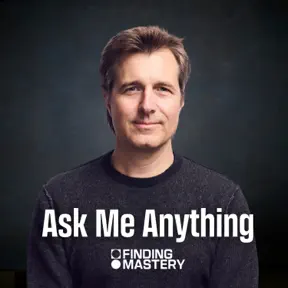
Ask Me Anything: Finding Purpose, Raising Resilient Kids & Navigating Workplace Politics | Vol. 27
Finding Mastery with Dr. Michael Gervais
July 2, 2025
How do you stay true to your values when others are playing political games? What if your purpose feels too small compared to others? And how do we raise kids who can handle life's inevitable hard blows?
Speakers Yogi Roth, Michael Gervais
TopicsSelf-ImprovementEducationHealth & FitnessMental Health
Yogi Roth (0:00)
Do you have any tips to change mindset and maximize the little free time I get to recharge?
Michael Gervais (0:06)
Isn't this the question of all questions? What questions are tugging at you right now? And how might exploring the answers to those questions help you unlock your potential? Welcome back, or welcome to a special edition of the Finding Mastery podcast. I'm your host, Dr. Michael Gervais, by trade and training a high performance psychologist. And this week, we're turning the microphone around again, and instead of diving into the Mastery through the minds of our remarkable guests, we're going straight to you for another Ask Me Anything episode.
Yogi Roth (0:38)
What is my ultimate purpose in life? Is it truly possible to detach ourselves from the fear of what others think?
Michael Gervais (0:46)
You've submitted deep and thoughtful, vulnerable questions about life, performance, relationships, and navigating the complexities of the human experience. In this episode, I am joined once again by author, documentarian, podcaster, football analyst, and all-around Renaissance man and my friend, a friend to the Finding Mastery community, Yogi Roth. I'll be offering insights and perspectives that are designed to help us all think a little differently.
Yogi Roth (1:15)
I'm trying to figure out what is my ultimate purpose in life.
Michael Gervais (1:20)
That is a cool question. Know your value. Keep doing the work that feeds you, that you're fueled by.
Yogi Roth (1:27)
I know that after this, we're going to be better human beings because these questions, Mike, today are absolute fire.
Michael Gervais (1:32)
So let's jump right into your questions, my reflections, and an exploration of what matters most right here on Finding Mastery.
What a treat. We get to do this again.
Yogi Roth (1:52)
Settling in, settling in.
Michael Gervais (1:54)
In some kind of odd world here, you know, is that one of the great treats of the AMAs is to learn from our community and then to sit with my friends. So, Yogi, thank you for doing this again.
Yogi Roth (2:06)
Yes, back again. This is great. This time, I'm going to hold you to it, because you did say we were going to paddle out when we're done. So I'm counting on that when we're done with these AMAs, because I know that after this, we're going to be better human beings, because these questions, Mike, today are absolute fire. Your community again shows up. So let's dive in to Emma, because this one landed on me. I think it's going to land on you pretty hard. As a leader overseeing a department that drives the most strategic initiatives, and holds the majority of the company's know-how, how do you navigate the balance between collaboration and protecting your team's expertise? So sit in this, this is a land grab type question, follow up. Specifically, how do you engage with other department leaders who may attempt to expand their scope or take credit for your department's ideas while also ensuring effective cross-departmental collaboration for the company? So how do I kill it while I know some people might be trying to take credit for what I am doing?
Michael Gervais (3:10)
Yeah, I mean, working with folks like that that are a bit Machiavellian or backhanded or untrustworthy, it's tricky. It's really tricky. I think the first principle here is to not play that game, you know, to, I don't know, was it Michelle Obama when they go low, you stay high, something along those lines. So that's my first impulse is like, there are, there's wolves, there's wolves that are dressed like sheeps, there's sheep dogs that are trying to bully your way through. Like there's a lot of different behind the scenes slippery. How do we do it? Operate from your core values. And I'm going to say that so often. There's a reason that some of the greatest thinkers of our times have pointed to first principles and values. Keep coming back to anchoring your decisions, your thoughts and your words from those values. If fear and protection, let's do fear. If fear is a first principle, wow, you're in good hands. Most people, their first principle is not fear. If...
Yogi Roth (4:20)
And define first principles for us.
Michael Gervais (4:22)
First principle is when you reduce all of the ideas that you could work from, what are the ones that are the kingpins that help everything else move? You know, it's an engineering term. First principle is also a philosophical term. What are the foundational principles that your psychology, your life perspective is running from, or is working from, to be more precise. The first principle is a love of good work. A first principle is... It all kind of sifts out in the end anyway. If a first principle is the cream rises to the top, you won't get bullied, if you will, by other people's land grabs. When it does happen, you have a choice. Do you call it out, or do you backdoor it? There's a risk to both. If somebody is in a public place and they're calling out work that you clearly were a significant part of and they're taking the credit for it, if you stand up in that moment and they have, let's call it, more seniority, or they have more political capital than you do in the organization, I'd be careful. I'd be really careful about that. However, if you're ready to kind of put a flag in the ground and be like, hold on, if it's you and me, and you're kind of taking a land grab of something I contributed to in a meaningful way, and I felt slighted by it, the risk of me not saying anything is that I just got stepped on and a lot of people know it. The risk of me saying something is now I've just challenged, whoever has the seniority. That could be really dangerous. So either way, I think there's a cost. Knowing which one feels well ahead of time, which one feels like a greater risk would be important.
58 more minutes of transcript below
Thousands of transcripts fetched by people building searchable podcast archives
Fetch the whole transcript
The demo key returns a sample episode in full, no card needed:
curl -H "x-api-key: pt_demo" \
  https://spoken.md/transcripts/1000651996090
Markdown with the speakers named, for your notes, your knowledge base, or anything that makes HTTP calls.
From $0.10 per transcript. No subscription. Credits never expire. Prices exclude VAT, added at checkout for EU customers. Not what you expected? Email us within 14 days with 20 or fewer credits used and we refund the pack in full.
Using your own key:
curl -H "x-api-key: YOUR_KEY" \
  https://spoken.md/transcripts/1000715399622